

How Hydrogen Reduces Inflammation After Heart Events
Yes - hydrogen may help lower inflammation after a heart event, but it is only a support tool, not heart treatment.
If you’re looking for the short answer, here it is:
- After a heart attack or blood-flow blockage, damage can keep going when oxygen returns to the tissue.
- That return of blood flow can trigger oxidative stress and inflammation, which may make heart injury worse.
- Molecular hydrogen (H2) is being studied because it may lower some of the most harmful radicals without shutting down normal cell signaling.
- Early research points to smaller infarct size, better heart function, and lower inflammation markers in some animal studies and small human trials.
- But the research is still limited, and hydrogen should be used only alongside prescribed cardiac care.
Here’s the plain-English version: the first problem is the blocked blood flow. The second problem can happen right after, when blood flow comes back. That second wave may damage heart cells, stress mitochondria, and switch on inflammatory signals like NF-κB, NLRP3, IL-6, and TNF-α. Hydrogen is getting attention because it may help slow that chain reaction.
A few numbers stand out:
- In the HYBRID II trial, survival was 85% in the hydrogen group vs. 61% in controls.
- Some studies suggest hydrogen may support the body’s antioxidant systems by about 25% to 40%.
- Many hydrogen-water studies use about 1 to 1.5 liters per day.
What I’d keep in mind: this is still an early research area. The data is interesting, but most studies are small, short, or based on animals. So if you’re recovering from a heart event, the main plan is still your cardiologist’s treatment, medicines, and rehab. Hydrogen-rich water may fit in as a simple add-on if your doctor says it’s okay.
Below, I break down the problem, how hydrogen may work, what the studies say, and where hydrogen-rich water may fit into a daily routine.
Hydrogen inhalation with metformin cardioprotective against diabetic cardiomyopathy
sbb-itb-6860cc4
The problem: inflammation and oxidative stress after heart events
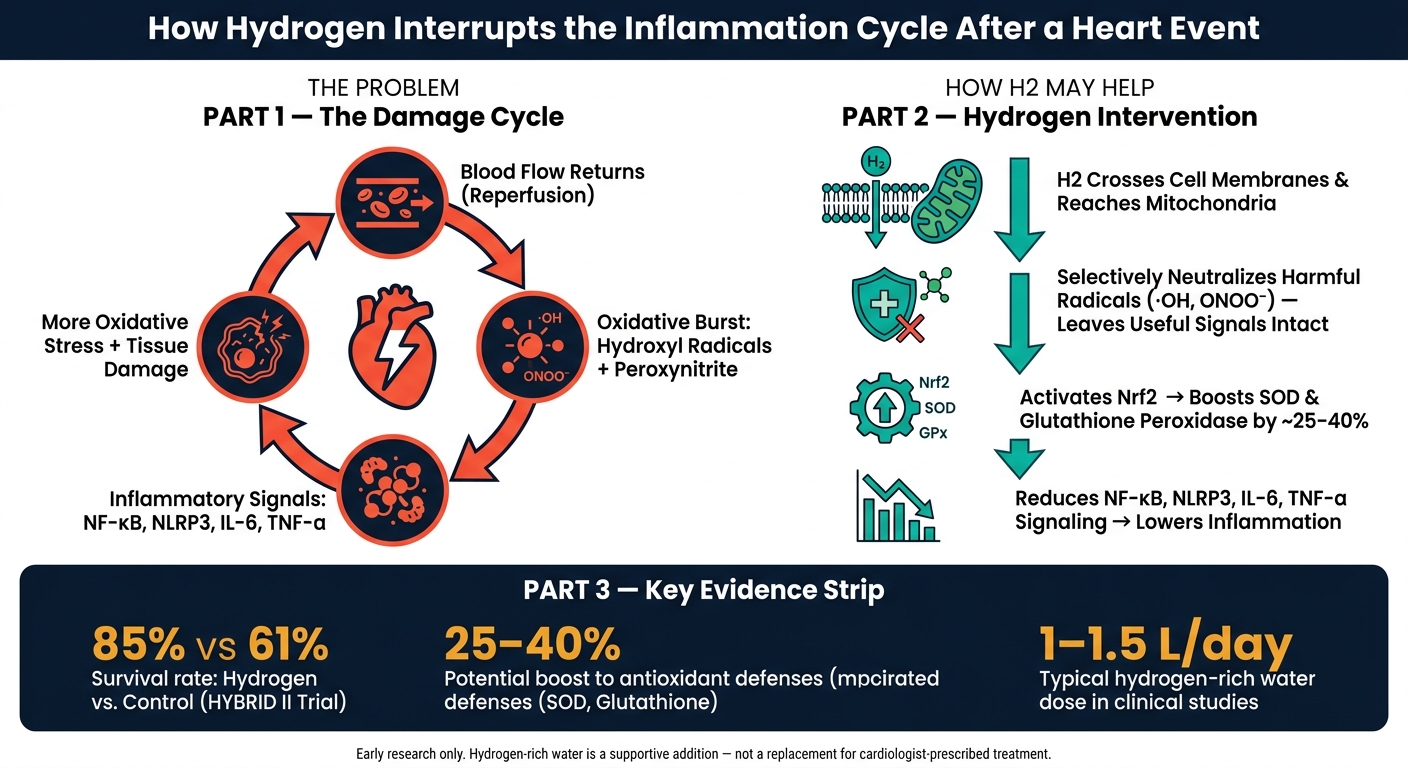
How Hydrogen Interrupts the Inflammation Cycle After a Heart Event
After blood flow returns, the heart can take a second hit: a sharp wave of oxidative stress and inflammation.
How heart tissue changes after myocardial infarction and reperfusion
When oxygen rushes back in, it can trigger one of the largest oxidative stress bursts in cardiac care [1]. Two of the main culprits are hydroxyl radicals and peroxynitrite. Hydroxyl radicals drive lipid peroxidation, which breaks down cell membranes. Peroxynitrite damages proteins and disrupts normal blood-vessel dilation [1].
Mitochondria also take a hit. As those structures are damaged, heart muscle cells lose energy and may die [1][5]. That means more tissue loss and a slower repair process. In plain terms, the oxidative burst can make the injury larger than the one caused by the original blockage.
Why ongoing inflammation slows recovery
The bigger issue after the initial ROS burst is what those radicals turn on next: NF-kB, the NLRP3 inflammasome, and related pathways that drive pro-inflammatory cytokines such as IL-6 and TNF-α [1][2][5].
If those signals stay active beyond the acute phase, recovery gets harder. They can push harmful left-ventricle remodeling, where healthy tissue is replaced by scar, and they can also contribute to endothelial dysfunction, which increases the risk of future events [2][6][7].
That creates a damaging loop after a heart event. Oxidative stress triggers inflammation. Inflammation then produces more oxidative stress. Together, they stretch the damage far past the initial injury. That self-reinforcing cycle is the problem molecular hydrogen is being studied to interrupt.
The solution: how molecular hydrogen may reduce inflammatory damage
That damage loop is where H2 may come into play. Molecular hydrogen (H2) is being studied for its potential to interrupt this cycle after a heart event. The main idea is its selective antioxidant activity. Put simply, H2 may help calm both halves of the cycle instead of hitting everything at once.
Selective antioxidant activity in heart and vascular tissue
H2 appears to go after the most harmful reactive oxygen species, especially the hydroxyl radical (·OH) and peroxynitrite (ONOO⁻), while largely leaving useful signaling molecules like superoxide and hydrogen peroxide alone [1][3]. That matters because not all reactive oxygen species are bad. Some help cells communicate. H2 seems to target the troublemakers without shutting down those normal signals.
It also moves fast across cell membranes and can reach mitochondria and nuclei, where much of the damage tends to build up [1][3].
On top of that, H2 may activate Nrf2, which can increase antioxidant enzymes such as SOD and glutathione peroxidase [3][8]. Some research suggests this effect may boost the body's own antioxidant defenses by about 25% to 40% [7].
By cutting down those radicals, H2 may also lower the signals that keep inflammation switched on.
Effects on inflammatory pathways and immune signals
H2 may also dial back inflammatory signaling that follows oxidative damage. Studies suggest it may reduce NF-κB, NLRP3, and MAPK signaling, along with IL-6 and TNF-α [1][8]. In plain terms, that means H2 may help cool the inflammatory response without shutting down normal immune function.
These mechanisms lead into the evidence reviewed next.
What the research shows so far
These mechanisms still need proof in actual cardiovascular care. The early signals look good, but most of the data still comes from animal work and small human trials.
Findings from preclinical cardiovascular studies
Animal studies have produced some of the steadiest results so far. In 2026, Wang et al. published a rat myocardial ischemia-reperfusion study in Biomaterials Advances. The team used hydrogen gas delivered through lipid microbubbles, then triggered those microbubbles with ultrasound at the heart. They saw a smaller infarct size, better ejection fraction, and lower activity in cell-death pathway mediators, including cleaved caspase-3/8. That points to less inflammatory injury after ischemia-reperfusion [1].
Other cardiovascular models show a similar pattern. After hydrogen treatment, researchers have reported lower inflammatory signals and better survival. In atherosclerosis models, hydrogen-rich water also improved plaque stability, which hints that the effects may extend beyond one part of the cardiovascular system [8].
What early human data may mean for recovery support
Animal data is useful, but human results carry more weight for recovery support. And while the human evidence is still limited, it does give us something to work with.
In the HYBRID II trial, 73 out-of-hospital cardiac arrest survivors received 2% inhaled hydrogen for 18 hours. Survival was 85% in the hydrogen group versus 61% in controls, although the primary neurological outcome did not reach significance [9]. That matters because better survival is hard to ignore, even when the main outcome misses the mark.
A systematic review of 23 randomized controlled trials also found drops in oxidative stress markers, including malondialdehyde (MDA) and 8-hydroxydeoxyguanosine (8-OHdG) [10]. In a randomized trial involving patients with hypertension, eight weeks of hydrogen-rich water was linked to lower C-reactive protein, which supports the idea of reduced inflammation [7].
There’s still a catch. These studies are small, short, and heavily focused on biomarkers, and the delivery methods vary from one trial to another. So the field still needs larger studies that track hard clinical endpoints like death, repeat cardiac events, or rehospitalization. Multi-center studies are underway, which is why the bigger and longer cardiovascular trials matter most.
Practical use and conclusion
Where hydrogen-rich water may fit into a daily routine
With those limits in mind, the next step is simple: where does hydrogen-rich water fit into recovery?
Molecular hydrogen should be viewed as a supporting addition to standard heart care, not a substitute. It may fit into a cardiologist-led plan that also includes medications and cardiac rehab.
Timing matters. Drink hydrogen-rich water within 30 minutes of preparation, because dissolved hydrogen escapes fast when exposed to air. Cold water also holds hydrogen in solution better than warm water [4]. Most clinical studies use 1 to 1.5 liters per day, spaced out across the day instead of taken all at once [7][4]. That helps explain why researchers are looking at it as a daily support habit, not a treatment.
Edenvia Molecular Hydrogen tablets dissolve in water to create hydrogen-rich water for a cardiologist-guided wellness routine.
Check with your cardiologist before adding anything new to your recovery plan.
Key takeaways
The evidence is promising, but the role here is still supportive.
- Hydrogen may help reduce oxidative stress and inflammation after heart events. Molecular hydrogen acts as a selective antioxidant compared to traditional options, targeting hydroxyl radicals and peroxynitrite without disrupting helpful cellular signaling [8][3].
- Early animal and human data are promising but limited. The HYBRID II trial showed 85% vs. 61% survival in cardiac arrest survivors, and hydrogen-rich water has been linked to lower C-reactive protein in hypertensive patients - but larger trials that track patient outcomes are still needed [9][7].
- Use hydrogen-rich water only as a complement to standard cardiac care. The cardiology warning sets the frame for everything here: hydrogen-rich water may support recovery, but it does not replace it.
FAQs
Can hydrogen replace heart medications?
No. Molecular hydrogen can't replace heart medications.
It may help lower oxidative stress and inflammation, but it's not a cure and it's not a substitute for prescribed treatment.
At most, it's a complementary option. Talk to your healthcare provider before adding it to your routine, especially if you have a heart condition or take heart medications.
When should I start hydrogen water after a heart event?
Talk to your cardiologist or healthcare provider before adding hydrogen water to your recovery plan after a heart event. Most research makes a clear distinction between acute, hospital-based use during a medical event and daily, long-term use at home.
If your doctor says it’s okay to use for daily wellness and antioxidant support, current use patterns point to steady, regular intake rather than stressing over the exact time of day.
Is hydrogen-rich water safe for heart patients?
Research suggests hydrogen-rich water is generally safe and well tolerated. Clinical trials haven’t reported major side effects.
That makes sense when you look at what hydrogen is: a natural molecule that your gut bacteria already produce. It also has FDA GRAS status as a food additive, which adds another layer of reassurance.
Still, if you have a heart condition or you’re recovering from a cardiac event, talk with your cardiologist or healthcare provider before adding it to your routine.
Related Blog Posts
Disclaimer: These statements have not been evaluated by the Food and Drug Administration. This product is not intended to diagnose, treat, cure, or prevent any disease. This article is for general informational purposes only and is not medical advice. Consult a qualified healthcare provider before starting any supplement, especially if you are pregnant or nursing, have a medical condition, or take prescription medication.