

Hydrogen Absorption: Water, Tablets, or Inhalation?
If I want the short answer: inhalation gives the highest body exposure, tablets can give a higher starting dose than bottled hydrogen water, and plain hydrogen water is the easiest to use every day.
Here’s the whole article in plain English:
- Hydrogen water is simple and portable, but the hydrogen level is low and drops fast after you drink it.
- Hydrogen tablets make hydrogen water on demand, so the drink can start at a higher concentration - often 5 to 10 ppm versus about 0.5 to 1.6 ppm for standard hydrogen water.
- Inhalation skips the gut and goes through the lungs, which is why it often leads to much higher body exposure - about 40% to 80% versus 2% to 5% for oral use.
- For oral use, blood levels tend to peak in about 5 to 15 minutes and then fall within about 1 hour.
- For inhalation, hydrogen stays more even during the session, often at 1% to 4% gas concentration for 20 to 60 minutes.
If I boil it down even more, the choice comes down to three things:
- How much hydrogen you want
- How long you want exposure to last
- How much setup you can deal with
Hydrogen WATER vs Hydrogen INHALATION BATTLE! with special guests! - Ep. 52 - H2Minutes
sbb-itb-6860cc4
Quick Comparison
| Method | How it gets in | Typical amount | Exposure pattern | Main tradeoff |
|---|---|---|---|---|
| Hydrogen-rich water | Through the gut | 0.5 to 1.6 ppm | Short spike after drinking | Easy to use, but fades fast |
| Tablets in water | Through the gut | Up to 5 to 10 ppm at first | Short spike after drinking | More dose control, but timing matters |
| Inhalation | Through the lungs | 1% to 4% gas mix | Steady during the session | Higher exposure, but needs gear and time |
Bottom line: if I care most about ease, I’d look at water. If I want more control in a drink, molecular hydrogen tablets make more sense. If I want the highest exposure, inhalation stands out.
That’s the core of the article, without the extra detail.
Hydrogen-Rich Water: Gut Absorption, Short Exposure, and Everyday Use
Hydrogen-rich water is drinking water infused with dissolved molecular hydrogen (H₂).[3]
Once you drink it, H₂ moves through the gut wall and into circulation fast.[3] So the effect starts soon after ingestion. But there’s a tradeoff: it also drops off soon.
What Happens in the Body After Drinking Hydrogen-Rich Water
Hydrogen can show up in the breath in about a minute. It usually peaks around 10 to 15 minutes after drinking, then clears fast.[7][8] Because hydrogen is a volatile gas, it doesn’t build up in tissues. A large share is exhaled through the lungs, and the effect from one serving often lasts about 2 to 4 hours.[3][2]
That short time frame is a big part of the appeal. Oral hydrogen is easy to repeat, easy to fit into the day, and simple to use without much planning.
Pros, Limits, and Best-Fit Use Cases
Hydrogen-rich water makes the most sense for simple daily use when convenience matters more than getting the longest possible exposure. There’s no equipment to set up, no session to schedule, and almost no habit change needed.[1] That’s a big reason people stick with it.
The FDA considers hydrogen gas "Generally Recognized as Safe" (GRAS) as a beverage ingredient.[6] To get more from each serving, drink it right after opening or generating it - best within 15 to 30 minutes. It also helps to drink it on an empty stomach and avoid shaking the container, since shaking speeds up off-gassing.[6][2]
Here’s the quick snapshot:
| Factor | Hydrogen-Rich Water |
|---|---|
| Pros | High convenience, portable, fits daily hydration habits[1][4] |
| Limitations | Hydrogen escapes fast once exposed to air; exposure window is short[2][6] |
| Typical Concentration | 0.5 to 1.6 ppm (mg/L) at standard pressure[3] |
| Time to Peak | 10 to 15 minutes post-ingestion[7][8] |
Tablets create hydrogen-rich water on demand, which changes preparation and dose control.
Hydrogen Tablets in Water: On-Demand Hydrogen-Rich Water With More Dose Control
Hydrogen tablets use the same oral route as hydrogen water, but they change when the hydrogen shows up.
When you drop a tablet into water, it reacts and releases molecular hydrogen into the drink.[6] That means the hydrogen is made right before you drink it, not earlier during bottling or storage. For best use, go with cool, still water and drink it soon after the tablet dissolves - ideally within 5 to 10 minutes.[6]
How Tablet-Generated Water Compares With Pre-Made Hydrogen Water
Tablet-made hydrogen water can start out at a much higher concentration than most pre-made products. In some cases, it reaches 5 to 10 ppm right after the reaction, while pre-made hydrogen water usually falls between 0.5 and 1.5 ppm.[5][2]
That said, the absorption route stays the same. You're still drinking hydrogen in water. The difference is timing, not how it enters the body. After you drink it, hydrogen is absorbed through the gut and then cleared fast through the lungs.[3][2]
Edenvia Molecular Hydrogen as a Tablet-Based Option
Edenvia Molecular Hydrogen sells tablets that dissolve in water to make hydrogen-rich water for daily use.
Pros, Limits, and Preparation Factors That Affect Absorption
Tablets are easy to carry and give you more control over the dose in each serving. That's the big draw. If you want to adjust intake, you can change the tablet count instead of being stuck with whatever comes in a can or pouch.
The downside is timing. Once the tablet finishes reacting, hydrogen starts escaping. Wait too long, and the drink in your hand contains less hydrogen than it did a few minutes earlier.
Here’s the side-by-side view:
| Factor | Tablet-Generated Water | Pre-Made Hydrogen Water |
|---|---|---|
| Typical Concentration at Consumption | Up to 5–10 ppm initially[5] | 0.5 to 1.5 ppm[2] |
| Timing Window | Drink within 5–10 minutes[6] | Drink immediately after opening[6] |
| Dose Control | High; adjustable by tablet count | Fixed by manufacturer per container |
| Hydrogen Loss Risk | High once reaction ends[7] | High once seal is broken[1] |
A small detail can matter here. Drinking on an empty stomach may help hydrogen reach the gut faster.[6][2] And if you can't drink it right away, a tightly sealed aluminum container helps slow hydrogen loss better than leaving it open on the counter.[6]
Inhalation changes the picture again because it skips the gut and delivers hydrogen through the lungs.
Hydrogen Inhalation: Pulmonary Absorption and Higher Systemic Exposure
Inhalation starts from a different place than drinking hydrogen water. Instead of taking in hydrogen dissolved in water, you breathe a low-concentration hydrogen gas mix - usually 1% to 4% - through a nasal cannula connected to a hydrogen generator.[3][1] From there, the gas moves across the lungs’ large alveolar surface area and enters the bloodstream directly, which means it bypasses digestion.[3][2]
That direct path changes the whole delivery model. With oral intake, hydrogen has to move through the GI tract first. With inhalation, it goes straight into circulation. It’s the most direct route discussed here, but it’s also the least convenient for day-to-day use.
Compared with oral methods, inhalation tends to keep exposure more stable during the session. And a single 60-minute session can extend exposure beyond the session itself.[2]
Why Inhalation Often Produces Higher Bioavailability
Skipping the gut makes a big difference. Oral hydrogen can off-gas in the stomach before it ever reaches the intestinal wall. Inhaled hydrogen reaches peak serum concentrations faster, usually within 5 to 15 minutes.[2]
The gap in bioavailability is hard to ignore:
This route also reaches tissues fast, including the brain.[2][6]
Safety Considerations and Day-to-Day Tradeoffs
The practical side matters just as much as the absorption side. Keep inhaled hydrogen at 1% to 4%, use it in a well-ventilated area, and keep it away from flames.[3][1] That’s simple enough on paper, but it adds friction to daily use.
Pros, Limits, and Session-Based Use
| Parameter | Hydrogen Inhalation | Oral (Water / Tablets) |
|---|---|---|
| Dose per session | High (continuous delivery via gas flow) | Limited by water solubility (~1.6 mg/L)[2] |
| Exposure pattern | Steady during a 20- to 60-minute session | Brief spike after drinking, then fast decline |
| Relative systemic exposure | High (40%–80%)[2] | Low (2%–5%)[2] |
| Distribution Pattern | Pulmonary absorption; direct systemic circulation | GI tract → portal vein → liver → blood |
| Equipment Needs | Specialized inhalation device and nasal cannula | Glass or bottle (tablets) or simple generator |
| Safety Requirements | Ventilation; keep concentration below 4%[3] | Standard water hygiene |
Inhalation uses a very different dosing model from oral hydrogen. It delivers hydrogen more directly and more evenly during a session, but it also asks more from you in setup, equipment, and time. Next, compare water, tablets, and inhalation side by side.
Water vs. Tablets vs. Inhalation: A Direct Comparison
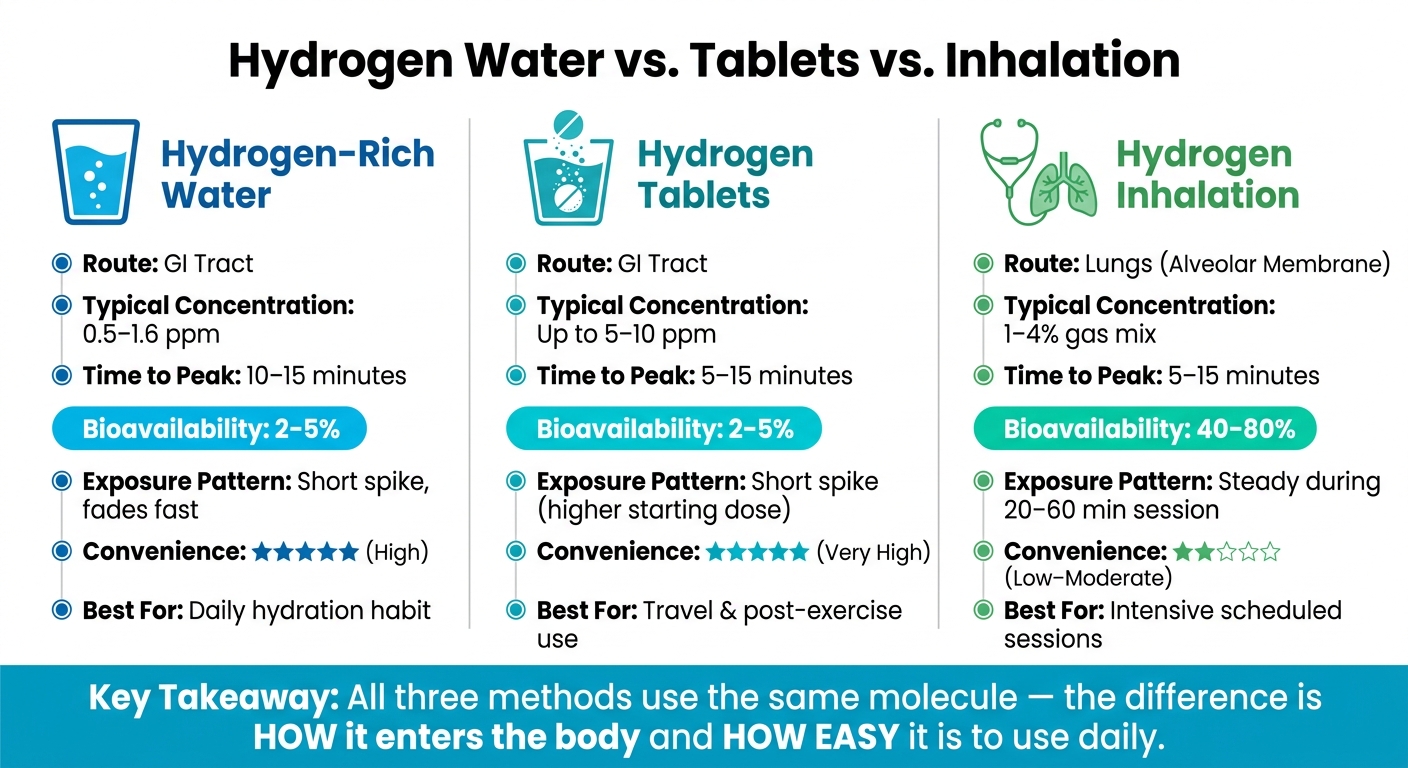
Hydrogen Water vs. Tablets vs. Inhalation: Absorption & Bioavailability Compared
The main difference comes down to route, exposure, and convenience. Here's the simplest side-by-side view.
Comparison Table: Absorption, Timing, and Practical Use
| Parameter | Hydrogen-Rich Water | Hydrogen Tablets in Water | Hydrogen Inhalation |
|---|---|---|---|
| Route of Absorption | GI tract | GI tract | Lungs (alveolar membrane) |
| Typical Exposure Pattern | Short, discrete dose | Short, discrete dose (higher concentration) | Steady during the session |
| Time to Peak | 5–15 minutes after drinking | 5–15 minutes after drinking | 5–15 minutes after session start [2] |
| Relative Exposure | Moderate | Moderate to high | High |
| Dose Control | Low to moderate (depends on freshness) | High (standardized per tablet) | High (adjustable by flow rate and duration) |
| Convenience | High (fits into daily hydration) | Very high (portable, on-demand) | Low to moderate (requires equipment and time) |
| Best Fit | General wellness and hydration | Travel and post-exercise recovery | Intensive, short, scheduled sessions |
Key Takeaways for Choosing a Delivery Method
Use the table for a quick comparison, then line the method up with your routine.
All three methods use the same molecule. The big shift is how it gets into the body and how easy it is to use on a normal day. Hydrogen-rich water is the simplest fit for a hydration habit because it doesn't ask much from you. You drink it and move on.
Tablets make things even easier when you're on the go. They offer better dose control and are easy to carry, which makes them a good pick for on-demand use at home, after exercise, or while traveling.
Inhalation is in a different lane. It usually gives the highest systemic exposure, and its 40%–80% bioavailability [2] makes it the most intensive option. The tradeoff is simple: you need equipment, setup, and time set aside for a session. That makes it a better match for short, planned use than casual daily use.
So the choice comes down to exposure level, timing, and convenience - and, just as much, which method you'll stick with.
FAQs
Which method is best for daily use?
For daily use, hydrogen water is often the best pick because it’s easy, portable, and simple to work into a normal hydration routine.
Edenvia Molecular Hydrogen tablets make that even easier. They give you a simple way to turn plain water into hydrogen-rich water, which makes day-to-day use more practical if your goal is to support overall wellness, help reduce inflammation, and improve joint mobility.
How often can I use each method?
There’s no established clinical protocol for how often to use hydrogen, and the best dose is still being studied.
With Edenvia molecular hydrogen tablets, use can fit into a daily wellness routine. Research on hydrogen water often points to 0.5 to 1.5 liters per day, sometimes split into two sessions, such as in the morning and after exercise. Used on a regular basis, it may help support overall wellness.
How can I reduce hydrogen loss before use?
To cut hydrogen loss, drink hydrogen-rich water right after it’s made - best within 15 to 30 minutes. If that’s not possible, keep the container tightly sealed.
Try not to shake or stir the water. Keep it cool to slow off-gassing. For the best absorption and bioavailability, drink it on an empty stomach.
Related Blog Posts
Disclaimer: These statements have not been evaluated by the Food and Drug Administration. This product is not intended to diagnose, treat, cure, or prevent any disease. This article is for general informational purposes only and is not medical advice. Consult a qualified healthcare provider before starting any supplement, especially if you are pregnant or nursing, have a medical condition, or take prescription medication.