

Top 7 Benefits of Hydrogen for Lipid Profiles
If you want the short answer: molecular hydrogen may help lipid markers a little, but it is not a stand-in for standard treatment. The clearest human data point to small drops in total cholesterol, LDL-C, and sometimes triglycerides, mostly in people with metabolic syndrome, overweight, or type 2 diabetes.
Here’s the article in plain English:
- Hydrogen-rich water (HRW) is the form used most often in studies.
- The best-supported effects are on total cholesterol and LDL-C.
- A 2026 meta-analysis of 13 randomized trials found average drops of about 6.71 mg/dL in total cholesterol and 3.21 mg/dL in LDL-C.
- Some studies also found lower triglycerides, less oxidized LDL, and better markers of insulin resistance.
- One study showed better HDL function even when HDL-C itself did not go up.
- Effects tend to be small, and healthy adults with normal lipids may see little or no change.
- If I were tracking results, I’d focus on LDL-C, triglycerides, and non-HDL cholesterol on a repeat lipid panel after about 8 to 12 weeks.
The Influence of High Concentration Hydrogen Rich Water for 24 Week on Body Composition
sbb-itb-6860cc4
Quick Comparison
| Benefit | What it may affect | What the human research suggests |
|---|---|---|
| 1. Lower total cholesterol | Total cholesterol | Small drop, with stronger effects in higher-risk groups |
| 2. Lower LDL and harmful LDL forms | LDL-C, sdLDL, oxidized LDL | Small LDL-C drop and less LDL oxidation |
| 3. Help triglycerides and non-HDL lipids | Triglycerides, non-HDL cholesterol | More likely to shift in insulin resistance or metabolic syndrome |
| 4. Help HDL work better | Cholesterol efflux, pre-β-HDL | HDL function may improve even if HDL-C does not |
| 5. Cut lipid oxidation | TBARS, oxLDL, SOD | Less oxidative stress in some human studies |
| 6. Help insulin resistance | Fasting insulin, HbA1c | Some trials show better metabolic markers |
| 7. Support the full cardiometabolic picture | Lipids, glucose, inflammation | Works best as an add-on to diet, exercise, and medical care |
Bottom line: I’d read these seven points as possible upsides with modest effect sizes, not promises. The article shows that hydrogen may support lipid health, but the data are still limited, and the main value seems to be as a low-risk add-on rather than a main treatment.
What to Know Before Using Hydrogen for Lipid Support
How Molecular Hydrogen May Affect Lipid Metabolism
Oxidative stress and inflammation can oxidize LDL and throw lipid balance off course. Hydrogen may help by lowering the most damaging reactive species while backing the body’s own antioxidant systems [1][2].
When these damaging reactive species build up, they can turn LDL particles into oxidized LDL, or oxLDL. That form is tied to arterial inflammation and plaque buildup [1][2]. H₂ appears to target the worst oxidants without shutting down normal cell signaling [3][9]. It may also switch on antioxidant defenses through the Nrf2 pathway, which can increase glutathione and superoxide dismutase (SOD) [3][9][2].
There’s also an inflammation angle. H₂ may lower pro-inflammatory cytokines such as TNF-α and IL-6, which may in turn cut VLDL production in the liver [1][2].
That’s why lipid panels matter more than symptoms here. You’re not likely to feel these shifts day to day, so the main way to track any response is through lab results.
What Current Human Studies Can and Cannot Show
The human research is still limited. Most trials are small, short, and point to the clearest effects in people with metabolic syndrome or type 2 diabetes [1][3][4].
As researchers Hamid Jamialahmadi et al. noted in the International Journal of Endocrinology and Metabolism: "Hydrogen-rich water demonstrated modest lipid-lowering effects in patients with metabolic disorders. However... further long-term trials involving larger populations are needed." [5]
So it helps to read the seven benefits below as possible effects, not promises. That’s the right frame for the data at this stage.
From a practical standpoint, the next question is simple: which lipid markers are most likely to move first?
How to Read Changes on a U.S. Lipid Panel
In the United States, lipid values are reported in milligrams per deciliter (mg/dL). What matters most is the trend over time, not one isolated result. Pay close attention to:
- LDL-C
- Triglycerides
- Non-HDL cholesterol
Non-HDL cholesterol is especially useful because it includes all atherogenic particles in a single number [1][6].
Lipid changes usually take 6 to 8 weeks to show up. A simple way to track progress is to get a baseline panel, then retest after about 8 to 12 weeks of steady use.
With that in mind, the seven benefits below point to the areas where hydrogen may have the biggest effect on lipid health.
1. Lowering Total Cholesterol
Total cholesterol is usually the first number people look at on a lipid panel. And based on human trials, molecular hydrogen may help bring that number down.
In a 24-week randomized trial, 60 adults with metabolic syndrome drank about 1.5 liters per day of hydrogen-rich water at about 4–5 ppm. The hydrogen group saw total cholesterol drop by 18.5 mg/dL, or about 9.9%, while the placebo group had no meaningful change [1][12].
That result lines up with the broader research. A meta-analysis of eight randomized controlled trials involving 357 patients found a statistically significant drop in total cholesterol [5]. Another 2025 meta-analysis looked at 13 RCTs in 757 overweight or obese participants and reported a pooled reduction of 6.71 mg/dL [7].
One likely reason is that hydrogen may help reduce oxidative stress and lipid peroxidation [1][3][9]. Put simply, it may help limit some of the damage tied to poor lipid metabolism.
The biggest shifts seem to show up in adults with metabolic syndrome, type 2 diabetes, or higher starting lipid levels [1][6]. That pattern showed up in a retrospective study of 1,088 people with type 2 diabetes, where adding hydrogen inhalation to standard care improved total cholesterol more than standard care alone [4].
Still, total cholesterol is just the first signal. For risk, LDL-C and non-HDL cholesterol usually matter more.
2. Reducing LDL Cholesterol and Atherogenic Lipoproteins
LDL-C matters because when LDL oxidizes, it turns into oxLDL, a form linked to artery inflammation and plaque buildup. Hydrogen may help slow that oxidation [2][1][3].
This seems most clear in people with higher cardiometabolic risk. In an 8-week trial, patients with type 2 diabetes drank 900 mL per day of hydrogen-rich water. Researchers found a 15.5% drop in modified LDL, which is a marker of oxidized particles, and a 5.7% drop in small dense LDL (sdLDL) [11]. That’s worth paying attention to because sdLDL is the kind of LDL that tends to be more atherogenic.
A meta-analysis of 13 randomized controlled trials with 757 participants also found a statistically significant drop in LDL-C of 3.21 mg/dL [7]. That number isn’t huge on its own, but the more interesting part may be how hydrogen works.
Hydrogen appears selective. It targets the most cytotoxic radicals while leaving useful ROS signaling in place [3][9]. So the main point here isn’t only lowering the LDL count on a lab report. It’s helping limit LDL oxidation, which may matter just as much.
Next, triglycerides and non-HDL cholesterol help show whether hydrogen affects the broader atherogenic load.
3. Modulating Triglycerides and Non-HDL Lipids
LDL gets most of the attention. But triglycerides and non-HDL cholesterol matter too, especially in people with insulin resistance. Non-HDL cholesterol gives a broader view of atherogenic particles in the blood.
Hydrogen may help by easing oxidative stress, inflammation, and insulin resistance. When that happens, the liver may put out fewer VLDL particles.
The effect seems most clear in people with metabolic syndrome or type 2 diabetes. In a 24-week randomized trial of 60 adults with metabolic syndrome, drinking 1.5 liters per day of 4–5 ppm hydrogen-rich water lowered triglycerides by 47 mg/dL (24.9%) and total cholesterol by 18.5 mg/dL (9.9%) [1][12]. A 2024 meta-analysis of 8 RCTs in 357 patients also found drops in triglycerides and total cholesterol [5].
That said, people who start with normal lipid levels usually see little change. So this doesn't look like a blanket effect for everyone.
These shifts point to another angle worth watching: whether hydrogen helps HDL function, not just the numbers on a lipid panel.
4. Supporting HDL Function and Cholesterol Efflux
Beyond LDL and triglycerides, hydrogen may also affect HDL quality. And that’s a big deal.
HDL-C tells you how much cholesterol HDL is carrying. It does not tell you how well HDL does its main job: removing cholesterol from tissues. HDL helps protect the body by pulling cholesterol out of cells and sending it back to the liver. That process is called cholesterol efflux, and it sits at the center of reverse cholesterol transport.
In a 10-week double-blind, randomized, placebo-controlled trial of 68 adults with untreated hypercholesterolemia, participants drank 0.9 liters per day of hydrogen-rich water. Total HDL-C levels did not change in a statistically significant way. But the H2 group showed higher ABCA1-mediated cholesterol efflux and higher plasma levels of pre-β-HDL [14]. Hydrogen also improved HDL quality, including LDL protection and anti-inflammatory activity, and increased levels of apolipoprotein M (ApoM), a protein tied to HDL function [14].
This helps put another finding into context. A 2025/2026 meta-analysis of 13 RCTs found a small statistically significant drop in HDL-C with hydrogen use (WMD: -1.16 mg/dL) [7]. On the surface, that might sound like bad news. But if hydrogen is making HDL work better, HDL-C alone may not show the full picture.
That’s the catch with a standard U.S. lipid panel: it does not measure HDL efflux capacity. So a change that matters may fly under the radar. These shifts in HDL may also line up with hydrogen’s broader effects on oxidative stress.
5. Reducing Lipid Peroxidation and Oxidative Stress
Cholesterol numbers matter. But in many cases, oxidation is where the damage starts.
When LDL becomes oxidized, it can help set off foam cell formation and plaque buildup. So the upstream issue to watch is oxidative stress.
Hydrogen may reduce the most harmful oxidants while leaving normal cell signaling in place. In plain English, that means it may help limit the oxidative step that directly damages lipids [1][2].
Human studies suggest the same pattern. After steady use of hydrogen-rich water, researchers have reported:
Put simply, the main signals seen in human studies are lower TBARS, higher SOD, lower oxidized LDL, and less overall oxidative stress [11][13].
Because oxidative stress and insulin resistance often climb together, the next benefit is metabolic improvement.
6. Improving Insulin Resistance and Metabolic Syndrome Markers
Hydrogen may do more than change lipid numbers on a lab report. It may also help with the metabolic problems that push those numbers in the wrong direction in the first place.
Insulin resistance tends to make lipid panels look worse by increasing VLDL output and triglycerides. Molecular hydrogen may help support insulin sensitivity by easing oxidative and inflammatory stress.
In a 24-week randomized controlled trial, 60 adults with metabolic syndrome drank 1.5 liters per day of hydrogen-rich water at 4–5 ppm. The group showed significant reductions in fasting insulin and HbA1c, along with improvements in total cholesterol, LDL, and triglycerides [1][6][12].
Those upstream shifts help explain why hydrogen may affect broader cardiometabolic risk, not just a single lipid marker.
7. Supporting Overall Cardiometabolic Risk Profiles
Hydrogen may do more than shift a few lipid numbers on a lab report. It may also help the broader cardiometabolic picture by lowering oxidative stress and inflammation [1][2].
That matters because cardiometabolic health is rarely about just one marker. Cholesterol, blood sugar, inflammation, and insulin response tend to move together. When one area improves, others sometimes follow.
In one 24-week trial, hydrogen-rich water improved lipids, fasting glucose, and inflammatory markers in adults with metabolic syndrome [1][12]. That helps explain why hydrogen is often discussed as support for overall risk, not only cholesterol.
A 2026 meta-analysis also found small but significant reductions in total cholesterol and LDL-C [7]. The changes were modest, but they lined up with shifts in oxidative stress, inflammation, and insulin sensitivity.
There are still clear limits to the research. Most trials are small, and there is not yet long-term data on cardiovascular events. So for now, hydrogen looks best used as an adjunct to core lifestyle habits, not a replacement for them [1][7].
That broader profile leads naturally to the practical question of how people use hydrogen day to day.
Using Molecular Hydrogen in a Daily Wellness Routine
For day-to-day use, the main things to look at are the delivery format, how much you use each day, and whether you stick with it.
Common Delivery Formats Used in Studies
Most clinical studies use hydrogen-rich water (HRW) [1][13]. In human research, a few formats show up again and again, and HRW is the one used most often.
| Delivery Format | Typical Concentration | Dissolve/Prep Time |
|---|---|---|
| Hydrogen Tablets | 4.0–5.0 ppm | About 3 minutes |
| Electrolysis bottle | 1.0–1.6 ppm (up to 5.0+ ppm) | About a 3-minute cycle |
| Magnesium Stick | 0.5–0.8 ppm | Several hours |
Across these options, the hydrogen concentration usually falls somewhere between about 0.5 ppm and 5.0 ppm, depending on the method used [1][13]. One 24-week trial used 1.5 liters per day of high-concentration HRW at 4–5 ppm [12]. It also helps to drink it soon after prep, since dissolved hydrogen fades fast [10].
What a Realistic Daily Routine Looks Like
Molecular hydrogen is usually used with standard medical care, nutrition, and exercise, not on its own [1][2]. In studies, daily intake often ranges from 500 mL to 2 liters, usually split into two or three servings [1][2].
That part matters because the lipid effects tend to be modest. This isn’t the kind of thing where one serving does much. In the research, lipid changes are usually checked after 8 to 24 weeks of steady daily use [1][5].
The next section compares which benefits seem most direct and which ones are more indirect.
An Example of a Hydrogen Tablet Product
Edenvia Molecular Hydrogen offers tablets that dissolve in water in about 3 minutes, which makes daily hydrogen-rich water simple to prepare.
How the Evidence Compares Across the 7 Benefits
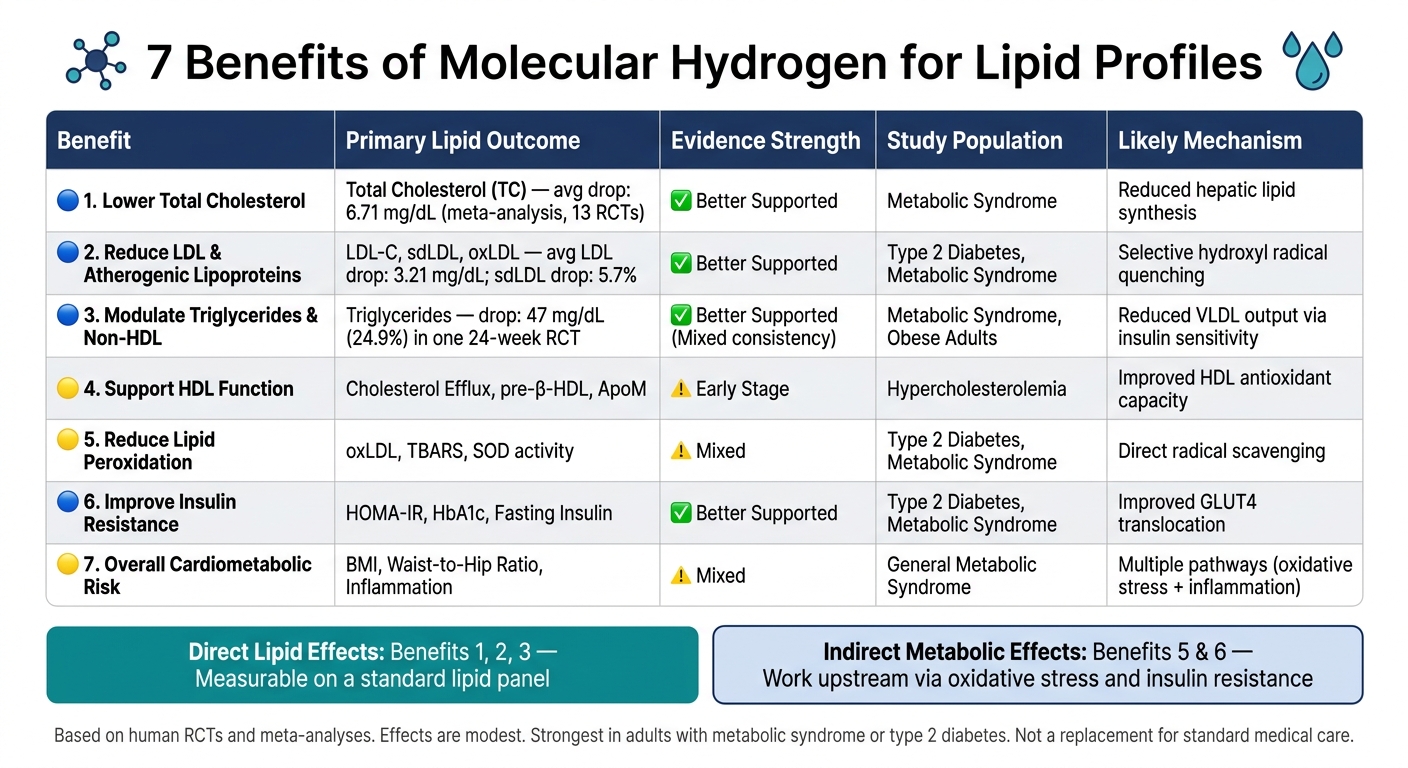
7 Benefits of Hydrogen for Lipid Profiles: Evidence Comparison
The easiest way to make sense of the research is to split it into two buckets: direct lipid changes and upstream metabolic effects.
Side-by-Side Comparison of the 7 Benefits
The table below shows which benefits have stronger support and which ones are still in the early stage.
| Benefit | Primary Lipid Outcome | Evidence Strength | Consistency | Study Population | Likely Mechanism |
|---|---|---|---|---|---|
| 1. Lowering Total Cholesterol | Total Cholesterol (TC) | Better supported | High | Metabolic syndrome | Reduced hepatic lipid synthesis |
| 2. Reducing LDL & Atherogenic Lipoproteins | LDL-C, small dense LDL | Better supported | High | Type 2 diabetes, metabolic syndrome | Selective quenching of hydroxyl radicals |
| 3. Modulating Triglycerides | Serum Triglycerides (TG) | Better supported | Mixed | Metabolic syndrome, obese adults | Direct lipid change |
| 4. Supporting HDL Function | Cholesterol efflux | Early | Low | Metabolic syndrome | Improved HDL antioxidant capacity |
| 5. Reducing Lipid Peroxidation | oxLDL, 8-isoprostanes | Mixed | High | Type 2 diabetes, metabolic syndrome | Direct radical scavenging |
| 6. Improving Insulin Resistance | HOMA-IR, HbA1c | Better supported | High | Type 2 diabetes, metabolic syndrome | Improved glucose transporter (GLUT4) translocation |
| 7. Overall Cardiometabolic Risk | BMI, waist-to-hip ratio | Mixed | Mixed | General metabolic syndrome | Multiple pathways |
Direct Lipid Effects vs. Indirect Metabolic Effects
Benefits 1, 2, and 3 are the most direct. They show up as measurable changes on a standard U.S. lipid panel. The shifts tend to be modest, but modest doesn’t mean meaningless. Over time, small changes can add up.
Benefits 5 and 6 work more indirectly. Instead of changing lipids first, they may help by lowering lipid oxidation and improving insulin resistance.
Benefits 4 and 7 are less settled. The clearest effects tend to show up in people with metabolic syndrome or prediabetes. Healthy adults usually see smaller changes on a lipid panel.
That’s the simplest way to size up what hydrogen may realistically change on a lipid panel.
Conclusion
Put it all together, and the case is strongest for small, direct changes in lipids along with broader metabolic support. The pattern is pretty clear: molecular hydrogen's most dependable lipid effects are modest drops in total cholesterol and LDL-C, with occasional gains in triglycerides and HDL function [7]. And this seems to go beyond cholesterol alone. Those indirect effects may add to its use when combined with diet, exercise, and medical care [1][8].
The strongest effects show up in people with metabolic syndrome and type 2 diabetes, not in healthy adults with normal lipid levels [1][3]. So for that group, hydrogen makes the most sense as a low-risk add-on to prescribed care, not as a stand-in for statins or other established treatments [1][3].
That said, the research is still early. Current trials are small, and long-term data are still limited [3][7]. Larger studies with more varied groups are still needed before hydrogen can be recommended as standard therapy for lipid management [1][3][7]. For now, molecular hydrogen fits best as a modest adjunct for lipid support.
FAQs
Who is most likely to benefit from hydrogen for lipid support?
People with metabolic dysfunction or existing metabolic conditions are the most likely to see a difference. That includes adults with metabolic syndrome, type 2 diabetes, or prediabetes. In these cases, hydrogen-rich water may help support triglycerides, LDL cholesterol, and glycemic control.
It may also help people dealing with chronic inflammation or high oxidative stress. Healthy adults can still use it for general wellness. But if there isn’t an existing metabolic imbalance, noticeable changes in cholesterol are less likely.
How long should I use hydrogen before rechecking my lipid panel?
For a clear check, test your lipid panel at baseline, 3 months, and 6 months. Some people may see measurable cholesterol changes within 6 to 8 weeks of steady daily use.
Results build over time, so daily use matters. Work with your healthcare provider to track your numbers and assess your personal response.
Can hydrogen replace statins or other cholesterol medications?
No. Molecular hydrogen should not replace statins or other cholesterol medications.
Research describes hydrogen-rich water as a support tool to use alongside your current lifestyle and medical care, not in place of prescribed treatment. Its effects on LDL oxidation and lipid profiles are modest. Always talk with your doctor before changing any prescribed medication.
Related Blog Posts
Disclaimer: These statements have not been evaluated by the Food and Drug Administration. This product is not intended to diagnose, treat, cure, or prevent any disease. This article is for general informational purposes only and is not medical advice. Consult a qualified healthcare provider before starting any supplement, especially if you are pregnant or nursing, have a medical condition, or take prescription medication.