

Hydrogen and Neuropathic Pain: Study Findings
Here’s the short answer: hydrogen looks promising in animal nerve-pain studies, but there is still no direct proof that it works for neuropathic pain in people.
If you’re looking for the bottom line, this is it:
- Most data comes from rats, mice, and lab research
- Human neuropathic pain trials are still missing
- Researchers are focused on 2 main pathways: oxidative stress and inflammation
- Forms studied include hydrogen gas, hydrogen-rich water, and other H2 delivery methods
- Main animal findings include lower pain sensitivity, less allodynia, less hyperalgesia, and shifts in tissue markers tied to nerve injury
- Dose, product quality, and timing are still unclear
In plain English, I’d read the current evidence this way: H2 is a research topic, not a proven treatment. Animal work suggests it may affect pain-related biology, especially ROS, inflammatory signaling, and pathways such as Nrf2, HO-1, and NQO1. But without controlled human trials, those findings do not tell us whether people with neuropathic pain will feel less pain, sleep better, or function better day to day.
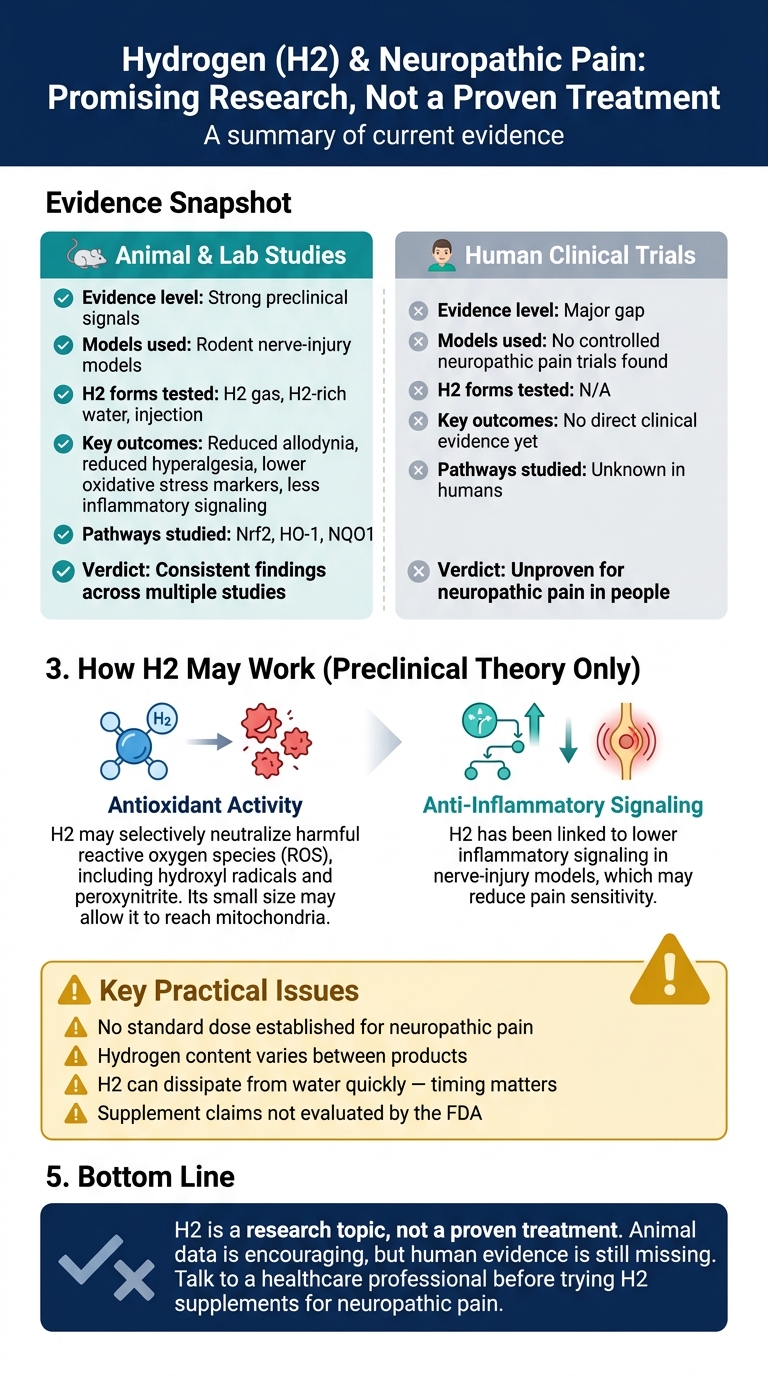
Hydrogen & Neuropathic Pain: Animal Evidence vs. Human Evidence
Using Molecular Hydrogen an Analgesic?
sbb-itb-6860cc4
Quick comparison
| Area | What the article shows |
|---|---|
| Best current evidence | Animal and lab studies |
| Human trial status | No controlled neuropathic pain trials found |
| Main targets studied | Oxidative stress and inflammation |
| Main animal outcomes | Lower pain sensitivity and lower nerve-injury markers |
| Proven treatment for people? | No |
| Practical issues | No standard dose; hydrogen levels can drop fast in water |
So if you want the simple takeaway, it’s this: the science is early, the human gap is large, and caution makes sense.
What Animal Studies Found
Most of the evidence on hydrogen and neuropathic pain comes from rodent studies. That gives researchers a controlled setup: they can create a nerve injury, track pain sensitivity, and compare what changes when hydrogen is used.
These models were chosen for a reason. They let scientists look closely at two big parts of neuropathic pain: oxidative stress and inflammation. Still, there’s a catch. Rodent studies are useful for testing cause and effect, but they don’t fully mirror how neuropathic pain shows up in people.
Pain Models Used in Animal Research
Researchers used mouse and rat nerve-injury models because they produce consistent injuries that are easier to compare across groups.
Tissue Markers Measured Across Studies
Rather than zeroing in on a single outcome, the studies mostly tracked nerve-injury signals tied to pain sensitivity. The main focus was on markers linked to oxidative stress and inflammatory signaling.
Changes Observed in Nervous Tissue
Across studies, researchers measured nerve-injury markers tied to pain sensitivity and found shifts in oxidative and inflammatory signaling at the tissue level [1][3][5]. Those mechanisms are discussed in the next section.
How Hydrogen May Affect Nerve Inflammation and Oxidative Damage
These findings point to two main ideas: lower oxidative stress and less inflammation. That’s why researchers keep coming back to those two pathways.
Selective Antioxidant Activity and Oxidative Stress
After nerve injury, excess reactive oxygen species (ROS) can damage cells and add to pain-related changes. Researchers study molecular hydrogen because it may selectively reduce the most harmful reactive species, especially hydroxyl radicals and peroxynitrite [1][3].
H2 is also extremely small. That may help it move across membranes and reach mitochondria, where a lot of oxidative damage can start or build up [1][3]. After nerve injury, oxidative stress and inflammation often rise at the same time, almost like two problems feeding each other.
Inflammatory Pathways Linked to Pain Sensitivity
In preclinical research, H2 has been linked to lower inflammatory signaling, which may reduce inflammation tied to nerve injury [1][5]. That may help explain why some studies report shifts in pain sensitivity after nerve injury. Put simply, if inflammation drops, pain sensitivity may drop with it.
Protective Signaling Pathways Under Study
Some studies also look at whether H2 activates Nrf2. If it does, that could increase HO-1 and NQO1 and help limit oxidative injury [1][5].
These mechanisms are still under study. The next section looks at how often these patterns show up across different studies.
Comparing Studies and the Limits of Current Evidence
Across preclinical studies, hydrogen is tied to lower oxidative stress, less inflammatory signaling, and signs of neuroprotection. The big issue isn’t whether hydrogen touches these pathways. It’s how much weight we should give the data from animals compared with data from people.
Study Comparison Table
| Study Type | Model | H2 Intervention | Pain Outcomes | Evidence Strength |
|---|---|---|---|---|
| Preclinical / Animal | Animal and cell models focused on oxidative stress and neuroprotection [1][5] | H2 gas, H2-rich water, or injection [5] | Reduced markers of nerve damage and inflammation [1] | Consistent across multiple preclinical studies |
| Controlled human neuropathic pain trials | None found | N/A | No direct clinical evidence yet | Major evidence gap |
That gap matters. Good signals in preclinical research do not automatically mean clinical proof.
What Early Human Evidence Can and Cannot Show
The human data available right now does not include controlled neuropathic pain trials [2][4]. So while early observations may give researchers a place to look next, they can’t show that H2 works as a treatment for neuropathic pain.
Put simply, the human side of the evidence is still thin. There are no large, well-controlled trials focused on neuropathic pain, which means there’s still no direct clinical proof.
So at this stage, hydrogen looks promising in preclinical work, but it remains unproven for neuropathic pain in people. The key issue now is whether those preclinical effects carry over into actual pain relief.
Bottom Line: Promising Research, but Not a Proven Treatment
Animal studies suggest molecular hydrogen may help reduce allodynia, hyperalgesia, oxidative stress, and inflammatory signaling in preclinical models [1][5]. Because it’s such a small molecule, it’s a plausible candidate for more nerve-pain research [1]. That’s encouraging. But animal data doesn’t prove it works in people.
And that’s the key issue here: human evidence is still thin. There are no large controlled trials in neuropathic pain, and supplement claims about treating disease are not evaluated by the FDA [1][2][3][4][5]. So while interest in H2 is growing, day-to-day use for neuropathic pain is still unsettled.
There’s also a practical problem. No standard dose for neuropathic pain has been established, and hydrogen content can vary from one product to another [3][5]. On top of that, hydrogen can dissipate from water pretty fast, so timing matters [5].
Taken together, the evidence points to caution. H2 looks promising in preclinical research, but it is not a proven treatment for neuropathic pain [1][5]. Anyone dealing with neuropathic pain should talk with a healthcare professional before trying supplements.
FAQs
Why don’t animal results prove it works in people?
Animal studies can give us clues about how molecular hydrogen might work. They can point to possible effects on free radicals and inflammation.
But that’s the catch: animal research does not prove the same thing will happen in people. Mice, rats, and humans don’t share the exact same biology, so results don’t always carry over.
Neuropathic pain in humans is also more complicated than it looks on paper. It can involve many causes, symptoms, and responses to treatment. That’s why human clinical trials matter. They’re needed to confirm safety, figure out the right dose, and show whether the treatment has a real effect in actual patients.
Which type of hydrogen has been studied most for nerve pain?
Research on nerve pain mainly looks at molecular hydrogen (H2), a gas made of two hydrogen atoms bonded together. Scientists have studied it for its antioxidant and anti-inflammatory effects.
In supplement form, including Edenvia Molecular Hydrogen tablets, H2 is dissolved in water to create hydrogen-rich water. This helps deliver it in a simple way and may support the body against oxidative stress.
What would human trials need to show?
Human trials would need to show steady, measurable gains in pain sensitivity and nerve-related discomfort.
They'd also need to show that molecular hydrogen lowers oxidative stress and inflammation in nerve tissue, and that those effects lead to lasting clinical relief while confirming the safety and long-term effect of hydrogen-rich water as a supportive option.
Related Blog Posts
Disclaimer: These statements have not been evaluated by the Food and Drug Administration. This product is not intended to diagnose, treat, cure, or prevent any disease. This article is for general informational purposes only and is not medical advice. Consult a qualified healthcare provider before starting any supplement, especially if you are pregnant or nursing, have a medical condition, or take prescription medication.