

Hydrogen Tablets and Glucose Control: Study Review
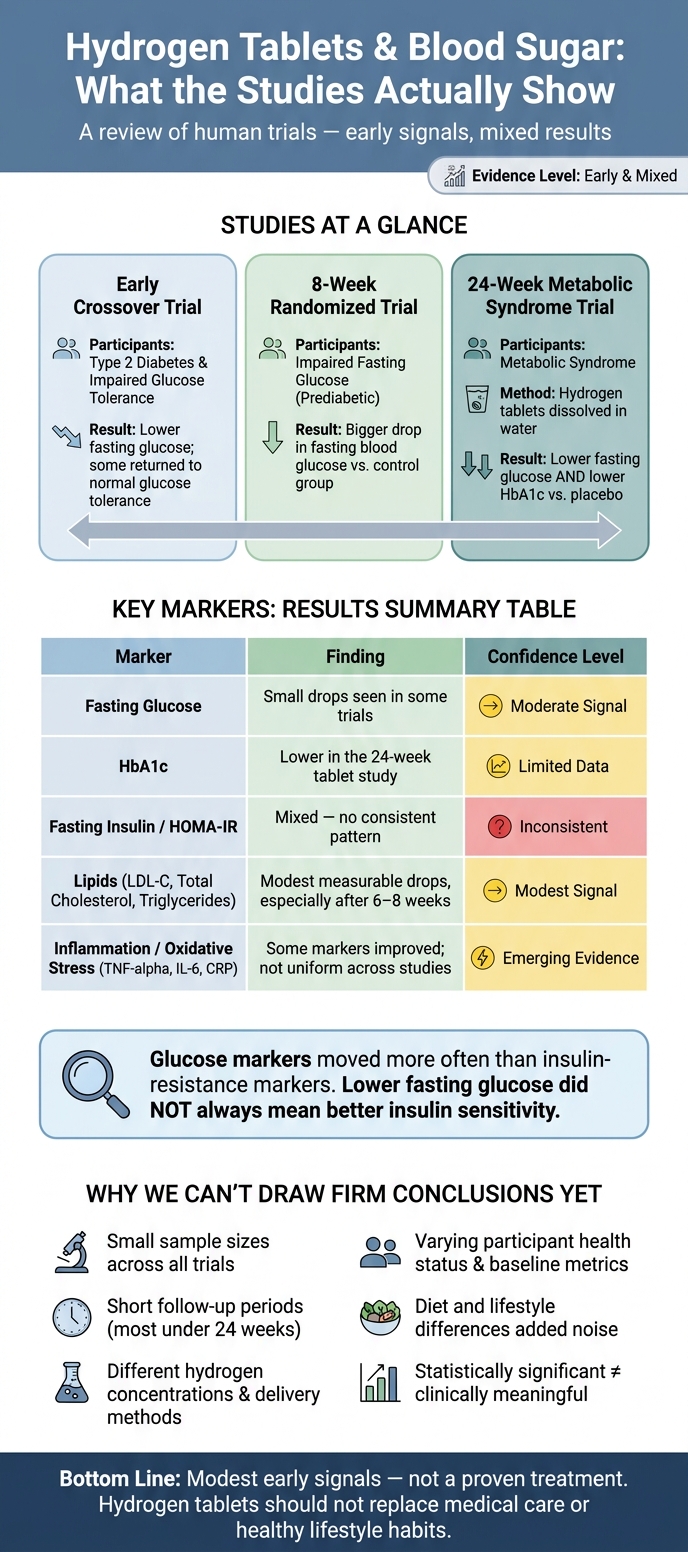
Bottom line: I’d read the research on hydrogen tablets and hydrogen-rich water as early and mixed, not as proof they help blood sugar. In the human studies covered here, some people with impaired fasting glucose, type 2 diabetes, or metabolic syndrome saw small drops in fasting glucose, HbA1c, LDL-C, total cholesterol, and triglycerides. But the studies were small, often short, and results for fasting insulin and HOMA-IR did not match from one trial to the next.
If you want the short version, here it is:
- Blood sugar: Some trials found lower fasting glucose after 8 weeks or 24 weeks
- HbA1c: The 24-week tablet study reported lower HbA1c
- Insulin resistance: Results were mixed for fasting insulin and HOMA-IR
- Lipids: There were small shifts in total cholesterol, LDL-C, and triglycerides in some groups
- Inflammation and oxidative stress: A few studies reported lower markers tied to oxidative stress and inflammation
- Main limit: Small study size and different tablet or water methods make the data hard to compare
What stands out to me is simple: glucose markers moved more often than insulin-resistance markers did. So even when fasting glucose went down, that did not always mean insulin sensitivity improved.
Here’s a quick side-by-side view:
| Area | What the studies suggest | My plain-English take |
|---|---|---|
| Fasting glucose | Lower in some trials | A small signal is there, but not in every group |
| HbA1c | Lower in the 24-week tablet study | More useful than a one-time glucose reading, but based on limited data |
| Fasting insulin / HOMA-IR | Mixed | This is one reason I would be careful with strong claims |
| Lipids | Small drops in LDL-C, total cholesterol, and sometimes triglycerides | Possible metabolic effect, but not a clear treatment result |
| Inflammation / oxidative stress | Some markers went down | This may help explain the blood sugar shifts, but it is still early |
My takeaway: the article points to modest effects, not a proven option for glucose control. If you’re looking at hydrogen tablets for blood sugar, the fairest read is: some early studies look promising on paper, but the data is still too limited to support firm claims or replace standard care.
Hydrogen Tablets & Blood Sugar: What the Studies Actually Show
Why I Changed My Mind About Hydrogen Water (with Tyler LeBaron)
sbb-itb-6860cc4
Clinical Studies on Glucose Markers
Published trials in this area include an early crossover study in people with type 2 diabetes or impaired glucose tolerance, an 8-week randomized trial in adults with impaired fasting glucose, and a 24-week study in people with metabolic syndrome. The easiest way to make sense of the results is to look at each study by design and participant group.
Early Trial in Type 2 Diabetes and Impaired Glucose Tolerance
One of the earlier crossover trials enrolled adults with type 2 diabetes or impaired glucose tolerance. The researchers reported lower fasting glucose and better lipid markers, and some people with impaired glucose tolerance returned to normal oral glucose tolerance by the end of the trial [3].
Randomized Trial in Impaired Fasting Glucose
A separate 8-week randomized trial looked at adults with impaired fasting glucose, which is a prediabetic state marked by high fasting glucose. By the end of the 8 weeks, the hydrogen-rich water group showed a bigger drop in fasting blood glucose than the control group [3].
24-Week Metabolic Syndrome Trial Using Hydrogen Tablets
The longest trial covered here lasted 24 weeks and enrolled adults with metabolic syndrome [3]. Participants used hydrogen tablets dissolved in water [1][4]. By week 24, the hydrogen group had lower fasting glucose and HbA1c than the placebo group [3]. That said, changes in glucose did not always move in step with insulin, lipid levels, or inflammatory markers.
Insulin Resistance, Lipids, and Inflammatory Response
Glucose shifts didn't always line up with the other results. So these same trials also looked at insulin, blood lipids, and markers tied to inflammation. That matters because a drop in blood sugar alone doesn't tell the whole story.
| Marker area | Overall pattern across studies | Key takeaway |
|---|---|---|
| Insulin / HOMA-IR | Mixed results | Some studies suggested better insulin sensitivity, but at least one reported no meaningful HOMA-IR change. Differences in hydrogen concentration, delivery method, and participant health status may help explain the variation [1][4][6]. |
| Lipids | Modest but measurable effects | Reviews point to modest lipid-lowering effects overall, especially for total cholesterol and LDL-C, with triglycerides improving in some metabolic syndrome populations. Measurable changes were more likely after 6 to 8 weeks of daily use [1][3]. |
| Inflammation / oxidative stress | Emerging evidence of improvement | Studies tracked markers such as TNF-alpha, IL-6, CRP, oxidized LDL, and oxidative stress markers. Hydrogen is described as a selective antioxidant that targets hydroxyl radicals and peroxynitrite [1][2]. |
Insulin and HOMA-IR Results Were Mixed
Some trials found better fasting insulin or improved insulin sensitivity. But at least one found no meaningful change in HOMA-IR, which is a standard way to gauge insulin resistance. In plain terms, lower fasting glucose did not always mean better insulin sensitivity.
Why the split results? A few things could be in play. Hydrogen concentration differed across studies. Delivery methods differed too. And participant health status wasn't the same from trial to trial [1][4][6]. Timing may matter as well, since hydrogen gas leaves water pretty fast after dissolution [1][5].
Lipid Markers: Total Cholesterol, LDL-C, Triglycerides, and HDL-C
Lipid changes showed up more often in longer interventions. Reviews point to modest but measurable effects overall, especially for total cholesterol and LDL-C. Some metabolic syndrome groups also saw triglyceride improvement [1][3].
That may point to more than a simple drop in cholesterol numbers. One likely mechanism is lower LDL oxidation, not just lower LDL itself. That's an important distinction, because it hints that the effect may involve how lipids behave in the body, not only how much is circulating.
Inflammation and Oxidative Stress Findings
Several studies tracked inflammatory markers such as TNF-alpha, IL-6, and CRP, along with oxidative stress markers like oxidized LDL. Some also reported lower oxidative stress markers alongside reduced inflammatory signaling [2].
That said, the pattern wasn't the same in every trial. The findings are suggestive, but not uniform across studies.
How Strong Is the Evidence
The metabolic and inflammatory findings above are mixed, so the main issue is simple: how much weight should we give them? Right now, the evidence looks promising, but it does not settle the case. These studies point to possible effects, yet the data is still too thin to support broad clinical claims.
Where the Findings Are Most Consistent
The clearest pattern so far is hydrogen's selective antioxidant action. It appears to target hydroxyl radicals and peroxynitrite without shutting down normal reactive oxygen signaling [2][4]. That matters because the body still needs some of those signals to function as it should.
Metabolic effects may happen too, but the results are uneven across different groups [1]. Some trials found shifts, while others did not show the same pattern. Study length seems to matter as well. Longer trials, especially those running 6 to 8 weeks or more, showed more measurable changes [3].
Another issue is study design. Dose levels and tablet formats differ from one trial to the next, which makes side-by-side comparison harder [1][4].
What Limits Confidence in the Results
There are a few clear limits here: small sample sizes, short follow-up periods, and differences in participants' starting health status. Diet and lifestyle also appear to shape the results, which adds more noise to the picture [1].
And this is a big point: a statistically significant lab change does not always mean a meaningful health benefit. A number can move on paper without leading to a change that people actually feel or that shifts health outcomes in day-to-day life.
Conclusion: What the Studies Suggest Overall
Taken as a whole, these trials suggest modest metabolic effects, not a proven treatment. Human studies on hydrogen-rich water and hydrogen tablets show small signals for fasting glucose and lipid markers, but the results are still mixed [1][3].
One possible reason is lower oxidative stress, but a clear clinical effect has not been shown yet [1][2][3]. Findings on insulin sensitivity and HOMA-IR are also mixed, which means the evidence still isn't enough to support firm claims for the general population [1].
So far, the early data is encouraging, but it's far from settled. People can respond very differently based on their health status, diet, and day-to-day habits, and larger, longer studies are still needed before any broad advice makes sense [1]. Hydrogen tablets should not replace medical care or healthy lifestyle habits [1].
FAQs
Do hydrogen tablets actually lower blood sugar?
Research suggests hydrogen-rich water may support metabolic health by helping with glucose and lipid metabolism. That may, in turn, help maintain insulin sensitivity. Some studies point to possible upsides for people who may be at risk of metabolic disorders, though results can vary from person to person.
That said, hydrogen tablets are not a substitute for medical care or a healthy lifestyle. If you have a medical condition or take prescription medications, talk with your healthcare provider before adding any new supplement.
Why were the study results mixed?
Results have been mixed, which makes sense: research on molecular hydrogen and glucose control is still developing. Some studies suggest that hydrogen-rich water may help with insulin sensitivity and support glucose metabolism. But the evidence still isn't strong enough to say it offers clear benefits for everyone.
There’s another wrinkle too. People don’t respond the same way across studies, so outcomes can vary from person to person. And these products should not replace medical treatment or a well-established healthy lifestyle.
Can hydrogen tablets replace diabetes treatment?
No. Hydrogen tablets cannot replace medical treatment for diabetes.
Early research suggests that molecular hydrogen may help support insulin sensitivity and glucose metabolism. But that does not make it a stand-in for medical care, prescription drugs, or day-to-day habits like eating well and staying active.
Edenvia Molecular Hydrogen tablets may offer antioxidant support. Still, they should be seen as an extra tool, not the main treatment.
Related Blog Posts
Disclaimer: These statements have not been evaluated by the Food and Drug Administration. This product is not intended to diagnose, treat, cure, or prevent any disease. This article is for general informational purposes only and is not medical advice. Consult a qualified healthcare provider before starting any supplement, especially if you are pregnant or nursing, have a medical condition, or take prescription medication.