

Molecular Hydrogen and Lifespan: Research Summary
Here’s the short answer: molecular hydrogen has not been shown to extend human lifespan. What studies do show is early support for healthspan-related areas like oxidative stress, inflammation, joint comfort, mobility, and exercise recovery.
If you want the plain-English version, this is what matters most:
- No human study has proven longer life from H₂
- Most research looks at short-term markers, not death rates or years lived
- Human trials are small and short
- The strongest current interest is day-to-day function, like recovery, stiffness, fatigue, and movement
- Hydrogen-rich water is the main form used in human studies
- Preparation matters because hydrogen leaves water fast
A few human studies report changes in markers like LDL oxidation, IL-6, TNF-α, and 8-OHdG over about 2 to 8 weeks. Some small trials also report less knee discomfort, less fatigue, and better morning mobility. But that is not the same thing as lifespan extension.
If I had to sum up the full article in one line, it would be this: H₂ looks like a healthspan topic right now, not a proven longevity tool.
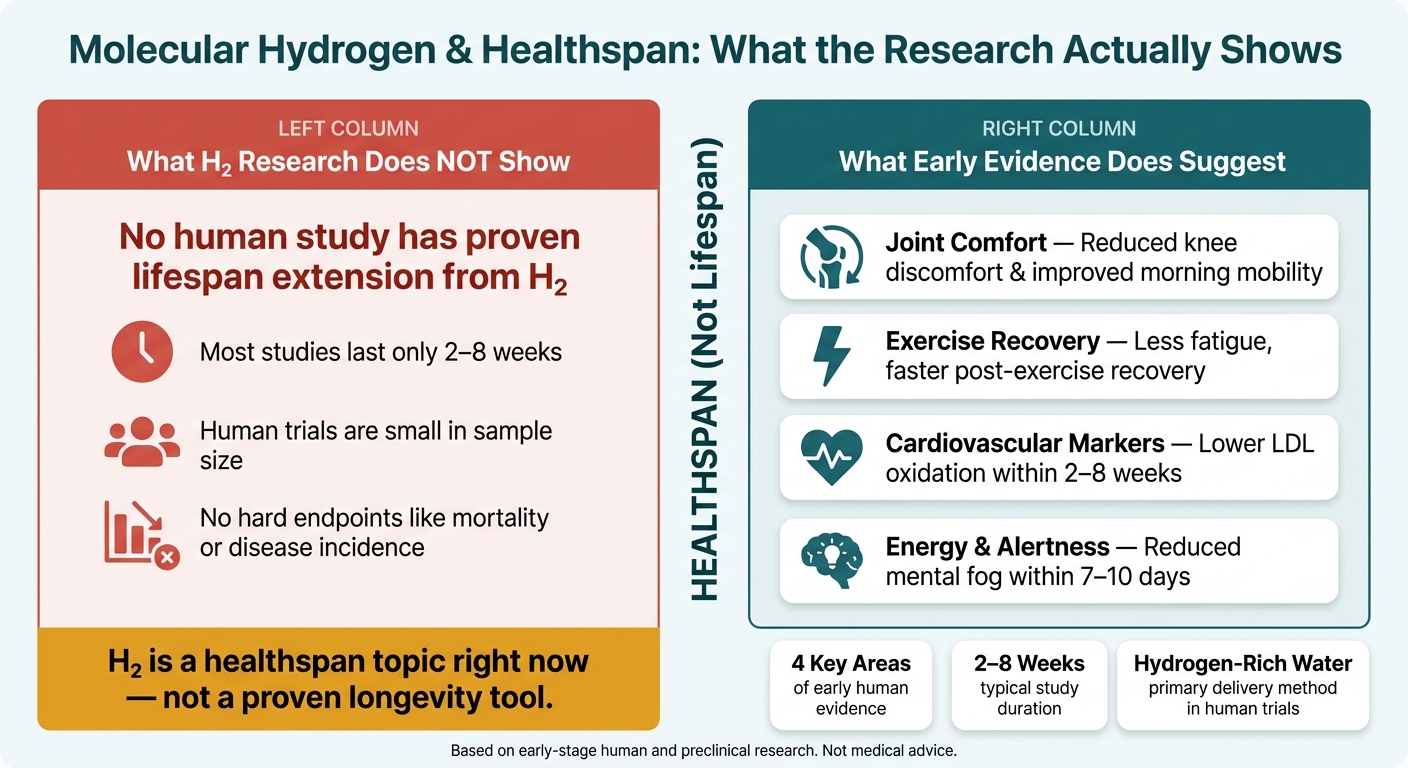
Molecular Hydrogen & Healthspan: What the Research Actually Shows
Tyler LeBaron: Hydrogen Water, Mitochondrial Health, Selective Antioxidants, & Longevity | TUH #265
sbb-itb-6860cc4
How Molecular Hydrogen May Affect Aging Biology
Once delivery is covered, the next step is simple: what does H₂ do inside cells? That’s why aging researchers pay attention to it. They study H₂ because it may affect oxidative stress, inflammation, and mitochondrial function - all tied to healthspan decline.
Oxidative Stress, Inflammation, and Redox Signaling
One of the main ideas in hydrogen research is selectivity. H₂ is often described as a selective antioxidant that targets hydroxyl radicals and peroxynitrite while leaving normal redox signaling alone. In this discussion, hydroxyl radicals (•OH) and peroxynitrite (ONOO⁻) are the reactive species that come up most often. The idea is that H₂ may lower cellular damage without interfering with the signaling cells still need to function [1][2].
Because H₂ is so small, it may pass through cell membranes and reach places like the mitochondria and nucleus with ease. Researchers look at it for its possible role in cellular balance, oxidative stress, and chronic inflammation [1][2][5].
Why These Mechanisms Matter for Aging and Mobility
In aging research, oxidative stress and chronic inflammation are linked to declines in mobility, recovery, and cognitive clarity [4][5]. Those are healthspan issues in plain terms - the day-to-day shifts that shape how adults feel, move, and recover.
H₂ is also thought to support energy production, which may help cells keep metabolic function on track and reduce fatigue [2]. That helps explain why researchers often study molecular hydrogen in relation to mobility, exercise recovery, and joint comfort.
Here’s a quick look at the main mechanisms researchers discuss and why they may matter for adults 45+:
| Mechanism | What It Targets | Potential Relevance for Adults 45+ |
|---|---|---|
| Selective Antioxidant | Hydroxyl radicals (•OH), Peroxynitrite (ONOO⁻) | May reduce cellular damage without blocking healthy signaling [1][2] |
| Mitochondrial Support | Energy production | May support sustained energy and reduce physical fatigue [2] |
| Anti-Inflammatory | Stress-related signaling in tissues | May support joint comfort and muscle resilience [2][6] |
| Cellular Diffusion | Cell membranes, mitochondria, nucleus | Delivers H₂ to cells and tissues [1][2][5] |
These are proposed mechanisms, not settled facts. Researchers are still studying the exact interactions in humans. So while these ideas help explain why H₂ may matter for healthspan, they don’t prove that hydrogen-rich water will lead to the same results for every person.
They do, however, give context for the animal, cell, and human findings that come next.
What Preclinical Studies Show About Lifespan and Cellular Aging
Preclinical studies look at a simple idea first: can H₂ slow functional decline, cut oxidative damage, or shift markers tied to cellular aging before researchers test for human effects? That leads to the bigger question: do those changes go beyond cells and animals?
Animal Studies That Measured Survival or Functional Decline
Only a small number of animal studies measure survival head-on. Most focus on things like cognition, vascular function, and oxidative stress. In those studies, researchers usually report lower oxidative stress and slower declines in cognition and vascular function [1][4].
That said, rodent aging is not the same as human aging. So while these findings are interesting, they don't carry over to people in any direct way.
Cell research picks up from there by asking whether similar effects show up at the molecular level.
Cell Studies on Senescence and Replicative Lifespan
In cell models, researchers look at DNA damage, senescence, and mitochondrial function. H₂ may help support ATP production and limit oxidative damage without shutting down the ROS signaling cells still need [1][2].
But cell cultures and isolated tissue samples are a long way from the messy, whole-body reality of an aging human being. A dish in a lab can show part of the picture, not the whole thing.
Preclinical Lifespan Evidence: Research Snapshot Table
| Model Type | H₂ Delivery Method | Primary Outcomes Reported | Major Limitations |
|---|---|---|---|
| Rodent (aging models) | Hydrogen-rich water, H₂ saline | Lower oxidative stress; slower cognitive and vascular decline [1][4] | Species differences; short study durations; no direct human lifespan evidence |
| Rodent (disease models) | Inhaled H₂ gas, infused saline | Reduced inflammation; mitochondrial protection [1][3] | Controlled lab conditions do not capture the complexity of aging in people |
| Cell cultures | H₂-infused media | Less oxidative damage; preserved energy production [1][2] | Far removed from whole-body aging; no proof of increased lifespan in humans |
| Tissue-specific studies | H₂-rich water | Reduced cellular damage [2][5] | Isolated tissue findings; dosing is not standardized across studies [3] |
Human studies then test whether these preclinical signals also show up in biomarkers, mobility, and recovery.
Human Studies on Aging Markers, Mobility, and Recovery
After animal and cell findings, human studies look at something more down to earth: do the same signals show up in daily life? That makes this part of the research more useful when you're thinking about mobility, recovery, and day-to-day wellness.
Biomarkers Researchers Use Instead of Lifespan
Researchers usually rely on short-term markers like 8-OHdG, IL-6, TNF-α, and LDL oxidation to track oxidative stress and inflammation. But it's worth being clear here: these markers do not measure lifespan.
Joint Comfort, Mobility, and Exercise Recovery Findings
Short-term trials have looked at hydrogen-rich water for joint discomfort, muscle fatigue, and post-exercise recovery. Results show lower inflammation markers and faster recovery after exercise [1][3]. Some participants also reported less knee discomfort and better morning mobility within days [6].
A few studies connect H₂ with less fatigue and faster recovery, possibly due to effects on mitochondrial function [2]. Cardiovascular-related markers, including LDL oxidation, also improved within 2 to 8 weeks of daily use [4]. Most human trials have used hydrogen-rich water [4][5].
The snapshot below shows the main outcomes researchers have tracked in short-term human studies.
Human Aging-Related Outcomes: Research Snapshot Table
| Outcome Area | Study Population | H₂ Form Used | Biomarkers/Markers Measured | Functional Findings | Key Limitations |
|---|---|---|---|---|---|
| Joint Comfort | Adults with knee discomfort | Hydrogen-rich water | Joint pain scores, inflammation markers | Reduced knee pain; improved morning mobility [6] | Small samples; short duration |
| Exercise Recovery | Adults in short-term exercise studies | Hydrogen-rich water | ATP production, muscle fatigue markers | Reduced fatigue; faster post-exercise recovery [2][3] | Limited participant numbers; short follow-up |
| Energy and Alertness | Adults in short-term tablet studies | 12 PPM H₂ water | Subjective alertness, oxidative stress | Improved daily energy; reduced mental fog within 7–10 days [4][5] | Self-reported outcomes; no long-term follow-up |
| Cardiovascular Markers | Adults with cholesterol concerns | Tablet-dissolved hydrogen-rich water | LDL oxidation, LDL cholesterol | Improvements in LDL oxidation markers within 2–8 weeks [4] | Pilot-scale; not proof of disease prevention |
The next section looks at what these short-term findings may mean for daily wellness, safety, and what researchers still need to test.
What the Evidence Means for Daily Wellness, Safety, and Next Steps in Research
Taken together, these short-term studies point to possible healthspan support, not proof that H₂ extends lifespan.
What Adults 45+ Can Reasonably Take From Current Evidence
Current human studies suggest H₂ may help with oxidative stress, inflammation, joint comfort, and exercise recovery. Those are healthspan-related effects. They are not proof that people will live longer. Right now, the evidence does not support any claim of proven lifespan extension [3].
For adults 45+, the most reasonable view is cautious interest. H₂ may have a role in day-to-day movement and recovery support, but it should not be treated as a longevity therapy. That puts the focus on practical questions like dosage, preparation, and the quality of the studies behind each claim.
Safety, Study Limits, and What Researchers Still Need to Prove
For daily use, the big practical issue is simple: was the tablet prepared the right way? Hydrogen-rich water is generally considered safe when used as directed. Tablets should be fully dissolved in about 12 oz of room-temperature or chilled water, then consumed within 30 minutes, since hydrogen leaves water fast [2][4][6]. Tablets should never be swallowed directly [2][6].
The other issue is the research itself. Current studies still have small sample sizes, and dosing is not consistent across products. Researchers also have not yet completed long-term trials that look at hard endpoints such as disease incidence or mortality [3][4]. If someone has a chronic condition or takes medication, checking with a healthcare provider before starting H₂ makes sense [3][4].
Evidence Strength by Research Area: Key Takeaways Table
The table below separates early signals from stronger claims.
| Research Area | Evidence Type | What Studies Suggest | Major Limitations |
|---|---|---|---|
| Oxidative Stress | Preclinical & Early Human | Selective neutralization of harmful free radicals [1] | H₂ gas volatility; difficult to maintain stable concentrations [3] |
| Mobility & Joints | Early Human Only | Early human evidence only [6] | Small sample sizes; no long-term clinical trials |
| Exercise Recovery | Early Human & Preclinical | Early human and preclinical signals [2][3] | Inconsistent results across fitness levels; short follow-up |
| Cardiovascular Markers | Early Human | Biomarker-only human findings; lower LDL oxidation over 6–8 weeks [4] | No hard endpoints like disease incidence |
| Lifespan | Preclinical Only | Preclinical studies show cellular protection and mitochondrial effects [1][3] | No proven extension of human lifespan in clinical trials [3] |
The proposed mechanism makes sense, and the early findings are steady enough to support more research. For now, the clearest day-to-day use case is in healthspan-focused areas like mobility, recovery, and inflammation support - not proven lifespan extension.
FAQs
Can hydrogen-rich water help with aging without extending lifespan?
Yes. Hydrogen-rich water may support healthy aging and everyday wellness, even if it doesn’t extend lifespan.
Molecular hydrogen acts as a selective antioxidant. That means it may help reduce oxidative stress without broadly shutting down the body’s normal signaling. In plain English: it may help the body handle some of the wear and tear that tends to build up with age.
That matters because oxidative stress is linked to things like mitochondrial function, joint comfort, mobility, and cardiovascular resilience. When that stress goes down, the body may be better able to support its own day-to-day repair and defense systems.
Edenvia Molecular Hydrogen tablets are made to create hydrogen-rich water, which may help support the body’s natural defenses against age-related oxidative damage.
Why don’t current studies prove molecular hydrogen helps people live longer?
Current research on molecular hydrogen mostly focuses on oxidative stress, cellular health, metabolic function, and inflammation. That means the research is looking at how the body works day to day, not whether people live longer.
So far, the findings point to possible gains for daily wellness, mobility, and recovery. But they do not show that molecular hydrogen extends human lifespan.
Most studies track specific biomarkers and changes in symptoms, not long-term mortality. Put simply, researchers are measuring signals inside the body and how people feel, rather than whether lifespan changes over many years.
At this point, the evidence leans more toward quality of life and cellular resilience than life extension.
What’s the best way to prepare hydrogen-rich water so it still contains H₂?
Drop one Edenvia molecular hydrogen tablet into a glass with about 12 oz (350 mL) of room-temperature or chilled water. Let the tablet dissolve on its own for 3 to 5 minutes. Skip hot water, since heat can affect the hydrogen.
For the best effect, drink it as soon as the tablet is fully dissolved. Molecular hydrogen dissipates fast, so try to finish it within 30 minutes.
Related Blog Posts
Disclaimer: These statements have not been evaluated by the Food and Drug Administration. This product is not intended to diagnose, treat, cure, or prevent any disease. This article is for general informational purposes only and is not medical advice. Consult a qualified healthcare provider before starting any supplement, especially if you are pregnant or nursing, have a medical condition, or take prescription medication.