

3 Ways Molecular Hydrogen Differs From Antioxidants
Molecular hydrogen is not the same as vitamin C or polyphenols. If I had to sum it up fast, I’d say the main difference is this: hydrogen is described as more selective, while many antioxidant supplements act across a broad range of free radicals.
Here’s the short version:
- Selectivity: Molecular hydrogen is presented as targeting hydroxyl radicals and peroxynitrite, while leaving other ROS used in cell signaling alone.
- Oxidative stress + inflammation: The article links hydrogen to both direct radical control and cell-signaling pathways tied to oxidative stress and inflammation.
- Daily use: Hydrogen has to be mixed into water and drunk soon after, because the gas leaves water over time. Vitamin C and polyphenols are often sold in more stable forms.
That matters because your body does not need every ROS removed. Some ROS help with normal signaling. So the question is not just “Does it fight oxidation?” It’s also “What does it act on, and how do you take it?”
At a glance, this is a comparison of target, effect, and use.
Is Molecular Hydrogen the BEST Antioxidant? - H2Minutes - Ep.12 ***See Description
sbb-itb-6860cc4
Quick Comparison
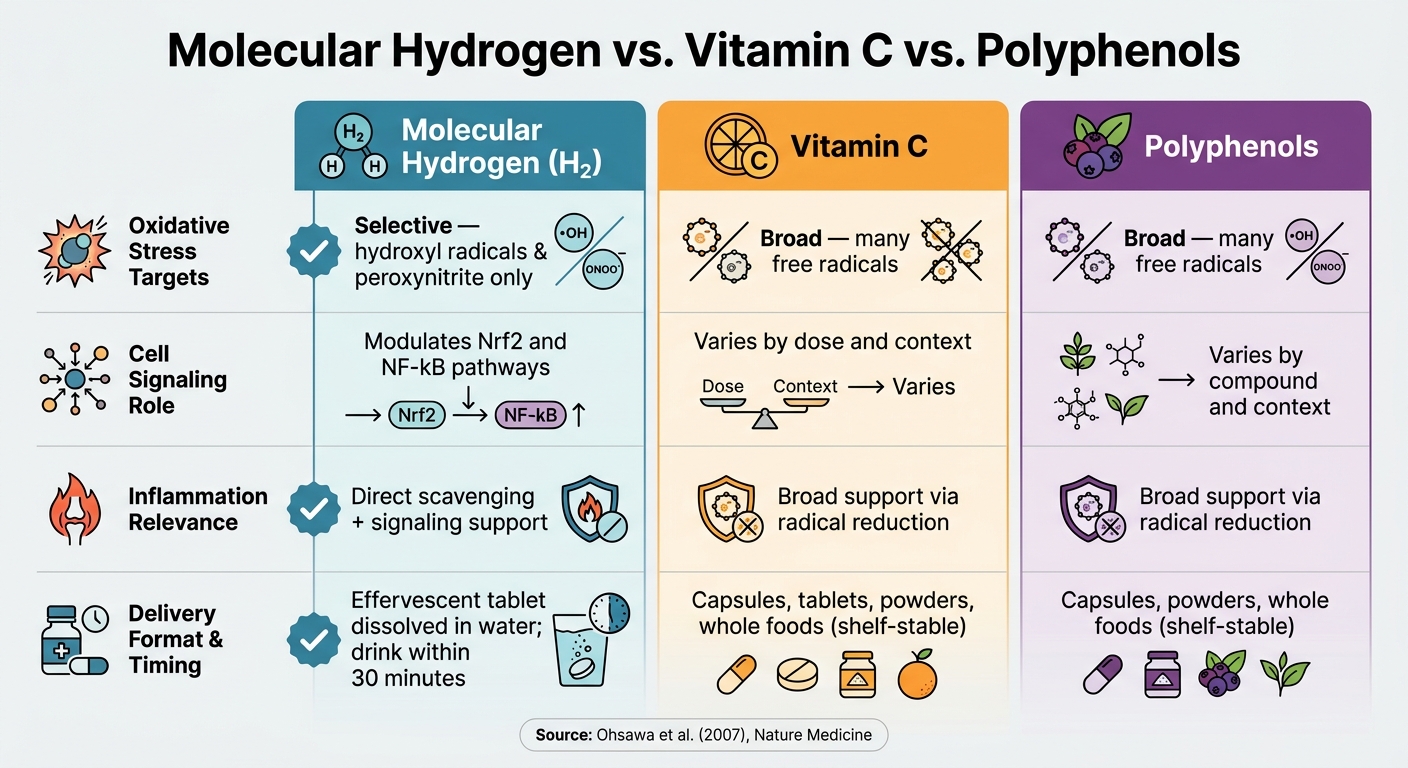
Molecular Hydrogen vs. Vitamin C vs. Polyphenols: Key Differences
| Factor | Molecular Hydrogen (H2) | Vitamin C | Polyphenols |
|---|---|---|---|
| Main action | Selective action on certain high-reactivity radicals | Broad antioxidant activity | Broad antioxidant activity |
| ROS focus | Hydroxyl radicals and peroxynitrite | Many free radicals | Many free radicals |
| Cell signaling role | Linked in the article to Nrf2 and NF-kB | Varies by dose and context | Varies by compound and context |
| How I’d use it | Mix in water and drink soon after | Capsules, tablets, powders, foods | Capsules, powders, foods |
| Main practical point | Timing matters after mixing | Usually shelf-stable | Usually shelf-stable |
One study cited in the article is from 2007 in Nature Medicine, and it is used to support the claim that hydrogen may act selectively on the most damaging radicals. From there, the article builds its case around those 3 core differences.
If you’re choosing between these options, the article’s bottom line is simple: broad antioxidant support and hydrogen-based support are not the same thing.
Why This Comparison Matters
Antioxidants are not interchangeable. Vitamin C, polyphenols, and molecular hydrogen affect oxidative stress in different ways.
Your body makes reactive oxygen species (ROS) all the time. In small amounts, ROS help with normal cell signaling. But when they build up faster than your body can handle them, they can add to oxidative stress. That’s where this comparison starts to matter.
Here’s the catch: not all ROS are bad. So the main issue isn’t just whether an antioxidant lowers ROS. It’s whether it lowers the damaging ROS without shutting down the ROS your body uses for normal signaling. A broad-spectrum antioxidant, like a vitamin C supplement or a polyphenol extract, can scavenge free radicals with little selectivity.
Molecular hydrogen works in a different way. It selectively targets the most cytotoxic free radicals - specifically hydroxyl radicals and peroxynitrite - while leaving beneficial ROS intact.[1] That difference matters because a compound’s effect depends on how it interacts with your body’s redox environment. In plain English: the kind of antioxidant matters just as much as the fact that it’s an antioxidant.
That difference in selectivity runs through the three differences below.
First, look at how molecular hydrogen differs from broad antioxidant activity.
References
- Ohsawa, I., et al. (2007). "Hydrogen acts as a therapeutic antioxidant by selectively reducing cytotoxic oxygen radicals." Nature Medicine, 13(6), 688–694. https://doi.org/10.1038/nm1577
1. Selective Targeting vs. Broad Antioxidant Activity
Vitamin C and polyphenols often work in a broad way across many ROS. Molecular hydrogen is different. It’s more selective, targeting hydroxyl radicals and peroxynitrite while leaving more useful ROS in place [1].
Its extremely small size also helps it move fast through tissues and cells, reaching places where larger molecules may not [1][2][4]. That makes it relevant not just for antioxidant support, but for broader oxidative stress control.
This matters even more when oxidative stress and inflammation show up at the same time.
2. Oxidative Stress and Inflammation Support
Oxidative stress and inflammation tend to feed each other. When free radicals build up faster than the body can neutralize them, they can add to inflammatory responses at the cellular level.
Molecular hydrogen may help disrupt that loop by modulating Nrf2 and NF-kB, which help support antioxidant defenses and inflammatory balance. Vitamin C and polyphenols also support antioxidant activity, but their effects depend on the compound, dose, and context.
Because it’s so small, molecular hydrogen can diffuse into cells and reach intracellular sites.
That process-level effect also helps explain how molecular hydrogen fits into daily use.
3. Daily Use and Delivery Format
That same small size changes how molecular hydrogen works in day-to-day use. Unlike common antioxidant supplements, molecular hydrogen needs fresh dissolution before you drink it. It has to be dissolved in water first, so freshness directly affects the amount you get.
Hydrogen also leaves water fast. So freshly made hydrogen water delivers more hydrogen than anything that’s been sitting around for a while [3][4].
Effervescent tablets make this pretty simple: drop one into cool or room-temperature water, let it fully dissolve, and drink it within 30 minutes. Skip hot water, since heat lowers hydrogen levels [2][3].
Edenvia Molecular Hydrogen uses this tablet format to make hydrogen-rich water easy to work into a daily routine.
Traditional antioxidant supplements are often shelf-stable and easy to take. But they don’t come with the same drink-it-fresh timing, because they aren’t delivering dissolved hydrogen gas. That hands-on difference shapes how molecular hydrogen fits into a daily wellness routine.
Quick Comparison Table
The table below gives you a fast side-by-side view of the three main differences.
| Factor | Molecular Hydrogen (H₂) | Vitamin C | Polyphenols |
|---|---|---|---|
| Oxidative Stress Targets | Selective: hydroxyl radicals, peroxynitrite [1][4] | Broad: many free radicals | Broad: many free radicals |
| Inflammation Relevance | Direct scavenging plus signaling support [1][2] | Broad support via radical reduction | Broad support via radical reduction |
| Common Format | Effervescent tablets; dissolve and drink fresh [2][3][4] | Capsules, tablets, powders, whole foods | Capsules, powders, whole foods |
Next, it helps to look at which delivery style best matches your routine and goals.
What to Keep in Mind Before Choosing a Daily Option
Start with your goal: broad antioxidant support or selective oxidative-stress support. That choice shapes how far each option can go and where it may act.
Size affects reach. H₂ is an exceptionally small molecule, which is why it can reach places larger antioxidants may not [1][3][4]. That tiny size also changes how you use it from day to day.
Hydrogen tablets need to be mixed fresh, unlike shelf-stable antioxidant supplements. Edenvia Molecular Hydrogen tablets follow that fresh-mixing format [2][3]. So this isn’t just about ingredients on a label. It’s also about what the routine looks like in real life.
At that point, one thing tends to matter most: consistency. The most useful option is the one you’ll keep using. The best fit is the one that matches your goal and your day-to-day routine.
Conclusion
Molecular hydrogen stands apart from common antioxidants in three main ways.
First, selectivity: H₂ selectively targets hydroxyl radicals and peroxynitrite while leaving beneficial reactive oxygen species intact [1].
Second, oxidative stress and inflammation support: H₂ supports oxidative-stress and inflammation balance, and its small size helps it diffuse inside cells, including mitochondria, where larger antioxidants may not reach as easily [1][4].
Third, delivery: molecular hydrogen is delivered as hydrogen-rich water after a tablet dissolves. If you use tablets, drink the solution soon after mixing so the hydrogen does not escape [2][3].
Results can vary based on the formulation, hydrogen output, baseline health, and how consistently you use it [2][3]. The right fit comes down to whether you want broad antioxidant support or more selective hydrogen-based support as part of your daily routine.
FAQs
Is molecular hydrogen stronger than antioxidants?
Molecular hydrogen is often described as one of the most powerful antioxidants in science. But its edge doesn't come from brute force. It comes from how it behaves.
Because it’s the smallest molecule, it can move fast and pass through cell membranes with ease. That small size gives it unusual reach inside the body.
It’s also selective. Instead of wiping out all reactive oxygen species, molecular hydrogen targets the harmful ones, such as hydroxyl radicals and peroxynitrite, while leaving the helpful reactive oxygen species alone.
Can I take molecular hydrogen with vitamin C?
Yes. You can use molecular hydrogen alongside supplements like vitamin C as part of your daily wellness routine.
Molecular hydrogen works differently from standard antioxidants. It selectively targets the most harmful free radicals while leaving helpful reactive oxygen species alone. In plain English, that means it can fit into your routine as an extra layer of cellular support and may help reduce oxidative stress.
How quickly should I drink hydrogen water?
For the best results, drink your hydrogen water right after the tablet finishes dissolving, or within 30 minutes at most.
That timing matters because while the reaction is still active, the water contains the highest concentration of molecular hydrogen.
Related Blog Posts
Disclaimer: These statements have not been evaluated by the Food and Drug Administration. This product is not intended to diagnose, treat, cure, or prevent any disease. This article is for general informational purposes only and is not medical advice. Consult a qualified healthcare provider before starting any supplement, especially if you are pregnant or nursing, have a medical condition, or take prescription medication.