

Molecular Hydrogen and Exercise Performance: Review
Here’s the short answer: molecular hydrogen is not a steady performance booster. From what I see in this review, it may help some people during hard, stop-and-go exercise, but the effects on endurance, VO2max, heart rate, and blood lactate are mixed or weak.
If you want the fast takeaway, it’s this:
- Best signal: hard efforts, repeated sprints, and some recovery markers
- Weak signal: steady endurance and maximal aerobic output
- Main issue: studies use different doses, timing, delivery methods, and fitness levels
- Practical point: if hydrogen water is used, it should be drunk soon after it’s made, often within 30 minutes
In plain English, I’d sum it up like this: the biology looks promising on paper, but the human performance results don’t line up well enough yet. Animal work points to lower oxidative stress and better ATP support under strain, but human trials have not shown a clear, repeatable effect across the board.
What this means for you: if your goal is a faster 5K, longer endurance, or a clear bump in VO2max, this review does not support a strong claim. If your goal is to cut fatigue during intense sessions or help recovery after hard training, there may be some upside, but the data is still limited.
This article breaks that down in a simple way, with a close look at performance, fatigue, lactate, oxygen use, and recovery.
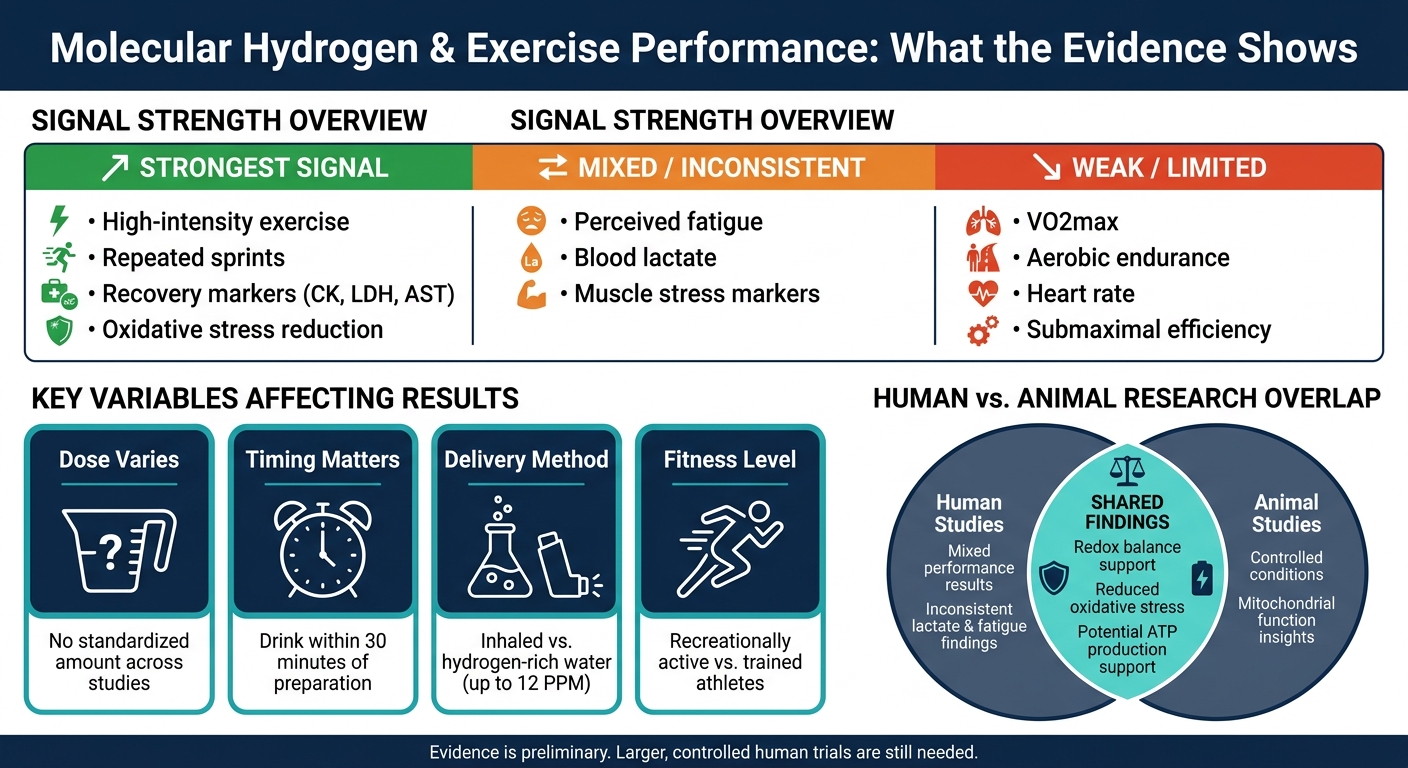
Molecular Hydrogen & Exercise Performance: What the Evidence Shows
Hydrogen Water for Bodybuilders: Benefits & Science Explained
sbb-itb-6860cc4
What Human Studies Show About Exercise Output
Human studies look at both recreationally active adults and trained athletes.
Acute use before exercise: where benefits appear
The results are modest. Some studies found lower perceived fatigue and small gains in short-duration performance. Others found no difference compared with a placebo. So while taking it right before exercise may help in some cases, it is not a consistent performance booster.
Aerobic endurance and maximal output: mostly limited effects
The data are weaker for VO2max and longer endurance performance, with no steady benefit [3]. That’s why researchers often look next at fatigue, lactate, and oxygen-use markers to see whether there may be smaller effects during exercise.
Tablet-generated hydrogen-rich water in research
Some studies use effervescent tablets that make hydrogen-rich water right before people drink it, reaching up to 12 PPM in a standard glass of water [2]. Researchers use this method in human trials because it lets hydrogen be generated fresh before drinking. From there, the next step is to see whether hydrogen changes fatigue, lactate, or oxygen-use markers during exercise.
Fatigue, Lactate, and Oxygen Use
Because performance results are mixed, researchers often look at fatigue, lactate, and oxygen-use markers next.
Perceived exertion and exercise fatigue
Perceived exertion and fatigue show up a lot in exercise research. That makes sense. If something helps performance, you’d expect people to feel less worn down too.
But that’s not what the data clearly shows. Human trials have not established a reliable reduction in fatigue.
Blood lactate and metabolic stress
If H2 changes exercise output, you’d also expect to see it in fatigue and metabolic stress markers. Blood lactate is one of the main ones researchers check.
So far, studies have not shown a steady drop in blood lactate. Lactate findings remain inconsistent across studies [3][1].
VO2, heart rate, and submaximal efficiency
Researchers also test whether H2 changes how well the body uses oxygen during exercise. This includes measures like VO2, heart rate, and submaximal efficiency.
Here too, the evidence is limited. Research has not shown consistent changes in VO2, heart rate, or submaximal efficiency [3][1].
Recovery, Muscle Stress, and Animal Research
Recovery markers after hard exercise
Human studies often look at CK, LDH, and AST to see how the body recovers after hard exercise. Those markers can show muscle stress and how much strain a workout may have caused.
Researchers also track oxidative stress and inflammatory markers. Why? Because molecular hydrogen may help limit exercise-related inflammation [1][2].
Animal studies give researchers another way to look at these same recovery pathways, but under tighter control.
What animal studies add
Mixed results in human studies can be hard to sort out. Animal research helps by testing the same pathways in more controlled settings, including oxidative stress, mitochondrial function, and inflammation.
That matters because it lets researchers isolate what may be happening at the cellular level. These studies suggest H₂ may support ATP production and reduce fatigue under physical stress [1][2].
Where human and animal findings overlap
When you compare the human and animal data, the clearest point of overlap is support for redox balance and control of oxidative stress [3].
That overlap helps put the mixed human recovery results in context. The biology may make sense even when workout outcomes don't line up neatly from one study to the next.
Limits of the Evidence and Key Takeaways
Why results vary across studies
The mixed findings above come down, in part, to a protocol issue. Studies don’t all use the same dose, timing, or delivery method. H₂ can be inhaled or taken in water-based form, and those methods can send different amounts of hydrogen into the body.
Dose also shifts based on how the hydrogen is prepared and delivered. There’s another wrinkle: hydrogen leaves solution fast, so the amount you actually get can drop if the water isn’t consumed soon after preparation [3]. On top of that, many studies have small sample sizes, short timelines, and different mixes of participant fitness levels and exercise protocols. Put all of that together, and it’s no surprise the results don’t line up neatly.
How to assess product relevance
So, product relevance comes down to one thing: does it match the research protocol? Using the same ingredient alone isn’t enough.
Tablet-based hydrogen water lines up with the method used in research if it’s prepared and consumed the same way it was in the trial. In plain English, timing matters. Drink it soon after the tablet dissolves, ideally within 30 minutes, before the hydrogen dissipates [5][4].
Bottom line from this review
The strongest signal in the evidence is around fatigue, lactate, and recovery, especially during high-intensity or intermittent exercise. By contrast, effects on aerobic endurance and maximal output are still weak and inconsistent [2].
That’s why larger, better-controlled human trials are still needed before anyone can say with confidence who benefits most, what dose works best, and under which training conditions [3].
FAQs
Who may benefit most from molecular hydrogen?
Those most likely to get the most from this are people looking for support with oxidative stress and inflammation, especially active adults and athletes who care about energy, fatigue, recovery, and cellular health.
Edenvia’s materials also say it may be a fit for people dealing with afternoon slumps, brain fog, or slower physical recovery and who want deeper antioxidant support.
Why are study results so inconsistent?
Results often vary because studies don’t all test the same thing in the same way.
Some use different delivery methods. Others change the hydrogen concentration, the timing of the dose, or the protocol itself. That means one study can look quite different from the next, which helps explain why outcomes may not line up neatly.
Hydrogen-rich water can lose potency fast. Effervescent tablets like Edenvia’s are meant to create high concentrations right when you use them, which may help reduce that issue.
There’s another layer too: the cellular environments being measured can differ from one study to another. And when the setting changes, the results can change with it.
When should hydrogen water be consumed?
For best results, take Edenvia molecular hydrogen tablets once a day, ideally in the morning.
Drop 1 tablet into a glass of room-temperature or chilled water. Let it dissolve for 3 to 5 minutes, then drink it right away while the reaction is still happening. Use the prepared water within 30 minutes.
Related Blog Posts
Disclaimer: These statements have not been evaluated by the Food and Drug Administration. This product is not intended to diagnose, treat, cure, or prevent any disease. This article is for general informational purposes only and is not medical advice. Consult a qualified healthcare provider before starting any supplement, especially if you are pregnant or nursing, have a medical condition, or take prescription medication.