

Hydrogen-Rich Water and Gut Microbiota During Detox
Short answer: maybe a little for oxidative stress, not proven for “detox,” and not clearly shown to reshape the gut microbiome in a big way.
If you’re looking at hydrogen-rich water (HRW) for gut support during a detox routine, here’s the plain takeaway:
- Human research is still small and early
- Some studies found minor microbiome changes, like higher Bifidobacterium
- The clearest pattern is around oxidative stress, not major gut-bacteria shifts
- “Detox” is a marketing term, not a set medical outcome
- Tablet ingredients matter because some products also contain magnesium, which can affect digestion on its own
A few studies in adults and athletes reported changes in stool consistency or gut bacteria. But those studies were short, small, or done in narrow groups. Animal work adds more detail, including changes in SCFAs, barrier markers, and stress-response pathways like Nrf2/HO-1 and SIRT1. Still, that does not prove the same thing happens when you drop a tablet into about 12 oz of water at home.
Here’s the bottom line I’d use: HRW may help support a lower-stress gut setting, but claims about detox or major microbiome repair go past what the data shows today, Sep 25, 2026.
What I’d keep in mind:
- Best-supported angle: oxidative-stress support
- Less clear: gut lining support in everyday use
- Still unproven: detox effects
- Easy mistake: treating small microbiome shifts as proof of better health
If you’re pregnant, nursing, taking medicines like PPIs or statins, or have a long-term digestive issue, I’d treat HRW as something to discuss with a clinician first.
That’s the article in one view: some early signals, a lot of limits, and no solid proof that hydrogen-rich water “detoxes” the gut.
Is Hydrogen the Key to Gut Health? (Before You Try More Probiotics…)
sbb-itb-6860cc4
How Oxidative Stress, Gut Lining Stress, and Microbial Balance Are Connected
These links matter because oxidative stress can affect both barrier function and microbial balance.
How Oxidative Stress May Strain the Gut Lining
Oxidative stress can fuel inflammation and cell stress in digestive tissue. If that stress drops, the gut lining may be better able to hold up. Molecular hydrogen is being studied as a selective antioxidant that may lower oxidative stress without broadly shutting down normal signaling.
During detox-focused routines, the big question is simple: does lower oxidative stress lead to a steadier gut environment? That naturally leads to the next point - whether HRW changes the gut environment enough to make a difference.
How the Microbiota and Gut Lining Influence Each Other
The microbiota and gut lining affect each other both ways. Some gut bacteria naturally make hydrogen during carbohydrate digestion, which suggests H₂ is already part of the gut’s chemical environment. Even so, it’s still unclear whether hydrogen-rich water changes that environment enough to matter in detox-focused wellness use.
Table: Proposed Mechanisms vs. What Studies Actually Measure
| Proposed Mechanism | Common Research Readouts | Evidence Status |
|---|---|---|
| Oxidative stress reduction | Oxidative-stress markers and related signaling | Early evidence |
| Gut lining support | Barrier-function and digestive comfort markers | Limited evidence |
| Microbial balance | Stool microbiome shifts and fermentation markers | Early evidence |
| Inflammation modulation | Inflammatory markers and cellular stress markers | Preliminary evidence |
The next section shows how human and animal studies line up - or don’t - with these proposed mechanisms.
What Human and Animal Research Reports
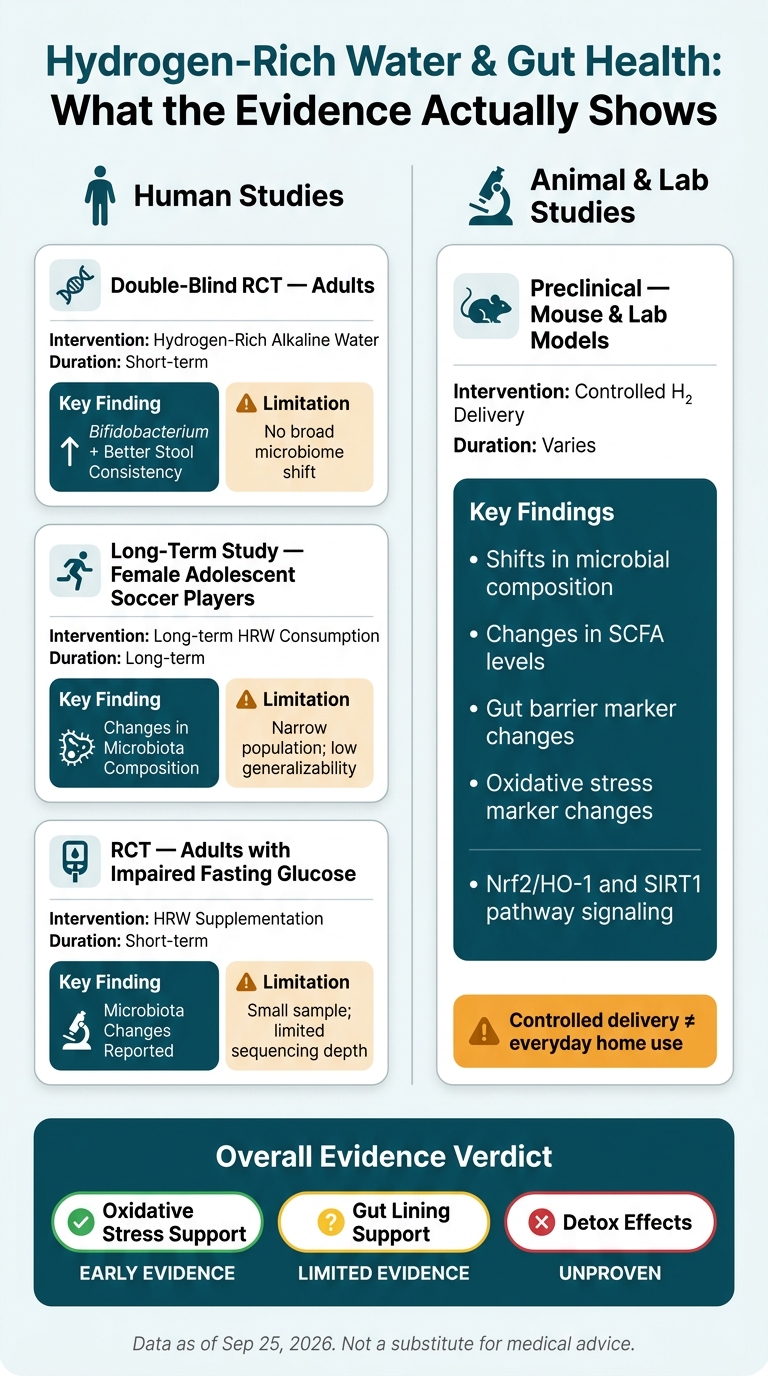
Hydrogen-Rich Water & Gut Health: What the Evidence Actually Shows
The main question isn't whether HRW can affect the gut. It's whether those changes mean anything that people can feel or use.
The ideas from the previous section give us a starting point. But when you look at the studies themselves, the picture gets murkier.
Human Studies: Early Signals and Limited Certainty
The human evidence is still thin. Right now, the most relevant data comes from three small human studies.
One double-blind randomized trial on hydrogen-rich alkaline water found better stool consistency and higher Bifidobacterium. But it did not show a broad shift across the microbiome.
For readers focused on detox, that's the sticking point. Are these changes a sign of gut support, or are they just small-study noise?
Another long-term study looked at female adolescent soccer players who drank HRW over time. Researchers reported changes in microbiota composition. Still, this was a very specific group, which makes it hard to apply the findings to the average adult user.
A third randomized study involved adults with impaired fasting glucose. That study also reported microbiota changes. Even so, the sample was small, the study period was short, and the sequencing depth was limited. So these findings are best viewed as early signals, not proof of detox effects or clear clinical gain.
Taken together, the studies hint at possible gut effects. They just don't tell us how much confidence those hints deserve.
Animal and Lab Studies: Mechanisms Worth Noting
Preclinical work helps fill in parts of the story that human trials still can't answer.
Mouse and other lab studies have reported shifts in microbial composition, short-chain fatty acid (SCFA) levels, gut barrier markers, and oxidative stress markers. Some papers also point to Nrf2/HO-1 and SIRT1 as stress-response pathways that may be involved.
That matters because it links three pieces of the puzzle:
- oxidative stress
- barrier function
- microbial balance
Still, there's a catch. Animal studies use tightly controlled dosing and delivery. That's a long way from tossing a tablet into a glass of water at home. So while the mechanism looks plausible, everyday use remains unproven.
That's why the next section looks closely at study limits, especially the problems that come up in microbiome research.
Table: Research Summary by Study Type, Design, Outcomes, and Limits
| Study Type | Population or Model | Intervention | Duration | Microbiota Method | Reported Outcome | Main Limitation |
|---|---|---|---|---|---|---|
| Human RCT | Adult participants | Hydrogen-rich alkaline water | Short-term | Not specified | Better stool consistency; higher Bifidobacterium; no broad microbiome shift | Limited certainty about clinical meaning |
| Human study | Female adolescent soccer players | Long-term HRW consumption | Long-term | Not fully reported | Changes in microbiota composition | Small, specific population; limited generalizability |
| Human RCT | Adults with impaired fasting glucose | HRW supplementation | Short-term | Not specified | Microbiota changes reported | Small sample size; short duration; limited sequencing depth |
| Animal/preclinical | Mouse and lab models | Controlled H₂ delivery | Varies | 16S rRNA sequencing; SCFA analysis | Changes in microbial composition, SCFAs, barrier markers, oxidative stress markers, Nrf2/HO-1 and SIRT1 signaling | Controlled delivery methods do not reflect everyday human use |
Limits of the Current Evidence and How to Read It Carefully
Even with these findings, the main issue is how the results are read. The evidence is still preliminary, and the biggest risk is reading too much into small shifts in the microbiome.
Why Microbiome Results Are Easy to Overinterpret
Microbiome studies may show that one group of microbes goes up while another goes down. But that is still a compositional change. It does not prove better gut health or a detox effect.
Things get messier from there. Studies often differ on hydrogen concentration, dissolve time, dosing instructions, diet, exercise, medications, and starting health status. That makes side-by-side comparison tough. And there’s another wrinkle: some tablets contain magnesium. So if a study reports digestive effects, it may not be fair to pin those results on hydrogen alone.
Table: Strengths and Weaknesses of the Evidence Base
| Category | Strengths | Weaknesses |
|---|---|---|
| Study Design | Increasing use of randomized, peer-reviewed designs | Human trials are often small and short-term |
| Mechanisms | Molecular hydrogen is of interest for its selective antioxidant properties | Most mechanistic evidence comes from animal or lab models, not confirmed in humans |
| Protocols | Some studies use repeated biological measurements | Hydrogen concentration, water composition, and dosing instructions vary widely |
| Outcomes | Some studies report measurable shifts in oxidative stress markers | Endpoints are often indirect; microbiome shifts do not automatically equal clinical benefit |
| Confounding | Some trials try to account for diet and baseline health | Diet, exercise, medications, magnesium content, and bowel habits can all affect results |
| Safety & Regulation | Molecular hydrogen is generally considered non-toxic for consumption | Limited long-term safety data |
| Replication | A few studies point to consistent signals in specific markers | Results have not been widely replicated across larger, more diverse populations |
These limits matter when reading the study summary above and the practical takeaways that follow.
Practical Takeaways and a Note on Edenvia Molecular Hydrogen
What Readers Can Reasonably Take From the Research
Taken together, the studies show a narrow but steady pattern: HRW seems more tied to oxidative stress than to major microbiota changes. Based on the research so far, HRW may help lower oxidative stress in the gut lining and may support digestive comfort [1][3][4].
That said, the human data is still early and limited. So it makes sense to read these results as preliminary, not settled fact [2].
The evidence also does not show that HRW is a proven detox treatment. A better way to read the current data is this: these are early signals worth watching, not proof of broad health effects.
A Note on Edenvia Molecular Hydrogen
For readers looking into hydrogen-rich water as part of a wellness routine, Edenvia Molecular Hydrogen is one product in this space. Edenvia sells effervescent tablets that dissolve in water to make hydrogen-rich water. That gives you molecular hydrogen in water and may help support antioxidant activity [1].
Just keep the line clear here. That product description reflects how Edenvia is marketed. It is separate from what the studies above prove, and it should not be taken as evidence that any HRW product treats or cures any condition.
If you are pregnant, nursing, taking prescription medications such as PPIs or statins, or dealing with a chronic digestive condition, talk with a qualified healthcare professional before using hydrogen-rich water tablets [2].
Conclusion: Key Points to Carry Forward
The main takeaway is pretty simple: HRW looks promising for oxidative stress, but its role in detox and microbiome change is still unproven. The most useful way to read the current evidence is as a sign of possible oxidative-stress support, not proof of detoxification [3][4][2].
FAQs
Can hydrogen-rich water actually improve gut health?
Hydrogen-rich water may help support gut health by lowering oxidative stress in the gut lining. That matters because less stress on those tissues can help support more comfortable digestion, ease bloating, and help the body keep normal nutrient absorption on track.
It may also help support esophageal comfort and cellular balance across the digestive tract. That said, the research is still early, and more clinical studies are needed to confirm these effects.
Does hydrogen-rich water do anything beyond oxidative stress support?
Yes. Research suggests hydrogen-rich water may do more than support the body’s response to oxidative stress. It may also help with mitochondrial function for ATP energy production, cellular hydration, and anti-inflammatory support.
It has also been linked to metabolic and glucose regulation, neuroprotection, and cardiovascular health. Edenvia Molecular Hydrogen tablets are designed to support cellular health and overall wellness.
Who should talk to a clinician before trying hydrogen-rich water?
Anyone thinking about trying hydrogen-rich water should talk with a healthcare professional first.
That conversation can help you figure out whether it’s safe and a good fit for your own health needs.
Related Blog Posts
Disclaimer: These statements have not been evaluated by the Food and Drug Administration. This product is not intended to diagnose, treat, cure, or prevent any disease. This article is for general informational purposes only and is not medical advice. Consult a qualified healthcare provider before starting any supplement, especially if you are pregnant or nursing, have a medical condition, or take prescription medication.