

Molecular Hydrogen Mechanisms: Oxidative Stress Guide
Molecular hydrogen (H₂) is being studied because it may lower some of the most damaging oxidants without shutting down the reactive molecules your body uses for normal cell signaling. That is the main idea.
Here’s the short version:
- Oxidative stress happens when reactive molecules build up faster than the body can control them.
- Not all reactive species are bad. Some help with signaling, blood flow, and normal cell function.
- H₂ appears selective in lab research, with attention on hydroxyl radicals and peroxynitrite rather than broad removal of all ROS/RNS.
- Human research is still limited. Small studies have looked at exercise fatigue, recovery, cholesterol, and glucose markers.
- Hydrogen-rich water loses gas fast, so timing matters. Many tablet products are used in 12 oz (350 mL) of water and then consumed within 30 minutes.
- Tablet-based products often claim 8 to 12 ppm dissolved hydrogen per serving.
If I strip the topic down to one point, it’s this: the science is more about balance than “more antioxidant = better.” H₂ is being studied for selective redox effects, but human results are not settled.
| Topic | What the article says |
|---|---|
| Main mechanism | H₂ may act on highly reactive oxidants while leaving useful signaling molecules alone |
| Cell access | Because H₂ is very small, it can move across membranes and reach areas like mitochondria |
| Human evidence | Early and limited; includes small studies on metabolic markers and exercise-related outcomes |
| Use in water | Effervescent tablets release H₂ into water, but the gas escapes fast |
| Practical use | Dissolve fully, use cool or room-temp water, and drink soon after preparation |
I’ll keep the rest simple: what oxidative stress is, where H₂ may fit, what tablet-made hydrogen water does, and where the evidence still has gaps.
Molecular Hydrogen Benefits, Oxidative Stress and Autophagy - Tyler LeBaron
sbb-itb-6860cc4
Oxidative Stress, Reactive Species, and Redox Signaling
ROS and RNS help cells communicate when their levels stay under control. Oxidative stress starts when their production moves past the body’s antioxidant defenses. That distinction matters because molecular hydrogen does not seem to work like a broad, wipe-it-all-out antioxidant. It appears to act more selectively.
The Main Molecules: Superoxide, Hydrogen Peroxide, Hydroxyl Radical, Nitric Oxide, and Peroxynitrite
Not all reactive species do the same job. Some help run normal signaling. Others are mostly tied to damage. That’s why selective antioxidant action matters so much.
Superoxide is an ROS involved in normal cell signaling. Hydrogen peroxide is another ROS the body uses in signaling pathways. Nitric oxide is an RNS that plays a central role in vascular signaling and blood flow. The hydroxyl radical, by contrast, is highly reactive and has no known signaling role. So when molecular hydrogen is called selective, the idea is pretty simple: it may act on the most reactive oxidants while leaving useful signaling species alone.
Normal Signaling Versus Oxidative Overload
The difference between signaling and stress comes down to balance. Within a normal range, reactive species support cell function. Once levels climb past what the body can handle, damage, signaling errors, and inflammation often show up at the same time.
| Molecule | Type | Normal Role | When Levels Become Excessive |
|---|---|---|---|
| Superoxide | ROS | Essential signaling molecule | Contributes to general oxidative strain |
| Hydrogen Peroxide | ROS | Beneficial signaling species required by the body | Can contribute to oxidative overload if not regulated |
| Nitric Oxide | RNS | Critical for vascular signaling and blood flow | Can react with superoxide to form peroxynitrite |
| Hydroxyl Radical | ROS | Highly reactive; no known signaling role | Causes direct damage to DNA, proteins, and cell membranes |
| Peroxynitrite | RNS | Highly reactive, damaging oxidant | Contributes to cellular damage and inflammatory stress |
When oxidative stress rises, the problem usually isn’t just one thing. Damage, signaling errors, and inflammation tend to feed into each other. Oxidized LDL can add fuel to inflammation, and that cycle can keep going when oxidative stress is left unchecked.
That selective pattern is the starting point for understanding how molecular hydrogen may work.
How Molecular Hydrogen May Work
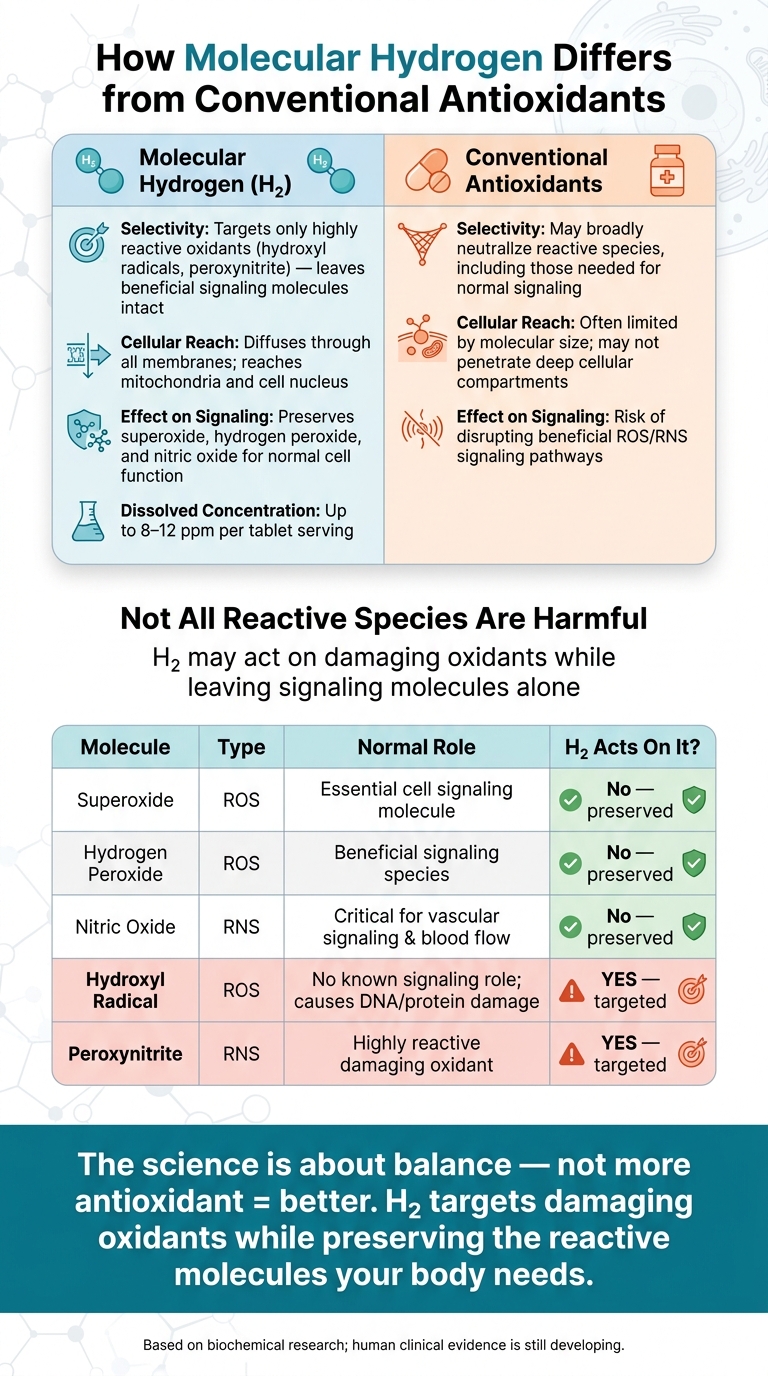
Molecular Hydrogen vs. Conventional Antioxidants: Selective Redox Action Explained
Oxidative stress comes down to balance. So the main issue is pretty simple: where does H₂ act, and what does it leave untouched?
Molecular hydrogen (H₂) is a tiny, nonpolar gas that diffuses across membranes and can reach mitochondria and the cell nucleus. [1]
Selective Action on Highly Reactive Oxidants
A lot of the interest in H₂ comes from its selectivity. H₂ may target hydroxyl radicals and peroxynitrite while leaving normal signaling species alone. [2]
| Feature | Molecular Hydrogen (H₂) | Conventional Antioxidants |
|---|---|---|
| Selectivity | Targets highly reactive oxidants like hydroxyl radicals and peroxynitrite [2] | May broadly neutralize reactive species, including those needed for signaling |
| Cellular Reach | Rapidly diffuses through membranes and can reach mitochondria and the nucleus [1] | Often limited by size and may not penetrate deep cellular compartments |
That direct selectivity is only one piece of the puzzle. The next point is whether H₂ also changes the cell's own defense systems.
Indirect Effects on Antioxidant Defenses, Inflammation, and Mitochondria
Beyond direct scavenging, H₂ may support endogenous antioxidant defenses, mitochondrial function, and inflammation control, but these effects are still being studied. [3]
From Hydrogen-Rich Water to Daily Use
Once the mechanism is clear, the next step is practical: how do you get H₂ into water and drink it before it disappears?
How Dissolving Tablets Create Hydrogen-Rich Water
Effervescent tablets make hydrogen-rich water through a chemical reaction, often using magnesium, that releases molecular hydrogen (H₂) into the water as soon as the tablet touches it [3][5]. High-quality tablets can produce 8 to 12 ppm (parts per million) of dissolved H₂ per serving [3][6].
The catch is simple: H₂ escapes fast. So a few basic habits can help keep more of it in the water long enough to drink:
- Use room-temperature or chilled water.
- Let the tablet dissolve for 3 to 5 minutes.
- Drink within 30 minutes.
- Do not swallow the tablet whole - it must dissolve completely before drinking.
The usual prep is one tablet in 12 oz (350 mL) of water [3]. Tablets come individually sealed in foil sachets to keep moisture out before use, since even a little moisture can start the reaction too early [3][6]. That’s why both prep time and drinking time matter.
Where Edenvia Molecular Hydrogen Fits in a Wellness Routine
For day-to-day use, Edenvia Molecular Hydrogen tablets are meant to make that process simple. They’re intended for once-daily morning use [4][3], and each tablet is formulated to generate up to 12 ppm of molecular hydrogen [3]. Edenvia Molecular Hydrogen tablets are designed to support antioxidant defenses and everyday wellness.
| Feature | Edenvia Molecular Hydrogen |
|---|---|
| Delivery Format | Effervescent tablet dissolved in 12 oz (350 mL) of room-temperature or chilled water [4][6] |
| Clinical Uncertainties | Human research is still developing, so long-term outcomes remain under study [1] |
Evidence, Safety, and Key Takeaways
What the Evidence Supports Today
A lab mechanism can show why something might work. Human research shows whether that idea holds up in practice.
In this case, the selective antioxidant mechanism has support from biochemical research. That gives the theory some footing. But the bigger question is how much support comes from studies in people.
So far, early human trials suggest possible effects on metabolic markers, including cholesterol and glucose regulation. There’s also limited evidence that H₂ may help reduce exercise fatigue and support recovery after physical activity [3][4][5].
Safe Use and Final Summary
Even when the mechanism looks promising, day-to-day use comes down to a few plain factors: dose, timing, and how well a person handles it.
For daily use, safety depends on following the label. Molecular hydrogen is generally well tolerated at tablet-generated concentrations. Use it as directed: dissolve one tablet in room-temperature or chilled water and drink it within 30 minutes. Do not swallow the tablet directly.
The bottom line is fairly simple: the selective antioxidant mechanism is well supported, but the human evidence is still developing. That means expectations should stay realistic.
References
- Ohsawa, I., et al. "Molecular hydrogen vs. traditional antioxidants shows how hydrogen acts as a therapeutic antioxidant by selectively reducing cytotoxic oxygen radicals." Nature Medicine, 2007. https://www.nature.com/articles/nm1577
- Ichihara, M., et al. "Beneficial biological effects and the underlying mechanisms of molecular hydrogen - comprehensive review of 321 original articles." Medical Gas Research, 2015. https://www.ncbi.nlm.nih.gov/pmc/articles/PMC4610055/
- Nakao, A., et al. "Effectiveness of hydrogen rich water on antioxidant status of subjects with potential metabolic syndrome." BMC Proceedings, 2010. https://www.ncbi.nlm.nih.gov/pmc/articles/PMC2956773/
- Aoki, K., et al. "Pilot study: Effects of drinking hydrogen-rich water on muscle fatigue caused by acute exercise in elite athletes." Medical Gas Research, 2012. https://www.ncbi.nlm.nih.gov/pmc/articles/PMC3395574/
- Kajiyama, S., et al. "Supplementation of hydrogen-rich water improves lipid and glucose metabolism in patients with type 2 diabetes or impaired glucose tolerance." Nutrition Research, 2008. https://pubmed.ncbi.nlm.nih.gov/19083400/
- LeBaron, T.W., et al. "Molecular hydrogen: An overview of its potential utility as a self-limiting selective antioxidant." Free Radical Research, 2019. https://pubmed.ncbi.nlm.nih.gov/31204498/
FAQs
Can molecular hydrogen lower oxidative stress without blocking normal cell signaling?
Yes. Molecular hydrogen may help lower oxidative stress without getting in the way of normal cell signaling because it is selective.
It appears to target some of the most harmful free radicals, including hydroxyl radicals and peroxynitrite, while leaving the reactive oxygen species tied to essential body functions largely undisturbed. Edenvia molecular hydrogen tablets support the body’s natural defense against oxidative stress without disrupting key signaling pathways.
How long does hydrogen stay in water after a tablet dissolves?
Once an Edenvia molecular hydrogen tablet dissolves in water, drink it within 30 minutes to help make sure it works as intended.
What do human studies show about hydrogen-rich water?
Human studies and early research suggest that molecular hydrogen may work as a selective antioxidant. In plain English, that means it may help neutralize harmful free radicals without wiping out the reactive oxygen species your body still uses for normal cell signaling.
That balance is a big reason researchers are paying attention. Clinical interest has focused on whether molecular hydrogen may help lower inflammation markers, support metabolic health, protect neurological function, and improve cardiovascular resilience and mitochondrial function.
The early findings look promising. At the same time, larger clinical studies are still needed.
Related Blog Posts
Disclaimer: These statements have not been evaluated by the Food and Drug Administration. This product is not intended to diagnose, treat, cure, or prevent any disease. This article is for general informational purposes only and is not medical advice. Consult a qualified healthcare provider before starting any supplement, especially if you are pregnant or nursing, have a medical condition, or take prescription medication.