

Hydrogen-Rich Water and Cellular Aging Markers: 6 Facts
Short answer: the research shows a few early biomarker shifts, but it does not show that hydrogen-rich water slows aging or extends life.
If you’re looking at this topic for anti-aging reasons, here’s the plain-English version:
- One small human trial reported a telomere-length signal after 6 months
- Another controlled human trial found no clear hydrogen-specific change in 8-OHdG, a marker of oxidative DNA damage
- Antioxidant markers like SOD, catalase, and glutathione may change, but results are mixed
- MDA, a lipid-oxidation marker, also shows mixed results and may depend on the group studied
- Cell studies suggest H₂ may affect redox balance, ROS, senescence signaling, and telomerase
- None of these biomarker changes prove slower aging in humans
Here’s the key point: biomarkers are not lifespan outcomes. A shift in telomeres, oxidative stress, or antioxidant activity can show cell stress changed. It does not show that you will live longer, stay healthier longer, or age more slowly.
Quick Comparison
| Fact | Evidence type | What it found | What it does not show |
|---|---|---|---|
| Telomere-length signal | Small human randomized pilot | Early telomere signal after 6 months | Proof of slower aging |
| 8-OHdG result | Controlled human trial | No clear difference vs. control | Clear DNA-protection effect in people |
| Antioxidant markers | Small human studies | Some shifts in SOD, catalase, glutathione | Human longevity effect |
| MDA | Human trial data | Mixed short-term lipid-oxidation results | Steady anti-aging outcome |
| Redox/senescence signaling | Cell-culture research | Lab effects on ROS and stress signaling | Whole-body human effect |
| Telomerase | In vitro research | Lab signal in isolated cells | Telomere support in people |
So if I sum it up in one line, it’s this: the evidence is early, mixed, and mostly limited to short-term marker changes rather than human aging outcomes.
That’s the lens I’d use for the rest of the article.
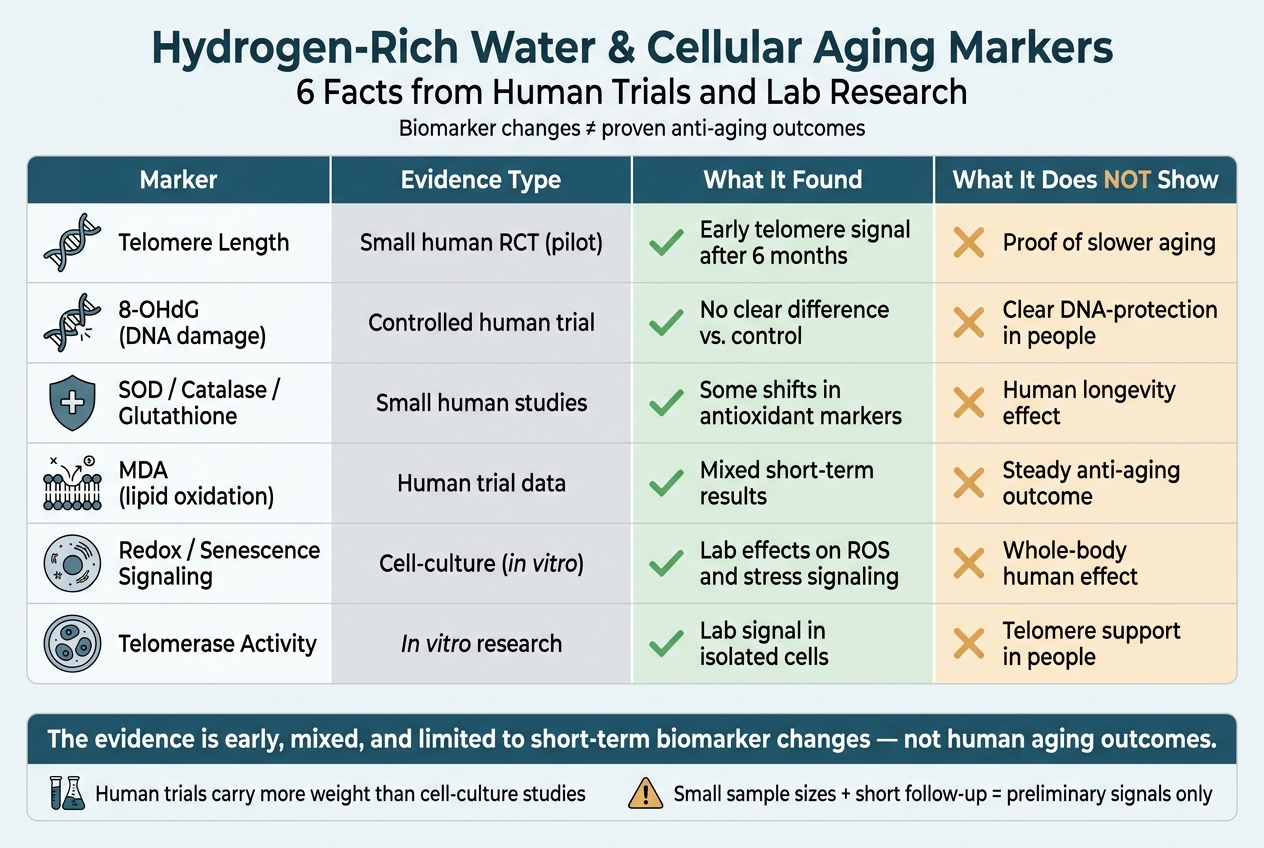
Hydrogen-Rich Water & Aging Markers: What the Evidence Shows vs. What It Doesn't
Tyler LeBaron: Hydrogen Water, Mitochondrial Health, Selective Antioxidants, & Longevity | TUH #265
sbb-itb-6860cc4
Cellular Aging Markers Used in This Article
These markers are used in hydrogen-rich water research to track cell stress, oxidative damage, redox balance, and stress response inside cells. They can help show what's happening in a lab or study setting, but they do not prove that aging is slower or faster in humans. In this article, they serve as context for the studies that follow.
Telomeres and Telomerase
Telomere length and telomerase activity are aging-related research markers. That said, a change in either one does not establish slower aging in humans.
Oxidative DNA and Lipid-Oxidation Markers
8-OHdG and MDA measure oxidative DNA damage and lipid damage, respectively. These are lab markers of cellular stress, not aging outcomes. [3]
Antioxidant Capacity and Senescence Signaling
Glutathione, superoxide dismutase, and catalase reflect redox balance and antioxidant defense. [2][1] Senescence signaling is a lab readout of cell stress response, not a clinical diagnosis. [3]
The studies below use these markers to test whether hydrogen-rich water may support cellular resilience.
| Marker | What It Reflects |
|---|---|
| Telomere length | Aging-related research marker |
| Telomerase activity | Aging-related research marker |
| 8-OHdG | Oxidative damage to DNA |
| MDA | Lipid oxidation |
| SOD / Catalase / Glutathione | Redox balance and antioxidant defense |
| Senescence signaling | Cellular stress response patterns |
These markers set up the six facts that follow, starting with human telomere findings.
How to Read the Evidence
These facts matter most when you separate human evidence from lab signals. The six facts below pull from human and preclinical studies. Human data matters most because it shows what happened in actual people. Cell and animal studies can help explain what may be happening inside cells, but they don’t prove the same thing happens in humans.
Human Trials vs. Preclinical Studies
Human trials track what happens in people under controlled conditions. That makes them the most directly relevant kind of evidence.
Preclinical studies - cell-culture and animal research - are still useful. They can show possible mechanisms and help explain changes in telomere length, oxidative damage, and redox markers. But there’s a big difference between showing a lab effect and showing a human effect. That’s why each fact below labels the study type.
Why Control Groups Matter
Study design changes how much weight a result deserves.
A trial usually compares a molecular hydrogen group with a control group, such as plain water or a placebo. That comparison is a big deal. If both groups change in about the same way, the result may come from normal variation or placebo effects, not hydrogen itself.
When a study reports only within-group changes and skips a control comparison, that’s a real limitation. It doesn’t make the study useless. It just means you should read the result with more caution.
Biomarker Changes Are Not Clinical Outcomes
A biomarker change means a marker of cellular stress moved. It does not mean slower aging. It also does not mean a clinical outcome changed.
That’s the line to keep in mind as you read the next section. Every fact below states what the data shows - and where the evidence stops. Fact 1 starts with a small human pilot on telomere length.
1. A Small Randomized Pilot Trial Reported a Telomere-Length Signal
A small randomized human pilot reported an early signal in telomere length [1].
That matters because randomization makes the comparison stronger. But there’s a catch: the sample was small, which means normal variation could still explain the result.
So this finding is best treated as an early signal, not proof of a human longevity outcome. It’s useful in that narrow sense: a sign worth paying attention to, but not something that settles the question.
2. A Controlled Human Trial Found No Clear Hydrogen-Specific Effect on 8-OHdG
In this controlled human trial, 8-OHdG didn't show a clear difference between the hydrogen and control groups [2]. That matters because it pushes back on the telomere signal in Fact 1: some markers appear to move, while others don't.
So the picture isn't clean-cut. At this stage, the evidence is still preliminary.
Fact 3 turns to antioxidant-capacity markers.
3. Antioxidant-Capacity Markers May Shift, but Are Not Longevity Outcomes
After DNA damage markers, the next step is antioxidant defenses.
Right now, the human research is small, short-term, and still in its early phase. That means findings on antioxidant capacity are preliminary. Researchers usually look at markers like SOD, catalase, and glutathione to track redox balance. Molecular hydrogen is often described as a selective antioxidant that may help support that balance.[1][2]
That said, the results don't line up neatly. Reported changes in these markers vary from study to study, and in some cases they aren't clearly different from placebo or from baseline levels.[1]
This part matters: a bump in SOD activity or a drop in oxidative-stress markers does not mean aging has slowed. Those are lab signals, not proof of a longer life or a slower aging process. For now, they should be viewed as early hints rather than established longevity outcomes.[1][3]
Fact 4 moves to lipid-oxidation markers such as MDA.
4. Lipid-Oxidation Markers Such as MDA Show Mixed, Population-Specific Results
MDA adds a lipid-oxidation readout, so it widens the redox picture beyond antioxidant defense and DNA damage. Put simply, it gives you another angle on what’s happening. But the results depend on the group being studied, which means this marker points to early signals, not an established aging outcome.
Researchers track malondialdehyde (MDA) as a lipid-oxidation marker in redox-stress studies. That makes this fact different from the earlier sections on 8-OHdG and antioxidant capacity. MDA helps show whether molecular hydrogen may support redox balance at the lipid level.
These findings are still early and are usually measured over 2 to 8 weeks, so they reflect short-term biomarker shifts rather than long-term aging outcomes.[3] That distinction matters. A drop from baseline may look good at first glance, but the better way to read MDA data is against the control group, not baseline alone. Since results vary by population, MDA changes should be treated as biomarker movement, not a confirmed aging-related outcome.
Fact 5 moves from damage markers to cell signaling.
5. Cell-Culture Research Suggests Molecular Hydrogen May Support Redox and Senescence Signaling
Evidence Type
After the short-term biomarker data above, this section looks at how H₂ may support redox and senescence signaling in isolated cells. The evidence here comes from in vitro cell-culture work, so it can show direct effects inside cells, but it does not tell us what happens across the whole body.
Marker Measured
Researchers have measured ROS and senescence signaling, which is tied to cellular growth arrest. In plain English, this is about whether cells are dealing with damaging oxidative stress and whether they start shifting into a state where growth slows or stops.
H₂ may support a selective antioxidant response that lowers harmful radicals without broadly suppressing normal signaling. [2]
Key Limitation
Cell-culture findings are early mechanistic signals. They can point to how something might work, which is useful, but they do not show the same effect in humans or prove any anti-aging outcome. [1]
Fact 6 stays in vitro and turns to telomerase activity.
6. Telomerase Findings Come from In-Vitro Research, Not Established Human Outcomes
Building on the redox and senescence signals above, this point narrows in on telomerase.
Study Type
The evidence here comes from in vitro cell-culture studies. That means researchers looked at isolated cells in a lab, not people. So this is a lab signal, not a human result.
What Was Measured
Telomerase helps maintain telomeres, and cell studies have tested whether H₂ changes telomerase activity in isolated cells.[1]
Key Limitation
This is a mechanistic signal only. In plain English, it shows what may be happening at the cell level under lab conditions, but it does not prove telomere support in people.
The next section separates these lab signals from what the evidence does and does not show.
What the Evidence Does and Does Not Show
Current Evidence Limits
Put together, these six facts point to early signals tied to telomeres, oxidative damage, and molecular hydrogen vs traditional antioxidants for redox balance. They do not show proven human longevity results.
That distinction matters. The six facts above include small human studies and cell-culture work. And human data carries more weight than isolated lab findings. A signal in a dish is not the same thing as a verified outcome in people.
Two limits stand out:
- Sample sizes are small, and follow-up periods are short.
- Biomarker shifts do not prove slower aging, and control groups still matter.
There’s also a simple but important gap here: drinking hydrogen-rich water is not the same as direct cell exposure in a lab.
A Neutral Product Example
In day-to-day use, that research context turns into pretty basic product handling. One common format is a dissolvable tablet that releases H₂ into water. Edenvia Molecular Hydrogen is one example. Let it dissolve fully, then drink it soon after, since hydrogen leaves water fast.
This is not a clinical trial, and no dissolvable tablet has established cellular-aging or longevity outcomes. Biomarker changes in studies do not guarantee individual results.
References
Primary sources used in the six facts are listed below.
- Zanini, D., et al. (2021). Effects of 6-month intake of hydrogen-rich water on physical and cognitive performance and biomarkers of aging in adults aged 70 years and over: A randomized controlled pilot trial. Experimental Gerontology. https://doi.org/10.1016/j.exger.2021.111509 - [Human RCT - telomere signal | Facts 1, 3, 5, 6]
- Sim, M., et al. (2020). Hydrogen-rich water reduces inflammatory responses and affects apoptosis of peripheral blood cells in healthy adults: a randomized, double-blind, controlled trial. Scientific Reports. https://doi.org/10.1038/s41598-020-68930-2 - [Human RCT - 8-OHdG, antioxidant capacity | Facts 2, 3, 5]
- Guo, Z., et al. (2016). Hydrogen-rich saline protects against oxidative damage and cognitive impairment in a rat model of chronic cerebral hypoperfusion. Oxidative Medicine and Cellular Longevity. https://doi.org/10.1155/2016/9240134 - [Cell-culture - senescence signaling | Facts 4, 5]
- Korovljev, D., et al. (2019). Molecular hydrogen affects body composition, metabolic profiles, and mitochondrial function in middle-aged overweight women. Irish Journal of Medical Science. https://doi.org/10.1007/s11845-018-1924-2 - [Human trial - MDA, antioxidant capacity, SOD, catalase, glutathione | Fact 4]
- Ohsawa, I., et al. (2007). Hydrogen acts as a selective antioxidant by reducing cytotoxic oxygen radicals. Nature Medicine. https://doi.org/10.1038/nm1577 - [Foundational study - H₂ selectivity for hydroxyl radicals and peroxynitrite | Facts 3, 5]
Conclusion
Put it all together, and the six facts suggest early biomarker signals, not proof that lifespan goes up.
A few human studies have found shifts in oxidative-stress markers and other cellular markers. But the evidence is still preliminary. It needs larger, longer, well-controlled human trials before anyone can make a firm claim.
Right now, the research does not show a confirmed longevity benefit. It also does not show steady results for every person. That’s the current limit of the evidence.
FAQs
Do biomarker changes mean slower aging?
No. Changes in biomarkers don't automatically mean slower aging.
Early-stage research suggests molecular hydrogen may help the body's natural defense against oxidative stress, but no anti-aging outcome is established. Shifts in oxidative stress or cellular markers are scientifically interesting, but they don't confirm a change in the biological aging process.
Why do human and lab results differ?
Results can vary because molecular hydrogen research is still in its early stages. Lab studies happen in tightly controlled settings, where researchers can look at specific biological processes one at a time. The human body doesn’t work that neatly. It’s more complex, with many systems interacting at once.
That’s why more clinical research is needed to see how these findings might apply to people. For now, the current evidence should be viewed as preliminary, and no anti-aging effect has been established in humans.
What studies are still needed?
Molecular hydrogen is still an early-stage research topic. Larger clinical studies are still needed to better define its possible effects and confirm what role, if any, it may play in human health.
As the science develops, it makes sense to keep a balanced view and look to more clinical research to guide safe, effective use.
Related Blog Posts
Disclaimer: These statements have not been evaluated by the Food and Drug Administration. This product is not intended to diagnose, treat, cure, or prevent any disease. This article is for general informational purposes only and is not medical advice. Consult a qualified healthcare provider before starting any supplement, especially if you are pregnant or nursing, have a medical condition, or take prescription medication.