

5 Ways Hydrogen Water Affects Muscle Recovery
Hydrogen water may help with post-workout recovery, but the research is mixed and the effects look modest. From what I see in the article, the main areas are muscle soreness, oxidative stress, joint comfort, training consistency, and how ready you feel for your next workout.
Here’s the short version:
- Muscle soreness: some small human studies suggest it may lower soreness after hard training.
- Oxidative stress: molecular hydrogen gas may help limit some exercise-related cell stress.
- Joint comfort: it may help with minor stiffness and make movement feel easier.
- Training consistency: if you feel less sore or stiff, you may find it easier to stick to your workout plan.
- Recovery between workouts: some people may feel less drained within the next 24 to 48 hours, though results vary.
A few points matter right away:
- This is not settled science.
- It should not replace sleep, food, hydration, or medical care.
- Daily use matters more than one serving.
- Because hydrogen gas fades fast, you should drink it soon after mixing.
Bottom line: I’d treat hydrogen water as a small add-on to a solid recovery routine, not the main driver of results.
| Area | What it may do | What to keep in mind |
|---|---|---|
| Muscle soreness | May lower soreness and fatigue | Human studies are small |
| Oxidative stress | May reduce some cell stress from exercise | Not all studies agree |
| Joint comfort | May help with mild stiffness | Not for pain that keeps coming back |
| Training consistency | May make it easier to stay on schedule | Best with steady use |
| Recovery speed | May help you feel ready sooner | Effects may take time |
If you want the plain-English take, that’s it: promising in some spots, unclear in others, and far from a sure thing.
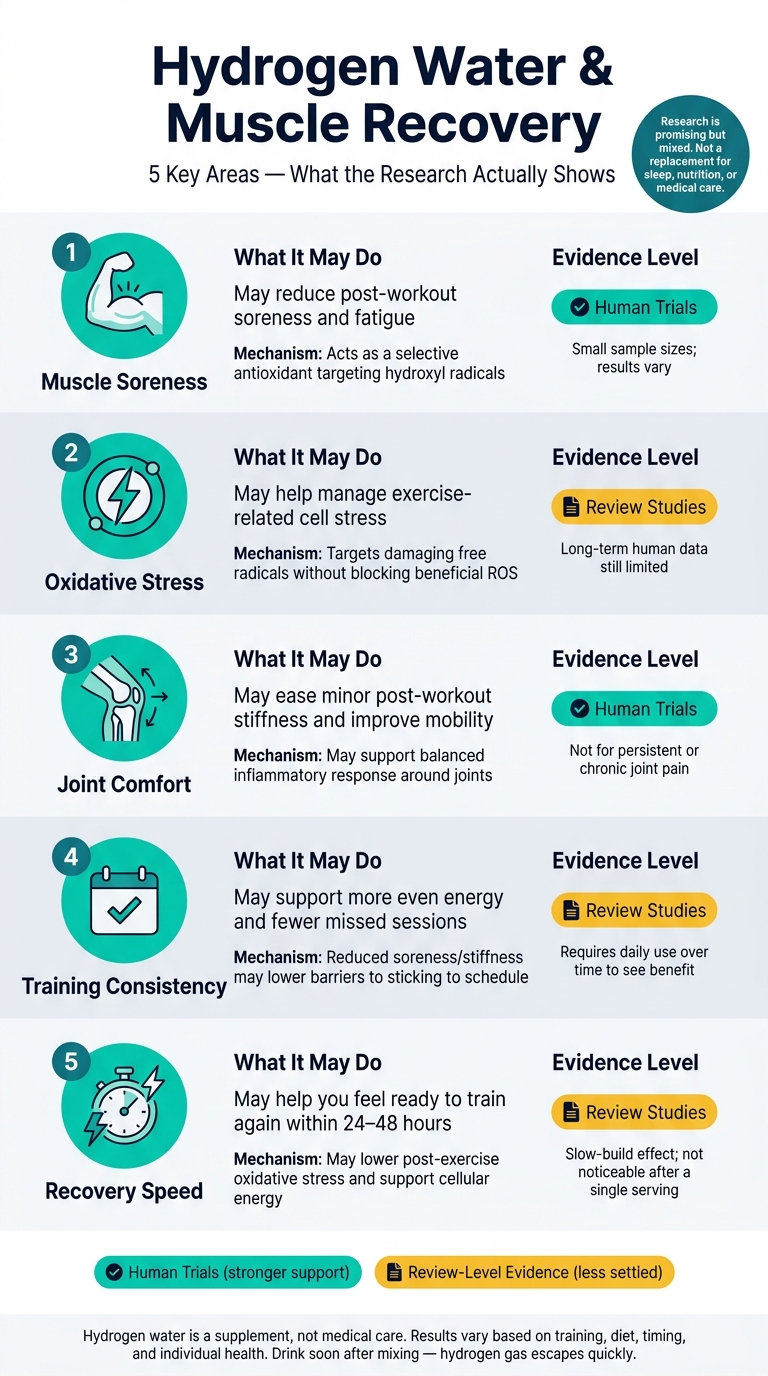
Hydrogen Water & Muscle Recovery: 5 Areas Explained
Hydrogen Water for Bodybuilders: Benefits & Science Explained
sbb-itb-6860cc4
How to Read These Recovery Claims
Recovery means less soreness, easier movement, and being ready for the next workout. [5][4]
On the cellular side, people often describe recovery as lower oxidative stress and better balance. [1][5][3] That matters most when you're looking at post-workout soreness.
Hydrogen water is a supplement, not medical care. If pain feels unusual or you have a medical condition, talk with a healthcare professional. [5]
Results can change based on your workout, timing, dose, diet, and overall health. [5] One more thing: hydrogen gas escapes fast after the tablet dissolves, so drink it soon after you make it. [5][3][4]
First, focus on soreness. It’s usually the most immediate sign of recovery.
The five areas below break the most common recovery claims into clear categories.
1. Muscle Soreness After Hard Workouts
One of the biggest claims around recovery is less soreness after tough training.
That idea makes sense on paper. Muscle soreness after a hard workout is a normal response to intense exercise. On the cellular level, hard training can lead to oxidative stress and low-grade inflammation in muscle tissue. That stress helps explain the stiffness and tenderness you feel later [1][5]. This is where the antioxidant angle comes into play.
Hydrogen-rich water contains molecular hydrogen, which acts as a selective antioxidant. In plain English, it appears to target the free radicals thought to cause the most harm - hydroxyl radicals and peroxynitrite - without interfering with reactive oxygen species that play useful roles in the body [1]. Because H2 is so small and dissolves easily, it may move through tissues fast and help reduce the stress tied to soreness [2][5].
The catch? The early human research looks promising, but the findings are still mixed [5].
2. Exercise-Related Oxidative Stress
Oxidative stress is extra strain on your cells that can build up during hard exercise. Push your training hard enough, and your body may make more free radicals than it can neutralize [3][4]. When that happens, inflammation and fatigue can climb, which helps explain why a brutal workout can leave you feeling drained afterward [3][4][5].
Hydrogen may work a bit differently from standard antioxidants. It appears to target the most damaging free radicals - hydroxyl radicals and peroxynitrite - while leaving helpful reactive oxygen species alone [1][2]. That matters because not all oxidative activity is bad; some of it helps your body respond to exercise.
Early studies suggest hydrogen-rich water may help reduce fatigue and post-workout inflammation, but the research is still taking shape [5]. And this same cell stress can also show up as stiffness and joint discomfort after training.
3. Joint Comfort and Mobility
Joint comfort is pretty simple: you can move without that stiff, heavy feeling. You notice it during squats, on a run, and even in basic day-to-day movement. And when post-workout stiffness lingers, it can throw off your next session.
A lot of that stiffness lines up with exercise-related oxidative stress and inflammation. That’s where hydrogen-rich water comes into the picture. Hydrogen may help support a more balanced response around the joints [1][5]. In plain terms, that could mean less stiffness and smoother movement after training.
Some users report better comfort after several days of steady use, though individual results vary [3][4].
If joint comfort gets better, the next thing to look at is whether that makes it easier to stay on track through the week.
4. Training Consistency Across the Week
If joint comfort starts to feel better, the next thing to watch is your weekly routine. Can you stay on schedule more easily?
That’s where recovery matters. When soreness, fatigue, and stiffness stack up, people tend to trim workouts, move sessions around, or skip them altogether. And that’s the main point here: fewer missed workouts and less need to scale things back.
When recovery feels more even, it gets easier to keep planned sessions on the calendar. Hydrogen-rich water may help by keeping recovery-related stress lower after hard workouts [1][2]. If you feel less sore and stiff between sessions, you have fewer reasons to back off the plan.
One thing matters a lot here: regular use. This isn’t the kind of thing where one workout or one bottle changes the week. Any upside tends to show up when use is steady over time. Even then, results can differ based on training load, diet, and your starting point for recovery [5].
For this use case, steady use matters more than occasional use.
5. Recovery Speed Between Workouts
Staying on track week after week matters. But there’s another piece of the puzzle: how soon you feel ready to train again.
In day-to-day life, that can look pretty simple. Maybe you get moving more easily the next morning. Maybe you deal with fewer afternoon energy dips. Maybe that worn-down feeling doesn’t hang around as long after a hard session [2][3][6].
Hydrogen-rich water may help here through two linked effects. First, molecular hydrogen may help lower the oxidative stress that builds up after tough training [1]. Second, it may help cells bounce back in terms of energy production [2]. Put those together, and you may feel ready for your next workout sooner. That can matter even more if your next session is coming within 24 to 48 hours.
Some users say they notice a change over time, with effects more likely to show up after steady daily use rather than after a single serving [3][4]. So this kind of between-workout recovery is usually a slow-build effect, not something you feel right after one glass. The main thing to watch is how you feel heading into the next workout - less heavy, less drained, and less flat - rather than judging it off one session.
The research is still developing, and results can vary based on diet, lifestyle, training intensity, and baseline health [5]. Edenvia Molecular Hydrogen tablets are made to produce hydrogen-rich water for daily use.
What the Current Research Does and Does Not Show
Taken together, the five recovery areas above suggest a promising but uneven body of research. The findings are mixed. Some studies report measurable gains, while others show little or no change.
On the plus side, a few studies have linked hydrogen use with reduced muscle soreness, better endurance, and faster short-term recovery after intense training [5][2]. One reason researchers keep coming back to it is simple: molecular hydrogen is small enough to move through cells with ease.
At the same time, there still isn't enough evidence to support broad health claims for the general population, and the research base is still taking shape [5].
Hydrogen is often studied as a selective antioxidant because it may lower the most damaging oxidative stress without blocking all training signals. In plain English, that means it could help recovery without getting in the way of the adaptations you're training for [1]. The snapshot below shows which recovery areas have the strongest support.
Recovery Area Snapshot
Here’s the short version: some areas look more backed by evidence than others.
| Recovery Area | Proposed Mechanism | Reported Outcome | Evidence Type | Evidence Limitation | Practical Takeaway |
|---|---|---|---|---|---|
| Muscle Soreness | May help reduce post-workout soreness. | May reduce post-exercise soreness and fatigue. | Human trials | Often small sample sizes, and results vary by individual. | Use it as a secondary support tool alongside proper cool-downs. |
| Oxidative Stress | May help the body manage exercise-related cell stress. | May help reduce exercise-related stress. | Reviews | Long-term human performance data are still limited. | Think of it as daily maintenance, not a one-time fix. |
| Joint Comfort | May help ease minor exercise-related stiffness. | May improve mobility and reduce joint discomfort. | Human trials | Evidence is still emerging and shouldn't replace medical care. | May help with minor post-workout stiffness; get medical advice for ongoing joint pain. |
| Training Consistency | May support more even energy across the week. | May improve more even energy across the week. | Reviews | Works best with daily use over time. | Build the habit first by taking it daily at about the same time. |
| Recovery Speed | May help the body feel ready to train again sooner. | May help speed return to training readiness. | Reviews | Long-term human data are still limited. | Drink soon after mixing. |
Two areas stand out a bit more here: muscle soreness and joint comfort. Those have some support from human trials, so they carry more weight than the rest.
The other three - oxidative stress, training consistency, and recovery speed - lean more on review-level evidence. That doesn’t mean they don’t matter. It just means the case is less settled, and the claims should be treated with a bit more caution.
Conclusion
Put it all together, and these five areas - muscle soreness, oxidative stress, joint comfort, training consistency, and recovery between workouts - help show where hydrogen water may have a place in a recovery routine. It’s not a shortcut. Sleep, nutrition, and smart training still do most of the work.
The research looks promising, but there are still gaps. That means it makes more sense to think of hydrogen water as a supportive add-on, not a substitute for solid recovery habits.
If you want a simple way to work hydrogen water into your day, Edenvia Molecular Hydrogen tablets dissolve in water to create hydrogen-rich water that supports antioxidant defenses and joint comfort. Use it as one part of a broader recovery routine.
FAQs
How long does hydrogen stay in water?
Once the tablet dissolves, the molecular hydrogen in the water starts to fade over time. So if you want the most from it, drink the hydrogen-rich water soon after it's ready.
Edenvia recommends drinking it within 30 minutes of preparation to support your recovery goals.
When should I drink hydrogen water after a workout?
After your workout, drop one Edenvia molecular hydrogen tablet into room-temperature or chilled water. Wait about 3 minutes, then drink it right away while the hydrogen reaction is still happening.
If needed, you can drink the prepared water within 30 minutes. Don’t use hot water, and don’t swallow the tablet directly.
Who might notice the biggest recovery benefits?
Athletes and active adults may notice the biggest recovery gains from hydrogen-rich water. After hard training, it can help lower oxidative stress, muscle soreness, and fatigue.
It may also support better endurance, faster recovery between workouts, and steadier support for physical performance and cellular health.
Related Blog Posts
Disclaimer: These statements have not been evaluated by the Food and Drug Administration. This product is not intended to diagnose, treat, cure, or prevent any disease. This article is for general informational purposes only and is not medical advice. Consult a qualified healthcare provider before starting any supplement, especially if you are pregnant or nursing, have a medical condition, or take prescription medication.