

Muscle Strain, Inflammation, and Molecular Hydrogen
A muscle strain is more than a pulled muscle. I’d sum it up like this: first I protect the area, then I bring motion back, then I add strength. Molecular hydrogen may help with oxidative stress during recovery, but it does not replace medical care or rehab.
Here’s the short version:
- Days 1–3: I focus on rest, ice, compression, and elevation
- Days 4–10: I start gentle, pain-free motion and light muscle use
- Weeks 2–4: I add light strengthening and steady load
- Week 4+: I return to normal activity if symptoms stay calm
- Hydrogen water: I’d only view it as a small add-on after the early protection phase
A strain can cause pain, swelling, stiffness, weakness, and less range of motion. Part of that comes from the tear itself. Part comes from the body’s repair response, which includes inflammation and oxidative stress. Small amounts of reactive oxygen species help repair, but too much can keep discomfort around longer.
One key number stands out in the recovery plan: if pain lasts more than 24 hours after exercise, or warmth and swelling come back, I’d pull back and reduce load.
If I put the whole article into one plain takeaway, it’s this: protect first, move next, load later - and use molecular hydrogen only as extra support, not as the main fix.
How to Treat Muscle Strains or Tears
sbb-itb-6860cc4
References
- Ohsawa I, et al. "Molecular hydrogen acts as a therapeutic antioxidant by selectively reducing cytotoxic oxygen radicals." Nature Medicine, 2007. https://www.nature.com/articles/nm1577
How tissue stress leads to pain, stiffness, and limited motion
When a muscle strain happens, the problem usually goes beyond the small tear itself. A strained muscle sets off inflammatory signaling and oxidative stress, and both can add to pain, stiffness, and limited motion beyond the first injury [2]. In plain English, the body’s response can make things feel worse than the tear alone. That’s also why a strain often hurts more when you move than when you’re still.
Muscles around the injured area often tighten up to protect it. That protective guarding can cut down movement and leave you feeling stiff, weak, and less flexible for a while.
| Underlying Process | What a Person May Feel | How It Can Affect Movement |
|---|---|---|
| Mechanical strain | Sharp or localized pain | Immediate guarding and limited range of motion |
| Inflammatory signaling | Swelling, heat, and stiffness | Reduced activity and avoidance of movement |
| Oxidative stress | Fatigue and heavy limbs | Slower recovery and reduced endurance |
| Nerve and cellular stress | Weakness or poor muscle control | Slower return of strength and flexibility |
These connected changes help explain why recovery can’t stay in “protect the area” mode forever. At first, protection matters. But later, the body needs a slow return to loading and movement. That’s why pain relief by itself doesn’t bring normal movement back.
The role of oxidative stress during recovery
Even after swelling starts to calm down, oxidative stress can still drag out recovery. Oxidative stress is an imbalance between reactive oxygen species (ROS) and the body's antioxidant defenses [4]. In small amounts, ROS help signal repair. But if ROS levels stay high, they can keep inflammation going longer and slow the return of strength and flexibility [4][3].
A step-by-step recovery plan to restore comfort and movement
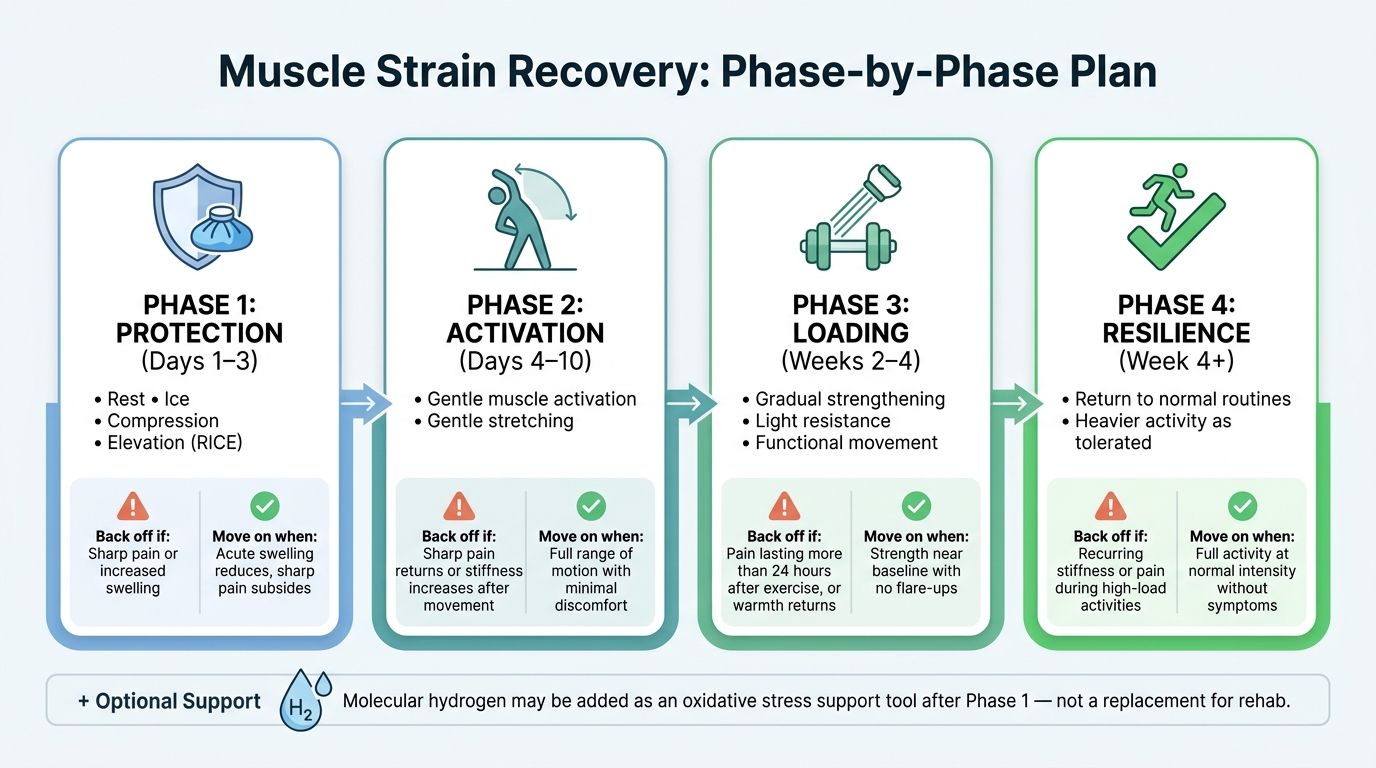
Muscle Strain Recovery Phases: A Step-by-Step Timeline
Recovery tends to go better in phases: protect first, restore motion next, then add load. A simple phase-based plan keeps things clear and helps you move at a pace your body can handle. The key is gradual progress based on symptoms, not guesswork.
| Recovery Phase | Suitable Activity | Back off / move on when |
|---|---|---|
| Phase 1: Protection (Days 1–3) | Rest, ice, compression, and elevation (RICE) | Back off: sharp pain or increased swelling. Move on: acute swelling reduces and sharp pain subsides |
| Phase 2: Activation (Days 4–10) | Gentle muscle activation; gentle stretching | Back off: sharp pain returns or stiffness increases after movement. Move on: full range of motion with minimal discomfort |
| Phase 3: Loading (Weeks 2–4) | Gradual strengthening; light resistance; functional movement | Back off: pain lasting more than 24 hours after exercise or warmth returns. Move on: strength near baseline with no flare-ups |
| Phase 4: Resilience (Week 4+) | Return to normal routines; heavier activity as tolerated | Back off: recurring stiffness or pain during high-load activities. Move on: full activity at normal intensity without symptoms |
Early protection and swelling control
During the first 1–3 days, keep it simple: stop any activity that causes sharp pain. This is the time for rest, ice, compression, and elevation (RICE). Compression and elevation can help limit fluid buildup, and ice may help keep swelling under control.
Think of this phase as giving the area a chance to calm down. You’re not trying to “push through it.” You’re trying to prevent the problem from getting worse.
Gentle motion and gradual loading
Once sharp pain starts to ease - often around days 4–10 - you can begin adding movement back in, slowly and with control. Start with pain-free range of motion. In plain English, that means moving the joint through its normal path without forcing it or chasing a deep stretch.
After that, gentle muscle activation helps keep the tissue engaged without asking too much from it. Then comes gradual strengthening, which helps build load tolerance back up based on how your body responds.
Strength matters, but it’s not the whole story. Balance and coordination matter too. Those pieces help protect the area when you get back to normal daily activity and heavier movement.
If symptoms get worse at any point - especially if pain lasts more than 24 hours after exercise or you notice warmth coming back - take that as a sign to pull back. Less intensity, more recovery time.
As pain settles and movement starts to come back, recovery support aimed at inflammation and oxidative stress can fit into the routine.
Where molecular hydrogen may fit in a recovery routine
As pain and swelling start to ease, tools that help with oxidative stress may matter more. Once the first protection phase has passed, molecular hydrogen may fit in as one part of recovery, along with rest, swelling control, and gradual loading.
How molecular hydrogen may support recovery biology
Molecular hydrogen (H₂) is small enough to enter cells. Researchers are studying it for its role in supporting oxidative balance and inflammatory signaling by targeting harmful free radicals while leaving useful signaling molecules in place [1][3].
That makes it a possible add-on during recovery, not a replacement for movement or load progression.
Put simply, molecular hydrogen comes after the basics are in place, not before them.
How Edenvia Molecular Hydrogen fits into daily use
Edenvia Molecular Hydrogen tablets dissolve in water to make hydrogen-rich water for daily use as part of a broader recovery routine. It can fit alongside hydration, sleep, and gradual movement - just one support tool in the mix.
If pain, weakness, or loss of motion sticks around, get medical guidance. The main goal is still getting back to normal movement without flare-ups.
Key takeaways: supporting recovery while restoring normal movement
After the protection and loading phases, the goal shifts a bit. Now it's about helping the tissue heal without stirring things up again. A muscle strain can set off inflammation and oxidative stress, and that can drag out pain, stiffness, and limited range of motion.
Recovery still starts with the basics: protect the injured area first, then bring movement and load back step by step. That part doesn't change. This is the context where molecular hydrogen may have a place.
Molecular hydrogen may help support recovery by helping manage oxidative stress without interfering with normal signaling [1][3]. That said, it does not fix the mechanical injury itself. The strain still needs protection, gradual rehab, and medical evaluation when symptoms are more serious.
Put simply:
- Mechanical injury needs protection and rehab
- Oxidative stress may be supported with molecular hydrogen
- Inflammation is best managed with symptom-guided activity
Edenvia Molecular Hydrogen tablets dissolve in water and can fit into a simple daily recovery routine. As part of that routine, Edenvia Molecular Hydrogen may support the cellular environment while the body heals.
FAQs
How do I know if my muscle strain is serious?
A serious muscle strain often needs a professional medical evaluation. See a healthcare provider if you have severe pain, can’t move the affected limb, have major swelling, or notice a visible deformity.
Edenvia Molecular Hydrogen tablets may help support recovery, inflammation, and oxidative stress. But they should be used as a complement to medical care, not as a substitute for an exam when the injury may be serious.
When should I start moving a strained muscle again?
When to resume movement depends on the severity of the strain and how your body responds. There isn’t an exact timeline here, but gentle movement is framed as an important part of recovery, along with proper support.
Edenvia Molecular Hydrogen tablets may fit into your routine to help reduce inflammation and support recovery. It’s smart to check with a healthcare professional about when to start moving again for your specific condition.
Can hydrogen water speed muscle strain recovery?
Yes. Molecular hydrogen may help with recovery after muscle strain by helping lower oxidative stress and inflammation, both of which play a part in muscle strain and the healing process.
Edenvia Molecular Hydrogen tablets dissolve in water to make hydrogen-rich water. This may help support physical recovery, comfort, and mobility while you heal.
Related Blog Posts
Disclaimer: These statements have not been evaluated by the Food and Drug Administration. This product is not intended to diagnose, treat, cure, or prevent any disease. This article is for general informational purposes only and is not medical advice. Consult a qualified healthcare provider before starting any supplement, especially if you are pregnant or nursing, have a medical condition, or take prescription medication.