

Hydrogen Water for Recovery After Hard Training
My take: hydrogen water is optional - not a proven way to recover after hard training. I’d put fluids, food, sleep, and rest first. If you try it, follow the label and track next-day soreness and fatigue - not just how you feel right after drinking it.
Here’s what I’d keep in mind:
- Research is limited. Small studies suggest possible changes in fatigue or soreness, but they don’t establish faster muscle repair, better performance, or joint-pain relief.
- Timing matters. Workout soreness often peaks 24–72 hours later. One good workout doesn’t prove the water helped.
- Use it as directed. Prepare tablets according to the label, drink soon after mixing, and never swallow a tablet directly.
- Check safety first. Ask a healthcare professional before use if you have kidney disease, take medications, or are pregnant or breastfeeding.
- Separate sales claims from study results. Edenvia’s recovery and joint-comfort claims are not proven product outcomes. I’d check ingredients, testing records, and purchase terms before buying.
<u>Joint pain isn’t the same as muscle soreness.</u> Persistent or worsening pain needs medical advice; severe swelling, dark urine, or sudden weakness needs urgent care.
Hydrogen Water for Bodybuilders: Benefits & Science Explained
sbb-itb-6860cc4
What Recovery Studies Show
Early studies suggest hydrogen-rich water may slightly reduce soreness or fatigue after hard training. But the evidence is too limited to support broad recovery claims, and small, narrowly selected athlete groups make it hard to apply the findings to others.[1]
What matters in practice is whether it changes your soreness, fatigue, or how you feel at your next workout.
Muscle Soreness and Fatigue
Feeling less tired during or right after training does not mean you’ll have less soreness the next day - or that your muscles have fully recovered.[1]
Oxidative Stress and Muscle-Stress Markers
Changes in biomarkers do not prove that tissue repairs faster or that recovery improves.[1]
Recovery Findings at a Glance
The table separates changes in symptoms from changes in biomarkers. Joint comfort is a separate recovery question.
| Outcome | Research pattern | Evidence limitations | Practical interpretation |
|---|---|---|---|
| Muscle soreness | Some studies suggest soreness may decrease.[1] | Results are not consistent enough to support a broad claim.[1] | May help you feel more comfortable, but does not replace recovery basics. |
| Subjective fatigue | Some studies suggest less exercise-related fatigue.[1] | Feeling less tired does not confirm muscle recovery.[1] | Track next-day soreness and workout performance separately. |
| Oxidative-stress markers | Short-term studies may show changes in these markers.[1] | Those changes do not guarantee faster tissue repair.[1] | Lab results alone cannot confirm recovery. |
| Training performance | Short-term effects vary.[1] | Small samples and brief study protocols limit confidence.[1] | Do not assume better workouts or more stamina. |
| Joint comfort | Direct evidence for exercise recovery is sparse.[1] | Joint-comfort benefits have not been established in this setting.[1] | Do not assume joint-pain relief or improved mobility. |
References
- Aoki K, et al. Pilot study: Effects of drinking hydrogen-rich water on muscle fatigue caused by acute exercise in elite athletes. https://pmc.ncbi.nlm.nih.gov/articles/PMC3301481/
How to Use Hydrogen Water in Your Recovery Routine
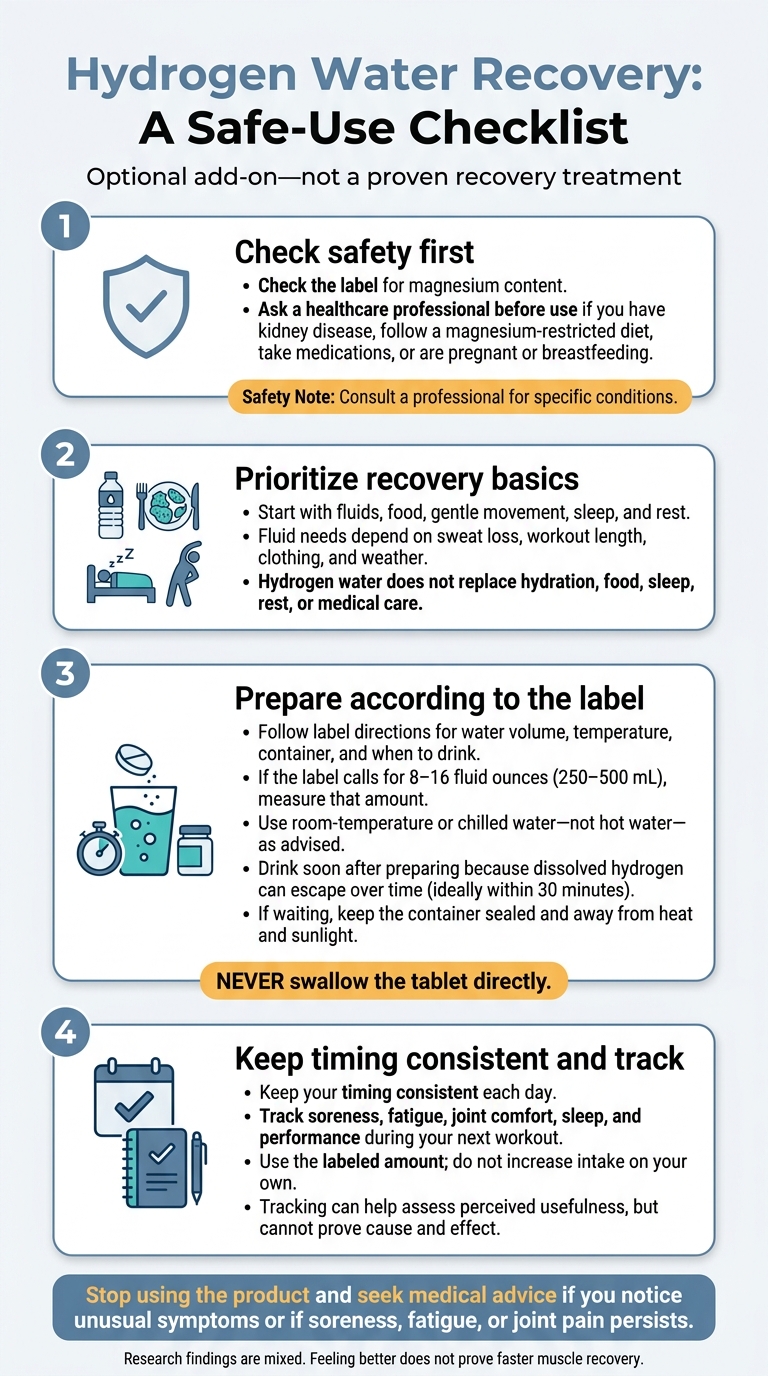
Hydrogen Water Recovery: A Safe-Use Checklist
Start With Fluids, Food, Gentle Movement, and Sleep
Treat hydrogen water as a small, optional add-on to your recovery routine. Hydration, food, gentle movement, and sleep come first when recovering from soreness and tired legs and preparing for the next day. Your fluid needs depend on sweat loss, workout length, clothing, and weather. Hydrogen water does not replace hydration, food, sleep, rest, or medical care[1].
Follow the Label When Preparing Hydrogen Water
Follow the label’s directions for water volume, temperature, container, and when to drink it. If it calls for 8–16 fluid ounces (250–500 mL), measure that amount rather than guessing[1]. Use room-temperature or chilled water - not hot water[1].
Dissolved hydrogen can escape over time, so drink the water soon after preparing it, ideally within 30 minutes[5][1]. Never swallow the tablet directly[3][1]. If you need to wait, keep the container sealed and away from heat and sunlight[1].
Set a Schedule and Track Your Response
Keep your timing consistent each day. Track soreness, fatigue, joint comfort, sleep, and performance during your next workout[5][1].
Research findings are mixed. Tracking can help you decide whether the routine feels useful, but it cannot prove cause and effect. Use the labeled amount instead of increasing your intake on your own.
Check Supplement Safety and Get Medical Advice
Check the label for magnesium content[1][6]. Talk with a healthcare professional before use if you have kidney disease, follow a magnesium-restricted diet, take medications, or are pregnant or breastfeeding[1][5][3].
Stop using the product and seek medical advice if you notice unusual symptoms or if soreness, fatigue, or joint pain persists[3].
Edenvia Molecular Hydrogen Tablets
Preparation and Brand Wellness Claims
Edenvia Molecular Hydrogen tablets make hydrogen-rich water when mixed with water.[5][7]
Edenvia markets the tablets for antioxidant support, joint comfort, mobility, and recovery.[5][7][4] These are brand claims, not proven recovery outcomes. The supplied material does not identify a product-specific clinical trial.[2]
Testing Claims and Purchase Terms
Before buying, check the product claims alongside the testing records. Review results for purity, potency, and safety, including any third-party lab results.[4]
The product comes with a 30-day money-back guarantee, and subscription refills ship every 28 days.[5][7] Check the ingredient list and serving count, too: a 30-day supply typically contains 30 tablets.[4]
Conclusion: Put Recovery Basics First
The evidence is limited and mixed, with no reliable benefits for joint comfort or performance.[1]
Treat it as an add-on - not a replacement for water, food, sleep, gradual training, and rest.
If you try it, follow the label. Track soreness, fatigue, and energy alongside sleep and training load. One better day doesn’t prove it helped.
Get medical advice if soreness, fatigue, or joint pain persists after hard exercise. Also check with a medical professional before use if you have kidney disease, take medications, or are pregnant or breastfeeding.
FAQs
How can I tell if hydrogen water helps my recovery?
Look for more energy, less muscle soreness, and better recovery after training. Many users report more energy and clearer thinking within 7 to 10 days of daily use. Over time, you may also notice greater joint comfort and overall resilience.
To stay consistent, dissolve one Edenvia tablet daily in 12 oz (350 mL) of room-temperature or chilled water, then drink it immediately.
Could less soreness hide incomplete muscle recovery?
Yes. Less soreness doesn’t mean your muscle tissue has fully repaired. Oxidative stress from hard training can linger after the pain fades. Using pain alone to judge recovery can lead to overtraining before your body has finished recovering.
Edenvia Molecular Hydrogen tablets target oxidative stress and support cellular health, which may help with recovery beyond soreness relief.
How do I distinguish joint pain from muscle soreness?
Muscle soreness usually feels like a dull ache and peaks 24 to 48 hours after intense exercise. Joint pain tends to feel sharp or centered in one spot, with discomfort or stiffness during movement or even at rest.
Soreness is common after hard training, but joint discomfort may call for extra support. Edenvia Molecular Hydrogen tablets may help reduce inflammation and support joint comfort and mobility during recovery.
Related Blog Posts
Disclaimer: These statements have not been evaluated by the Food and Drug Administration. This product is not intended to diagnose, treat, cure, or prevent any disease. This article is for general informational purposes only and is not medical advice. Consult a qualified healthcare provider before starting any supplement, especially if you are pregnant or nursing, have a medical condition, or take prescription medication.