

Molecular Hydrogen Tablets Investigated: Labels
A label can tell me what’s listed in the bottle. It cannot prove what the tablet does in water.
If I’m checking a molecular hydrogen tablet, I should separate label facts from test proof. The label may show serving size, tablet count, ingredients, directions, storage, and the FDA supplement disclaimer. But it does not confirm hydrogen output, purity, or batch consistency on its own.
Here’s the short version:
- A 60-count bottle is not always 60 servings. If the serving size is 2 tablets, that’s 30 servings.
- Magnesium matters most because it drives hydrogen production.
- “Proprietary blend” can hide ingredient amounts, so I may not know how much magnesium is inside.
- PPM or mg/L claims need lab proof, not just package text.
- Water volume, temperature, and timing change output, so home results may differ.
- A CoA tied to the lot number is the main document I’d ask for if a brand mentions testing.
A buyer review in the source also points to a label gap: no certifications or purity details were shown on the package. That does not prove a problem. But it does mean I’d want paperwork before treating output or purity claims as settled.
Quick check
| What I can learn from the label | What I still need testing to confirm |
|---|---|
| Serving size and tablet count | Hydrogen output in ppm |
| Ingredient names | Exact ingredient amounts if hidden in a blend |
| Directions and storage | Heavy metals, microbes, and contaminants |
| Company name and address | Batch-to-batch consistency |
My bottom line: the label is a starting point, not final proof. If claims go beyond basic package facts, I’d ask for batch-specific lab documents.
sbb-itb-6860cc4
How to Read a Molecular Hydrogen Tablet Label
Start with the Supplement Facts panel. That’s where the label tells you what you’re getting. From there, check whether it gives exact details on dose, ingredients, and how to use the tablets.
Serving Size, Servings Per Container, and Tablet Count
Look at the serving size first. This is where people often get tripped up.
A 60-count bottle with a 2-tablet serving gives you 30 servings. That’s the same number of servings as a 30-count bottle with a 1-tablet serving. If you compare bottles by tablet count alone, your cost-per-dose math will be off.
Active Ingredient Names, Amounts Per Serving, and Other Ingredients
The active ingredient line should list the ingredient name and the amount per serving. In these tablets, magnesium is what reacts to produce hydrogen gas, and labels may name it as elemental magnesium or magnesium malate.[1][3] A clear label shows the amount per serving in milligrams.
Watch for terms like "Proprietary blend", "matrix," or "complex" with no milligram amounts. Those words tell you what is in the tablet, but not how much. That makes side-by-side comparison much harder.
Just below the Supplement Facts panel, you’ll usually see Other Ingredients. This section often lists binders, flavors, or acids such as malic acid that help support the effervescent reaction.
Directions, Storage, and Manufacturer Contact Details
With molecular hydrogen tablets, the directions matter more than they do for many other supplements. A solid label should spell out the water volume, water temperature, dissolution time, and how long you have to drink it after the tablet dissolves.[3]
Hot water releases hydrogen faster, so room-temperature or chilled water is the better pick. The 30-minute consumption window matters for the same reason: hydrogen dissipates fast after dissolution. Storage matters too. Keep the tablets in a cool, dry place with the container tightly closed. Moisture can start the reaction too early and reduce potency.[3]
You should also see a clear company name and a U.S. address printed on the bottle. That gives the label some accountability. Edenvia's operator, SRV Marketing LLC is based in Albuquerque, New Mexico.[5] If those details are missing or vague, the label becomes a lot less useful when you're trying to make a smart call.
Where Labels Often Leave Gaps
Once the basic label fields make sense, the next step is looking at what the package doesn't say. And that's where things often get murky.
Even when a label checks the usual boxes, it can still leave out key details, especially around ingredient amounts and hydrogen output.
How Proprietary Blends Hide Amounts
Under U.S. rules, a proprietary blend has to show the total weight of the blend and list ingredients in descending order by weight. But it does not have to say how much of each ingredient is inside.
Here's what that can hide:
| What the Label Shows | What It Leaves Out |
|---|---|
| Total blend weight | Amount of each ingredient in the blend |
| Ingredient names in descending order | Exact ratio of reactants, such as magnesium and a catalyst |
| General "Magnesium" listing | Whether it is elemental magnesium or a compound such as magnesium malate |
| Tablet count per container | Actual H2 gas output per tablet (PPM or mg/L) |
Why does that matter? Because reactive magnesium is what drives hydrogen production. If the magnesium amount is buried inside a blend total, you can't calculate the dose.
Why Output Claims Cannot Be Verified from the Package Alone
Terms like "hydrogen-rich" or "ultra-high purity" sound impressive. But they still don't tell you how much dissolved hydrogen gas the tablet actually makes.
Without a stated PPM or mg/L number on the label, the output stays unmeasured from the buyer's point of view.
There’s another catch: test conditions change the result. Hydrogen output can vary based on:
- Water volume
- Temperature
- Dissolution time
Most packages don't list those conditions. So even if a claim sounds clear, it's hard to repeat the same result at home.
And without certifications or batch-specific purity data on the package, the label also can't confirm consistency from one bottle to the next. That’s why label claims often need testing before they can be treated as confirmed.
What Research and Testing Can Verify
U.S. Labeling Rules Versus Independent Laboratory Verification
A supplement label can follow FDA rules and still leave big questions unanswered. Those are two different things.
In the U.S., dietary supplement makers are responsible for the accuracy of their own labels. FDA review usually happens after products reach the market, not before. So label compliance does not prove that a product contains exactly what it claims.
That’s where independent lab testing matters.
A compliant label shows that the required fields are there. It does not show that the stated amounts are correct, that the product is free from contaminants, or that the tablet delivers the hydrogen output being claimed.
| What Label Compliance Confirms | What It Does Not Confirm |
|---|---|
| Required fields are present | Declared ingredient quantities are accurate |
| Ingredient names are disclosed | Actual hydrogen concentration produced in water |
| Absence of heavy metals or contaminants | |
| Batch-to-batch consistency |
How to Assess Composition, Hydrogen Output, and Third-Party Testing Claims
Independent lab testing can check a few core points that a label alone can’t settle. It can verify ingredient identity and quantity. It can also measure hydrogen output in ppm, screen for heavy metals and microbes, and look at consistency across batches.
The main document to ask for is a Certificate of Analysis (CoA). A CoA links test results to a specific batch, which matters because one clean batch doesn’t automatically speak for every batch.
If a brand says it uses third-party testing but doesn’t share CoA documents, the claim is still unverified. Put simply: no paperwork, no proof.
How to Place Edenvia Molecular Hydrogen in a Label-Review Framework
This framework gets more useful when you apply it to an actual product page and package. For Edenvia Molecular Hydrogen, the starting point is simple: look at what the product page says, then look at what the package shows.
The product page says the tablets undergo purity, potency, and safety testing. One verified purchaser, Renee, noted:
"I noticed that there weren't any certifications or purity information on the package." - Renee, Verified Purchaser [1]
That gap is the main label-review issue here. The next things to check are batch-level CoA documents and hydrogen output figures in ppm. Those are the proof points that can move the review from marketing language to something you can actually verify.
References
- Edenvia Molecular Hydrogen Tablets – Product listing and customer reviews. Available at: https://tryedenvia.com
A Simple Label Review Checklist and Closing Summary
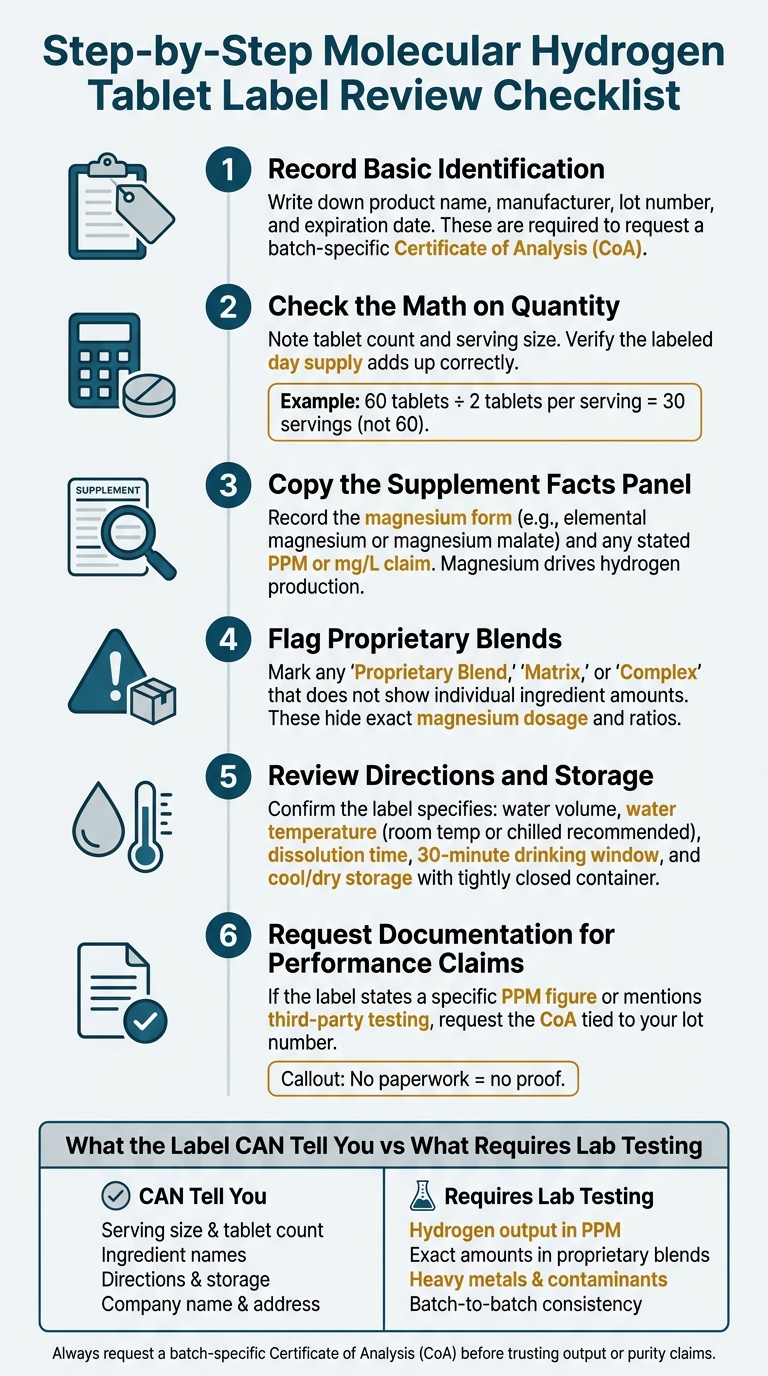
How to Review a Molecular Hydrogen Tablet Label: Step-by-Step Checklist
A Step-by-Step Label Review Method
Use this checklist as a quick pass/fail screen. The idea is simple: spot what the label says, note what it leaves out, and separate stated facts from claims that need proof.
- Record basic identification Write down the product name, manufacturer, lot number, and expiration date. If you need to ask for a batch-specific Certificate of Analysis (COA) later, those details matter.
- Check the math on quantity Note the tablet count and serving size. Then make sure the labeled day supply actually adds up.[1][3]
- Copy the Supplement Facts panel details Write down any stated magnesium form and any ppm claim.[1][3]
- Flag blends and unnamed complexes Mark any proprietary blend or complex that does not show individual amounts.[1]
- Review directions and storage Check that the label includes water temperature, dissolve time, drinking window, and storage instructions.[2][4]
- Request documentation for performance claims If the label gives a specific ppm figure or mentions third-party testing, ask for the COA tied to your lot number.[1][3]
That’s as far as the label can take you on its own.
Key Takeaways for Reading Labels with Fewer Assumptions
A label can tell you the declared ingredients, serving size, tablet count, directions, and storage requirements. It cannot confirm everything people often assume from marketing copy. Testing has to do that job.
The biggest gap is still proprietary blends. If a label hides the amount of each ingredient, you’re left guessing. The same goes for output claims. A performance claim without clear testing conditions is just marketing language until the paperwork backs it up.
For Edenvia Molecular Hydrogen, ask for batch-specific documentation tied to your lot number before you treat output or purity claims as confirmed.
References
- Edenvia Molecular Hydrogen Tablets – Product listing and customer reviews. Available at: https://tryedenvia.com
- Edenvia Molecular Hydrogen. Available at: https://tryedenvia.com
FAQs
What should I check first on the label?
First, check the expiration date to make sure the product is still in good condition and works as intended.
Then read the ingredient list, directions, and safety warnings on the actual packaging, since those details can change. If you have any questions about the ingredients or whether the product is right for your health needs, talk to a physician or licensed healthcare professional before using it.
Why does magnesium matter in hydrogen tablets?
Magnesium is the main reactive ingredient in molecular hydrogen tablets. When a tablet dissolves in water, magnesium helps release molecular hydrogen gas and turns plain water into hydrogen-rich water.
It also plays a part in energy production, recovery, and cell health. So it’s doing two jobs at once: helping generate hydrogen and helping your body as part of a daily wellness routine.
What lab proof should I ask for?
Ask for third-party testing documents that confirm purity, safety, and potency. That can help you spot common label problems, like missing details or information that doesn’t match from one place to another.
It also helps to choose brands that are open about where their ingredients come from and explain their formulas clearly, with research to back them up.
Related Blog Posts
Disclaimer: These statements have not been evaluated by the Food and Drug Administration. This product is not intended to diagnose, treat, cure, or prevent any disease. This article is for general informational purposes only and is not medical advice. Consult a qualified healthcare provider before starting any supplement, especially if you are pregnant or nursing, have a medical condition, or take prescription medication.