

How Molecular Hydrogen May Lower Oxidative Stress
Molecular hydrogen may affect oxidative stress, but drinking hydrogen-rich water is not proven to improve long-term health. My takeaway: follow the product label, and use a 2–4-week log to track your routine and comfort - not to measure changes inside your cells.
Here’s what I keep in mind:
- Balance matters. Reactive oxygen species help cells work, but excess amounts can damage cells and feed inflammation.
- Research has limits. Lab findings and small human studies suggest possible effects; biomarker changes do not prove better health.
- Preparation matters. Dissolved hydrogen escapes from water, so follow the label’s directions for dose, water temperature, and drinking time.
- Safety comes first. Long-term safety data are limited. Check ingredients and ask a clinician before use if you take medication, have a medical condition, or are pregnant or breastfeeding.
I’d treat hydrogen water as an optional addition to hydration - <u>not a replacement for medical care, diet, or movement</u>.
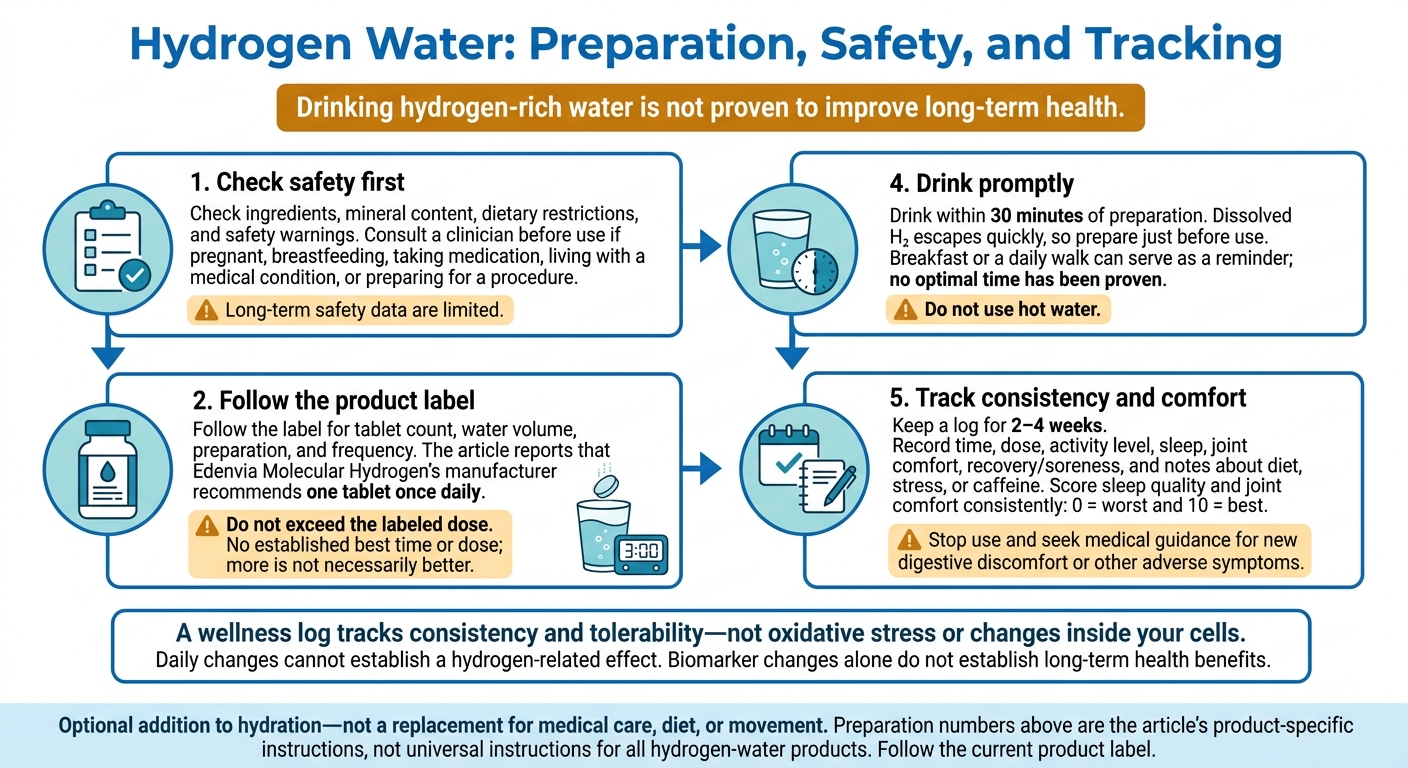
Hydrogen Water: Preparation, Safety, and Tracking
References
- [1] Ohsawa I, et al. “Hydrogen acts as a therapeutic antioxidant by selectively reducing cytotoxic oxygen radicals.” Nature Medicine (2007). https://doi.org/10.1038/nm1577
sbb-itb-6860cc4
How Molecular Hydrogen May Affect Oxidative Stress
With oxidative stress defined, we can look at how H₂ might affect it.
Molecular hydrogen (H₂) is a gas dissolved in hydrogen-rich water. It’s different from water (H₂O) and hydrogen peroxide (H₂O₂). Because H₂ is small and nonpolar, it can pass through cell membranes and reach areas such as mitochondria. How H₂ reaches the body matters when studying its possible effects on oxidative stress.
Proposed Effects on Antioxidants and Cell Signaling
Laboratory research suggests H₂ may interact with highly reactive molecules, such as hydroxyl radicals.[1] But this is a proposed mechanism - not proof that drinking hydrogen-rich water lowers oxidative stress in people. Other proposed pathways involve Nrf2, NF-κB, AMPK, and mitochondrial function.
Human studies may show a response, but changes in biomarkers alone don’t establish long-term health benefits or tell us exactly which mechanism caused those changes.[2]
What Hydrogen Studies Show
Results depend on the dose, delivery method, participants, and study design.
| Research type | What it can show | Key limitation |
|---|---|---|
| Mechanistic research | Possible chemical interactions and cell-signaling effects | Does not establish benefits in people |
| Animal studies | Biological responses under controlled conditions | Findings may not translate to humans |
| Human studies | Responses in the populations and protocols studied | Often limited by sample size, duration, and varying methods |
When reading a study, check whether it measured health outcomes or only biomarkers. Also check whether its protocol matches how you plan to use hydrogen-rich water.
Next, we’ll look at how hydrogen-rich water delivers H₂ and how the body absorbs it.
References
[1] Ohsawa I, et al. “Hydrogen acts as a therapeutic antioxidant by selectively reducing cytotoxic oxygen radicals.” Nature Medicine (2007). https://doi.org/10.1038/nm1577
[2] Sim M, et al. “Hydrogen-rich water reduces inflammatory responses and prevents apoptosis of peripheral blood cells in healthy adults: a randomized, double-blind, controlled trial.” Scientific Reports (2020). https://doi.org/10.1038/s41598-020-68930-2
How Hydrogen-Rich Water Delivers H₂
Hydrogen-rich water provides dissolved H₂ in a drinkable form that the body can use. Dissolved H₂ escapes quickly, so how you prepare the water - and when you drink it - matters. Once H₂ dissolves, the next step is absorption by the body.
How Tablets Release H₂ and the Body Absorbs It
Hydrogen tablets release H₂ when you drop them into water. Edenvia Molecular Hydrogen tablets use magnesium and are designed to dissolve in water, making hydrogen-rich water. Prepare it just before use and drink it soon after it’s ready.
Preparing and Drinking Hydrogen Water
Follow the tablet instructions closely: drop one tablet into cool or room-temperature water, let it dissolve for about 3 minutes, and drink the water within 30 minutes. Do not use hot water.
Creating a Daily Hydrogen-Water Routine
After preparing hydrogen water, fit it into a simple daily habit. Hydrogen-rich water can support hydration alongside diet, movement, and medical care - not replace them. There’s no established best time or dose, and more isn’t necessarily better.
Following the Label and Choosing a Time
Follow Edenvia Molecular Hydrogen’s label for tablet count, water volume, preparation, and frequency. The manufacturer recommends one tablet once daily [3][4]. Do not exceed the labeled dose.
Breakfast or a daily walk can serve as a reminder. No optimal time has been proven, so choose a habit you can stick with while following the label. Before use, check the ingredients and safety warnings.
Checking Ingredients and Safety Warnings
Check the ingredient list, mineral content, dietary restrictions, and warnings to see whether the product fits your needs. Consult a clinician before use if you’re pregnant, breastfeeding, taking medication, living with a medical condition, or preparing for a procedure [2].
Long-term safety data are limited [1][2]. Stop use and seek medical guidance if you develop new digestive discomfort or other adverse symptoms.
Tracking Your Routine Without Assuming Results
Once you start, keep a short log of consistency and comfort. Use 2–4 weeks to track how well you follow the routine and how it feels - not to judge results. Your notes can show whether the routine is easy to follow, but they cannot tell you whether hydrogen lowered oxidative stress.
Keeping a Simple Wellness Log
Before starting, record your usual sleep quality and joint comfort if practical. Each day, note the time, dose, sleep, joint comfort, soreness, and any changes in stress, diet, or caffeine. Score sleep and joint comfort using 0 = worst and 10 = best to keep your ratings consistent.
Date Time / Dose Activity Level Sleep Quality (0–10) Joint Comfort (0–10) Recovery/Soreness Notes (Diet/Stress) 10/13/2026 8:00 AM / 1 tablet Moderate (Gym) 7 6 Mild soreness High stress at work; extra coffee 10/14/2026 8:15 AM / 1 tablet Low (Walking) 8 7 No soreness Clean diet; felt focused in PM 10/15/2026 - - - - - -
Why Symptoms Do Not Measure Oxidative Stress
Energy and movement can change with sleep, activity, diet, medications, caffeine, stress, or expectations. Daily changes cannot establish a hydrogen-related effect.
Measuring biomarkers requires specific lab tests and qualified interpretation. No routine test measures all oxidative stress. A wellness log tracks consistency and tolerability - not changes inside your cells.
Conclusion: What We Know and What Remains Unclear
Oxidative stress and inflammation can reinforce each other. Researchers have studied molecular hydrogen for selective antioxidant activity[1], but human evidence remains limited, and more research is needed. Your notes track how the routine fits your day and how well you tolerate it; they do not measure cellular changes.
References
- Ohsawa I, et al. “Hydrogen acts as a therapeutic antioxidant by selectively reducing cytotoxic oxygen radicals.” Nature Medicine (2007). https://doi.org/10.1038/nm1577
FAQs
Could hydrogen water affect beneficial cell signals?
Molecular hydrogen is not thought to disrupt cell signals that support normal function. It may selectively target harmful reactive molecules, such as hydroxyl radicals and peroxynitrite, while leaving signaling molecules like hydrogen peroxide, superoxide, and nitric oxide intact.
These signaling molecules help cells grow, repair, and communicate with the immune system. Preserving them may allow molecular hydrogen to reduce oxidative stress and inflammation without interfering with normal cell activity.
How much dissolved hydrogen actually reaches my cells?
How much molecular hydrogen reaches your cells depends on how you prepare the water and when you drink it, because hydrogen escapes quickly [1]. Its small size lets it cross cell membranes and reach the mitochondrial matrix and nucleus [2].
Drink the water as soon as the tablet fully dissolves [2][3]. In an open container at room temperature, dissolved hydrogen levels can drop by about 50% within 30 minutes [2].
What evidence would confirm long-term health benefits?
Track clinical markers and how they change over time. For chronic conditions, inflammatory markers such as C-reactive protein (CRP) and erythrocyte sedimentation rate (ESR) can offer objective evidence of reduced inflammation [1].
With consistent daily use, cholesterol balance and arterial function may improve within 2 to 8 weeks [2]. Also track energy levels, mental clarity, and joint comfort over 4 to 6 weeks to help assess effects that build over time [1].
Related Blog Posts
Disclaimer: These statements have not been evaluated by the Food and Drug Administration. This product is not intended to diagnose, treat, cure, or prevent any disease. This article is for general informational purposes only and is not medical advice. Consult a qualified healthcare provider before starting any supplement, especially if you are pregnant or nursing, have a medical condition, or take prescription medication.