

Molecular Hydrogen and Aging: Oxidative Stress Review
My takeaway: molecular hydrogen is not a proven way to slow aging. If you’re considering hydrogen tablets, talk with your clinician first - especially if you take prescription medicines.
Here’s how I read the research:
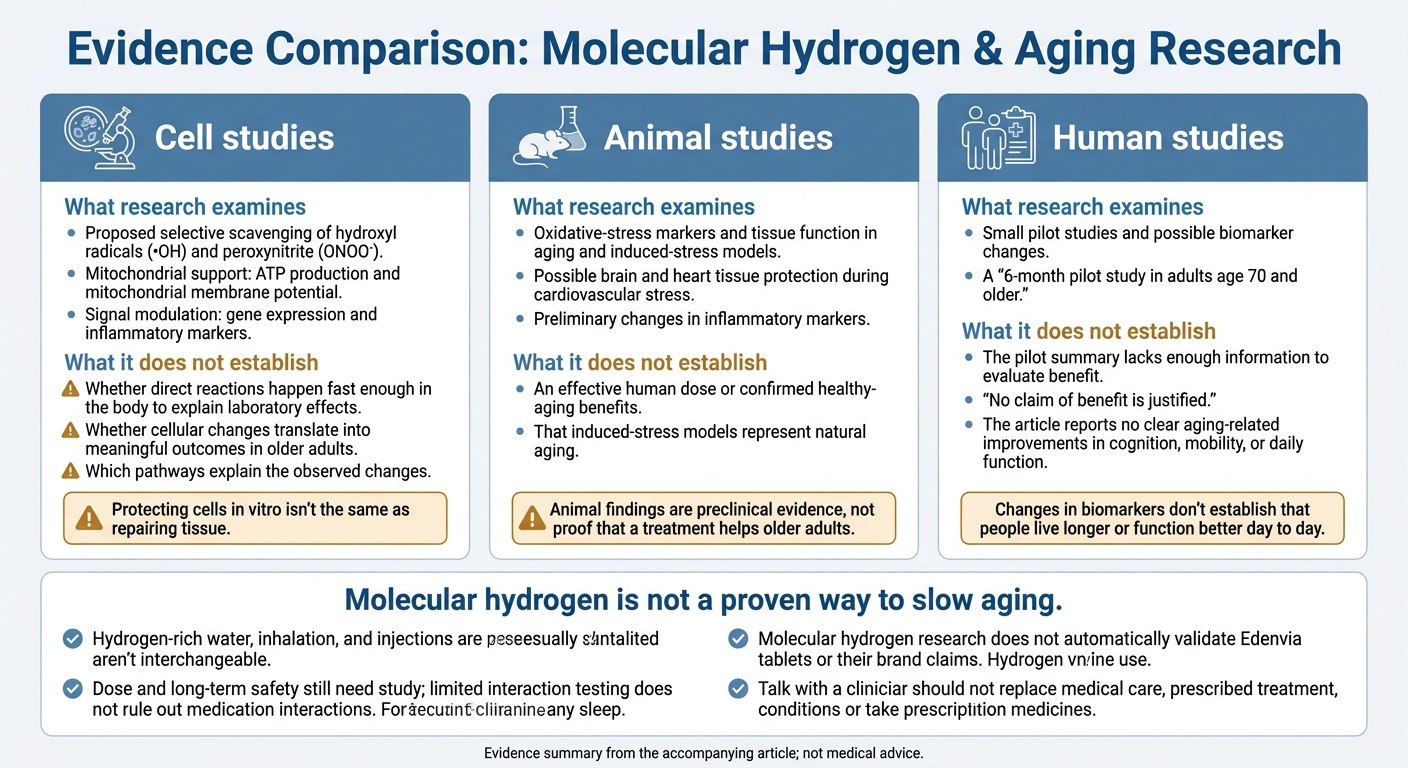
- Cell and animal studies: H₂ may affect oxidative stress and cell signaling, but those findings don’t establish better health in older adults.
- Human studies: Research is limited. The article’s 6-month pilot study in adults 70 and older lacks enough detail to support a claim of improved memory, mobility, or daily function.
- Delivery and safety: Hydrogen-rich water, inhalation, and injections aren’t interchangeable. Dose and long-term safety still need study.
- Product claims: Research on H₂ does not prove that Edenvia tablets deliver the results the brand describes.
I’d focus on <u>how people feel and function</u>, not just changes in lab markers. Hydrogen products should not replace medical care, exercise, nutrition, or sleep.
Molecular Hydrogen and Aging: What the Evidence Shows
Dr. Tyler LeBaron | Understanding Mitochondria, Aging, and Health #69
sbb-itb-6860cc4
Redox Mechanisms and Cell Studies
Mechanistic studies examine how H₂ may affect cells - not whether it slows aging. In cell models, H₂ can pass through cell membranes and reach mitochondria. There, it may influence oxidative stress, signaling, and energy production.
Proposed Selective Antioxidant Effects
Lab studies suggest H₂ may react with highly reactive species, including hydroxyl radicals and peroxynitrite, while leaving signaling ROS intact.[1]
| Proposed mechanism | Supporting evidence type | Common biomarkers | Main uncertainty |
|---|---|---|---|
| Selective scavenging | Cell and chemical experiments | Hydroxyl radicals (•OH); peroxynitrite (ONOO⁻) | Whether direct reactions happen fast enough in the body to explain the effects seen in the lab |
| Mitochondrial support | In vitro cell models | ATP production; mitochondrial membrane potential | Whether better cellular markers translate into meaningful outcomes in older adults |
| Signal modulation | Laboratory signaling studies | Gene expression; inflammatory markers | Which pathways explain the observed changes |
Antioxidant Responses and Cell Protection
Ohsawa et al. reported selective reduction of cytotoxic oxygen radicals, and Iuchi et al. linked hydrogen to gene-expression changes through oxidized phospholipid pathways.[1][2]
These findings support further study, but they don't establish how H₂ works.
Exposure timing, concentration, and cell type all affect the results. Protecting cells in vitro isn't the same as repairing tissue, and findings from aging models still need stronger human trials. The next question is whether these cell-level effects also appear in animal aging models.
References
- Ohsawa I, et al. Hydrogen acts as a therapeutic antioxidant by selectively reducing cytotoxic oxygen radicals. Nature Medicine (2007). https://doi.org/10.1038/nm1577
- Iuchi K, et al. Molecular hydrogen regulates gene expression by modifying the free radical chain reaction-dependent generation of oxidized phospholipid mediators. Scientific Reports (2016). https://doi.org/10.1038/srep18971
Animal Studies of Aging and Tissue Function
Animal findings are preclinical evidence, not proof that a treatment helps older adults. These studies can test tissue function in a living body, but they can't establish an effective human dose or confirm healthy-aging benefits.
Aging Models and Oxidative Stress Markers
When reading aging studies, check the animals' age and sex, sample size, controls, dose, delivery route, and study duration. Look for biomarker changes alongside functional outcomes, such as mobility, memory, or lifespan.
Brain, Heart, and Tissue Stress Studies
Animal studies also test whether hydrogen changes organ function - not just oxidative-stress markers. Findings suggest possible protection of the brain and heart tissue during cardiovascular stress, but the evidence is still preliminary.[1][3] Inflammation models also suggest lower inflammatory markers, though these induced-stress models differ from natural aging.
For older adults, the key question is whether tissue-level changes lead to better function, rather than just lower stress markers. Delivery route matters, too: findings from inhaled, injected, and water-based protocols can't be applied interchangeably.
The next question is whether similar effects appear in people.
Human Studies and Research Gaps
Human research is still in its early stages and mostly consists of small pilot studies. Some reports suggest possible changes in biomarkers, but no trial has shown clear aging-related improvements in cognition, mobility, or daily function. The 6-month pilot study is the clearest example, though its summary does not support firm conclusions.
6-Month Pilot Study in Adults Age 70 and Older
The summary alone does not provide enough information to evaluate this study. No claim of benefit is justified.
Human Studies by Delivery Method
The delivery method matters: dose, absorption, and exposure differ across formats. Findings from each route should remain separate until larger trials compare them directly.
What Stronger Human Trials Need
Future trials should report participants’ age and health status, dose, adherence, adverse events, and hydrogen concentration.
Larger, longer randomized trials should measure oxidative stress markers alongside validated tests of cognition, mobility, and daily function. Follow-up after exposure ends would help researchers determine whether any functional improvements last.
Practical Considerations for Older Adults
Human evidence is limited, so use should focus on safety and realistic expectations. For older adults, changes in biomarkers do not prove better daily function.
These products should not replace medical care, prescribed treatment, exercise, nutrition, or sleep.
Possible Benefits, Limits, and Safety
| Finding or consideration | Evidence level | Practical limitation |
|---|---|---|
| Selective antioxidant activity [1] | Cell and animal research | Benefits in humans remain unproven. |
| May support the body’s own antioxidant defenses | Preliminary | Evidence is too limited to recommend everyday use. |
| Hydrogen-rich water delivery | Depends on preparation and storage | Temperature and timing affect how much hydrogen is available. |
| Changes in redox markers do not prove lasting benefit | Uncertain | Lasting benefits for mobility and longevity have not been established. |
| Limited safety reporting | Incomplete | Safety and compatibility with medications remain uncertain. |
Safety depends on your health, medications, and how the hydrogen is delivered.
Talk with a clinician before use if you have medical conditions or take multiple medications. If the tablets contain magnesium, review the ingredient label and your total magnesium intake with your clinician. Limited interaction testing does not mean drug interactions are ruled out.
When considering a specific product, check both the label and the delivery method.
Edenvia Molecular Hydrogen Tablets
Edenvia Molecular Hydrogen tablets dissolve in water to make hydrogen-rich water. The brand says its tablets support antioxidant defense, joint comfort, mobility, and overall wellness. These are structure/function claims - not proven results for this product. Edenvia’s formulation and exposure may differ from those used in research, so molecular hydrogen studies do not automatically validate these tablets.
Follow the package directions for water volume and timing. Use room-temperature or chilled water, not hot water. Do not swallow the tablet dry. Do not increase the serving size or reduce prescribed medication because you think you feel better.
References
- Ohsawa I, et al. [1] “Hydrogen acts as a therapeutic antioxidant by selectively reducing cytotoxic oxygen radicals.” Nature Medicine (2007). https://doi.org/10.1038/nm1577
Conclusion: What the Research Means for Aging
Cell and animal studies suggest molecular hydrogen may help cells respond to oxidative stress.[1] These findings do not prove that hydrogen helps people age better.
Research in older adults is still limited. Changes in biomarkers don’t establish that people live longer or function better day to day. Stronger trials need to measure daily function and establish the dose, delivery method, and long-term safety.
For older adults, expectations should stay grounded in human data. If you’re considering hydrogen tablets, talk with your clinician, especially if you have chronic conditions or take prescription medicines.
References
- Ohsawa I, et al. “Hydrogen acts as a therapeutic antioxidant by selectively reducing cytotoxic oxygen radicals.” Nature Medicine (2007). https://doi.org/10.1038/nm1577
FAQs
How can I tell whether hydrogen research is credible?
Give priority to peer-reviewed studies on how molecular hydrogen may support cellular protection and reduce inflammation [1]. Look for sources that separate early findings from established clinical conclusions [2]. Health claims should rely on published research - not anecdotes [1].
Research on molecular hydrogen is still developing, so talk with a healthcare professional before starting a new regimen. Choose reputable sources that are open about product quality and clearly explain safety standards [2].
Could reducing oxidative stress disrupt healthy cell signaling?
No. Molecular hydrogen selectively targets harmful free radicals, such as hydroxyl radicals, and reactive compounds like peroxynitrite. It leaves intact the reactive oxygen species your body needs for key processes [1][2]. This selective action helps protect cells and supports the body’s natural defenses without disrupting healthy cell signaling [1][2].
What should I ask my clinician before trying hydrogen tablets?
Before trying molecular hydrogen tablets, check with your physician, pharmacist, or another licensed healthcare provider to see whether they fit your specific health needs [1][2].
Supplement information is not a substitute for professional medical advice, diagnosis, or treatment. If you think you may have a medical problem, contact your healthcare provider immediately [2].
Related Blog Posts
Disclaimer: These statements have not been evaluated by the Food and Drug Administration. This product is not intended to diagnose, treat, cure, or prevent any disease. This article is for general informational purposes only and is not medical advice. Consult a qualified healthcare provider before starting any supplement, especially if you are pregnant or nursing, have a medical condition, or take prescription medication.