

Molecular Hydrogen and Air Quality: What the Research Shows
My takeaway: molecular hydrogen has not been shown to protect people from everyday air pollution. I’d start by checking AirNow and limiting outdoor exertion when air quality is poor - not by relying on hydrogen products.
Here’s how I read the research:
- Lab and animal studies: They offer early clues about oxidative stress, not proof of protection for people.
- Human studies: Short-term inhalation measurements don’t establish lasting respiratory effects or results from drinking hydrogen water.
- Edenvia tablets: The cited studies did not test this formulation. Results from other hydrogen formats don’t automatically apply.
For context, PM2.5 particles measure 2.5 micrometers or smaller. Hydrogen does not remove these particles from the air. I keep early research separate from <u>proven exposure-reduction steps</u>.
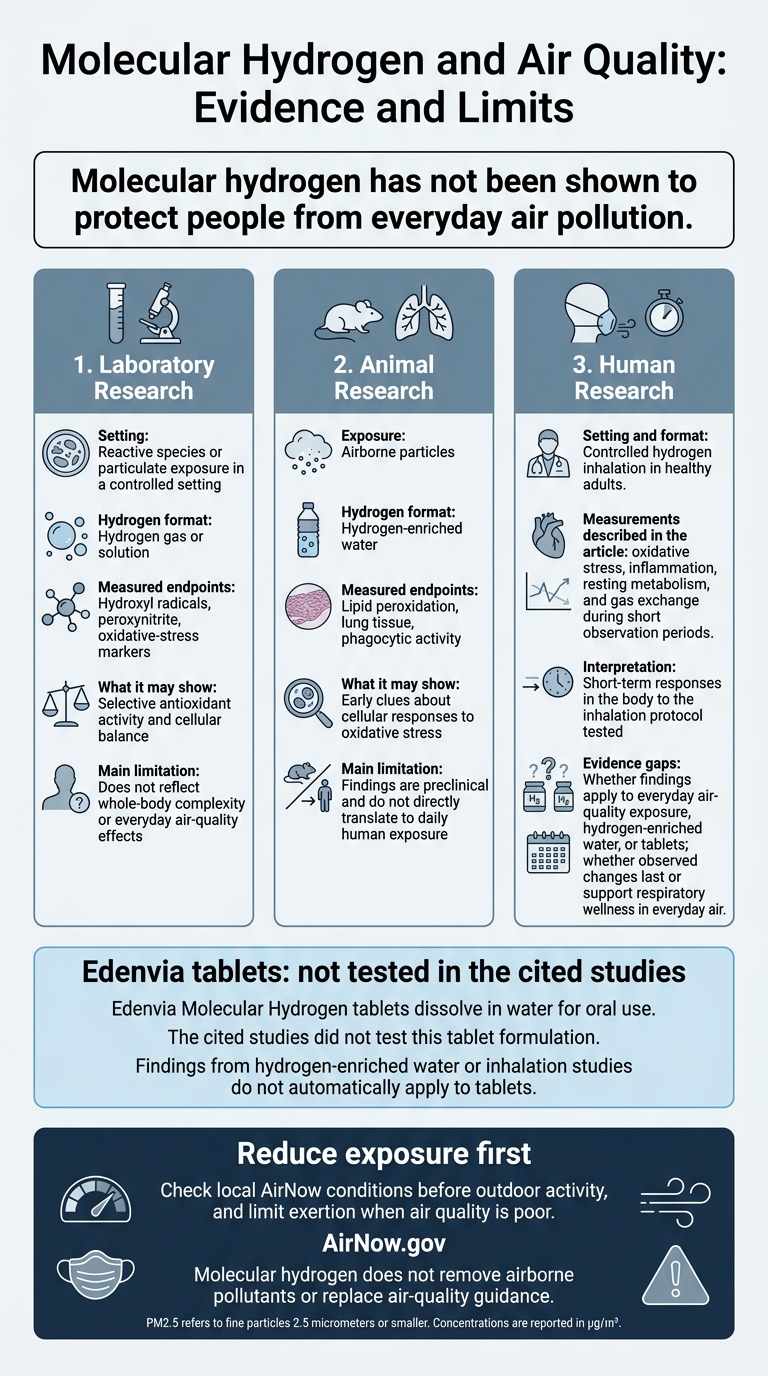
Molecular Hydrogen and Air Quality: Evidence and Limits
References
- Ohsawa I, et al. “Hydrogen acts as a therapeutic antioxidant by selectively reducing cytotoxic oxygen radicals.” Nature Medicine (2007). https://doi.org/10.1038/nm1577
- Li N, et al. “Ultrafine particulate pollutants induce oxidative stress and mitochondrial damage.” Environmental Health Perspectives (2003). https://doi.org/10.1289/ehp.6000
sbb-itb-6860cc4
Airborne Particles and Antioxidant Balance
Airborne particles can upset antioxidant balance in airway tissues. Their chemistry affects how strongly they influence reactive species and the cell’s defenses.[2] That’s why the studies below focus on oxidative-stress markers.
Fine Particles and Reactive Species
Particle size and chemistry shape how particles interact with airway lining fluid and respiratory tissues.[2] With this in mind, researchers have tested whether molecular hydrogen changes oxidative-stress markers under controlled conditions.
How Molecular Hydrogen Relates to Oxidative Stress
Molecular hydrogen may help maintain antioxidant balance by selectively targeting highly reactive species, such as hydroxyl radicals and peroxynitrite, while leaving signaling-related reactive species intact.[1] These early findings do not establish a direct link to everyday airborne-particle exposure.
Reading Oxidative-Stress Measurements
Lipid peroxidation markers show oxidative damage to fats. Antioxidant enzyme activity reflects the capacity of cells to defend themselves. On their own, neither measurement shows support for everyday respiratory wellness. The next section looks at these markers in laboratory and animal particle models.
References
- [1] Ohsawa I, Nishimura Y, Tatsuzawa H, et al. Nature Medicine. 2007. PubMed: https://pubmed.ncbi.nlm.nih.gov/17486089/ | DOI: https://doi.org/10.1038/nm1577
- [2] Li N, et al. “Ultrafine particulate pollutants induce oxidative stress and mitochondrial damage.” Environmental Health Perspectives. 2003. DOI: https://doi.org/10.1289/ehp.6000
Laboratory and Animal Research
Hydrogen-Enriched Water in an Animal Particle Study
The mechanism discussed above gives researchers a reason to test molecular hydrogen in controlled particle-exposure models: it diffuses easily and may help maintain antioxidant balance.[1][2]
In these animal models, researchers use hydrogen-enriched water and track oxidative-stress markers, lung tissue, and phagocytic activity. The measurements reflect responses to controlled exposure, not what healthy adults should expect from everyday air quality. To interpret the results, look at the species, exposure setup, dose, and study duration.
Study Models Compared
Lab and animal models address different questions. Laboratory experiments test whether molecular hydrogen interacts with reactive species. Animal models examine how tissues respond to controlled particle exposure. Neither establishes support for normal respiratory wellness in daily life.
| Study model | Exposure | Hydrogen format | Measured endpoints | What it may show | Main limitations |
|---|---|---|---|---|---|
| Laboratory | Reactive species or particulate exposure in a controlled setting | Hydrogen gas or solution | Hydroxyl radicals, peroxynitrite, oxidative-stress markers | Selective antioxidant activity and cellular balance | Does not reflect whole-body complexity or everyday air-quality effects |
| Animal | Airborne particles | Hydrogen-enriched water | Lipid peroxidation, lung tissue, phagocytic activity | Early clues about cellular responses to oxidative stress | Findings are preclinical and do not directly translate to daily human exposure |
When reading a study, check whether its exposure matches everyday air quality and whether the control group received the same particle exposure without hydrogen. Also check whether researchers tracked one marker or several. Human studies ask whether these early markers carry over to normal respiratory wellness.
References
- Ohsawa I, Nishimura Y, Tatsuzawa H, et al. Nature Medicine. 2007. https://pubmed.ncbi.nlm.nih.gov/17486089/
- Li N, Sioutas C, Cho A, et al. Environmental Health Perspectives. 2003. https://doi.org/10.1289/ehp.6000
Human Research and Its Limits
Hydrogen Inhalation in Healthy Adults
Human studies remain limited. Most track short-term markers - oxidative stress, inflammation, resting metabolism, and gas exchange - after controlled hydrogen inhalation.
These measurements show immediate responses, not the effects of everyday air quality. The question here is narrower: Does controlled hydrogen inhalation change markers linked to air-quality stress?
What the Findings Do and Do Not Show
| What was measured | What they may suggest | What remains unclear |
|---|---|---|
| Resting metabolism and gas exchange | Short-term responses in the body to the inhalation protocol tested | Whether the findings apply to everyday air-quality exposure, hydrogen-enriched water, or tablets |
| Changes during short observation periods | Immediate responses in the markers measured | Whether those changes last or support respiratory wellness in everyday air |
Applying these early findings to everyday air-quality choices requires separating responses to controlled inhalation from effects under daily conditions. That distinction frames the everyday air-quality guidance that follows.
Conclusion: Research and Everyday Air-Quality Choices
Animal particle studies and a surrogate lung-fluid model offer early clues about antioxidant balance. They do not provide direct evidence for everyday human exposure, so reducing exposure comes first.[1][2]
Following U.S. Air Quality Guidance
Check local AirNow conditions before outdoor activity, and limit exertion when air quality is poor. PM2.5 refers to fine particles 2.5 micrometers or smaller. Concentrations are reported in μg/m³.
Molecular hydrogen does not remove airborne pollutants or replace air-quality guidance.
Edenvia Tablets and the Cited Research
Edenvia Molecular Hydrogen tablets dissolve in water for oral use. The cited studies did not test this tablet formulation. Findings from hydrogen-enriched water or inhalation studies do not automatically apply to tablets.[1][3]
Keep tablet use separate from air-quality precautions, and follow the product label.
Primary Research References
These sources examine different research settings.
References
- [1] Animal particle study of hydrogen-enriched water. Full text on PMC
- [2] Surrogate lung-fluid study examining oxidative pathways. Full text on PMC
- [3] Healthy-adult inhalation study examining physiological measurements. Study record on PubMed
FAQs
Do changes in oxidative stress reflect respiratory wellness?
Oxidative stress can affect cell health and overall well-being, so keeping it in balance matters for respiratory wellness [1][2][3]. Molecular hydrogen may support the body’s natural defenses by helping neutralize harmful free radicals within cells [1][4][2]. This balance helps support normal respiratory wellness and cells’ ability to withstand stress [1][5].
What human research would clarify hydrogen’s role?
Larger human studies are needed to better understand molecular hydrogen’s role in wellness [1]. Research suggests it may support cellular protection, metabolic function, and oxidative balance, but more evidence is needed across general populations [2][1].
Studies that use standardized doses, track long-term outcomes, and measure specific physiological markers would help clarify whether - and how - molecular hydrogen supports normal respiratory function and overall wellness [1].
What evidence supports Edenvia tablet claims?
Research on molecular hydrogen’s selective antioxidant role supports Edenvia’s tablet claims: it helps maintain cellular balance while preserving reactive oxygen species that serve useful functions [1]. Studies also suggest support for the body’s natural defenses against oxidative stress, healthy cholesterol balance, arterial lining comfort, cardiovascular resilience [2], digestive wellness, and esophageal comfort [3].
Each tablet is formulated to provide 12 ppm of molecular hydrogen to support daily antioxidant replenishment and overall cellular health [4][5].
Related Blog Posts
Disclaimer: These statements have not been evaluated by the Food and Drug Administration. This product is not intended to diagnose, treat, cure, or prevent any disease. This article is for general informational purposes only and is not medical advice. Consult a qualified healthcare provider before starting any supplement, especially if you are pregnant or nursing, have a medical condition, or take prescription medication.