

Molecular Hydrogen Detox: Study Summary
Molecular hydrogen has not been shown to remove toxins from your body. My takeaway: before buying a “detox” product, ask which toxin was measured and whether human tests showed its removal - not just changes in blood markers.
Here’s how I read the research and product claims:
- Hydrogen: Research from 2007 and a 2020 human trial examines oxidative stress and inflammation, not proof of detoxification.
- Cleanses and detox teas: Weight loss or more bowel movements do not prove toxin removal. Laxatives may cause diarrhea and dehydration.
- Fasting: Studies focus on weight and metabolism, not toxin clearance. Food restriction can pose risks, especially with medications.
- Edenvia tablets: The article identifies no published human trials of the finished product. Preparation instructions and a 30-day refund offer do not prove that it works.
<u>My bottom line:</u> I would separate general hydrogen research from tablet claims, check the ingredients, and discuss use with a healthcare professional if pregnant, nursing, taking medications, or managing a health condition.
Tyler LeBaron: Hydrogen Water, Mitochondrial Health, Selective Antioxidants, & Longevity | TUH #265
sbb-itb-6860cc4
Research on Oxidative Stress and Inflammation
Hydrogen-rich water contains dissolved H₂ gas. Findings from lab and animal studies don’t automatically apply to drinks or tablets, and no controlled human trial details were supplied. The main question is whether these findings lead to measurable results in people.
Proposed Mechanisms and Study Quality
A June 2007 study tested hydrogen in laboratory experiments and an animal model. Researchers reported that hydrogen selectively reduced certain harmful oxygen radicals and oxidative damage.[1] Those findings support further research, but they don’t prove that commercial tablets provide health benefits. Proposed anti-inflammatory pathways involving NF-κB, interleukins, and TNF-α also remain unproven in humans.
| Study citation | Study type | Participants or model | Delivery method | Hydrogen concentration | Duration | Primary outcome | Main limitation |
|---|---|---|---|---|---|---|---|
| Ohsawa et al., June 2007 [1] | Laboratory | Cell-based experiments | Not reported | Not reported | Not reported | Selective reduction of cytotoxic oxygen radicals and oxidative damage | In vitro findings do not establish tablet benefits |
| Ohsawa et al., June 2007 [1] | Animal | Animal model | Not reported | Not reported | Not reported | Measures of oxidative injury | Animal findings do not establish human results |
Detox claims need human evidence of toxin removal. Changes in biomarkers alone aren’t enough.
Human Trials: Biomarkers and Daily Function
A change in a marker doesn’t necessarily mean someone feels or functions better day to day. Anecdotal reports also can’t establish cause and effect or a usable dose. No verifiable controlled results were supplied for exercise recovery, inflammation, metabolism, mobility, or quality of life.
What the Evidence Suggests / What It Does Not Establish
| What the Evidence Suggests | What It Does Not Establish |
|---|---|
| Laboratory findings support further research into oxidative-stress mechanisms.[1] | A demonstrated improvement in joint comfort, mobility, or quality of life |
| Different delivery methods need separate evaluation. | That laboratory or animal findings apply directly to hydrogen-water tablets |
| Anecdotal reports can point to questions worth studying. | Controlled evidence of exercise recovery or metabolic benefits |
| The supplied evidence leaves toxin-removal claims unverified. | Cleansing or removal of heavy metals |
This lack of evidence matters when comparing molecular hydrogen with cleanses, detox teas, and fasting.
References
- Ohsawa I, et al. Hydrogen acts as a therapeutic antioxidant by selectively reducing cytotoxic oxygen radicals. Nature Medicine. June 2007. https://doi.org/10.1038/nm1577 [1]
Comparing Molecular Hydrogen, Cleanses, Detox Teas, and Fasting
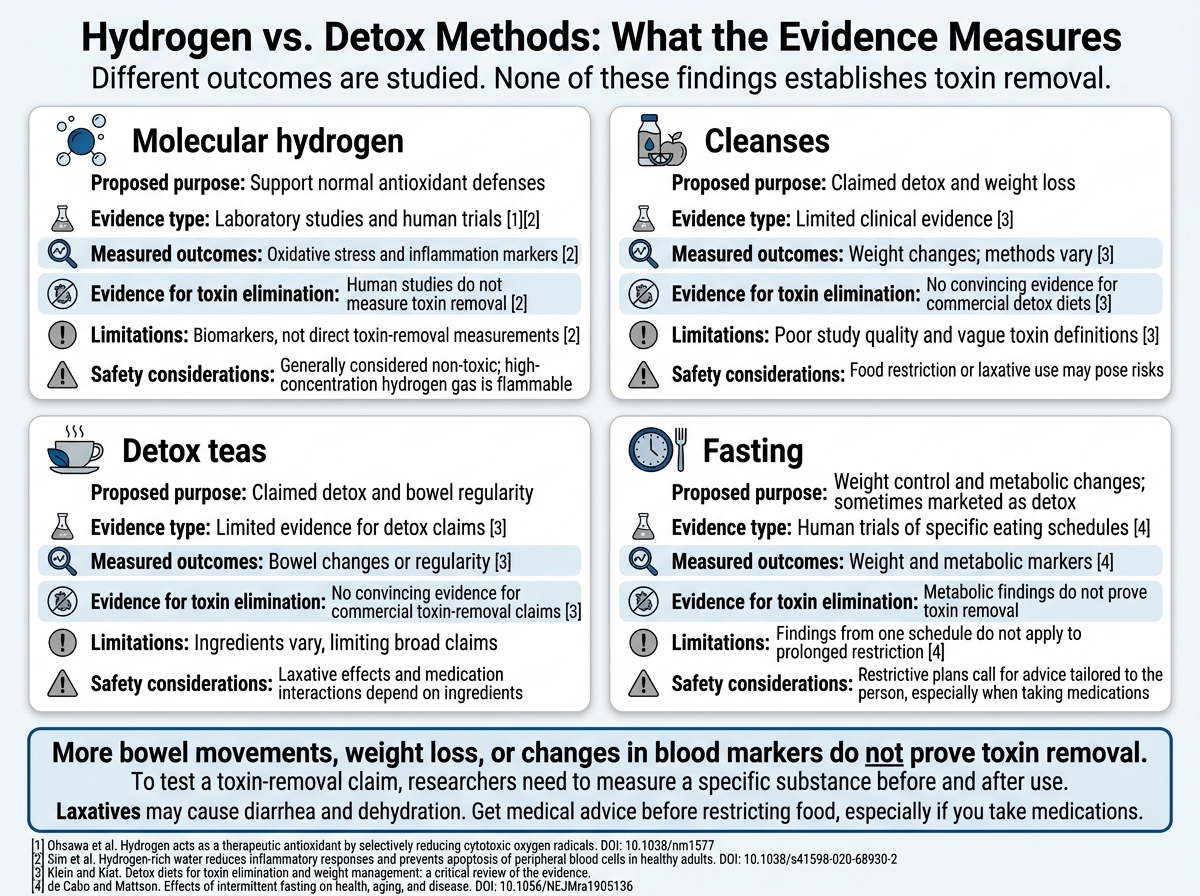
Hydrogen vs. Detox Methods: What the Evidence Measures
These approaches measure different outcomes, so “detox” isn’t a catch-all label for them. To test a toxin-removal claim, researchers need to measure a specific substance before and after use. The studies below measure different endpoints.
| Comparison | Molecular hydrogen | Cleanses | Detox teas | Fasting |
|---|---|---|---|---|
| Proposed purpose | Support normal antioxidant defenses | Claimed detox and weight loss | Claimed detox and bowel regularity | Weight control and metabolic changes; sometimes marketed as detox |
| Evidence type | Laboratory studies and human trials [1][2] | Limited clinical evidence [3] | Limited evidence for detox claims [3] | Human trials of specific eating schedules [4] |
| Measured outcomes | Oxidative stress and inflammation markers [2] | Weight changes; methods vary [3] | Bowel changes or regularity [3] | Weight and metabolic markers [4] |
| Evidence for toxin elimination | Human studies do not measure toxin removal [2] | No convincing evidence for commercial detox diets [3] | No convincing evidence for commercial toxin-removal claims [3] | Metabolic findings do not prove toxin removal |
| Limitations | Biomarkers, not direct toxin-removal measurements [2] | Poor study quality and vague toxin definitions [3] | Ingredients vary, limiting broad claims | Findings from one schedule do not apply to prolonged restriction [4] |
| Safety considerations | Generally considered non-toxic; high-concentration hydrogen gas is flammable | Food restriction or laxative use may pose risks | Laxative effects and medication interactions depend on ingredients | Restrictive plans call for advice tailored to the person, especially when taking medications |
Cleanses and Detox Teas: Claims and Risks
Klein and Kiat found little clinical evidence for commercial detox diets.[3] More bowel movements or a drop in weight do not prove toxin removal. Products with laxatives can cause diarrhea and dehydration. Some herbs can also interact with medications.
Fasting belongs in a different category: its research focuses on metabolism, not toxin clearance.
Fasting: Metabolic Findings and Detox Claims
Fasting studies examine eating schedules and their effects on metabolism - not toxin removal.[4] Results from one fasting schedule should not be applied to prolonged food restriction.[4] Get medical advice before restricting food, especially if you take medications.
The same distinction applies to hydrogen research: changes in biomarkers are not direct proof of toxin removal. Keep that difference in mind when assessing hydrogen products marketed for antioxidant support.
References
- Ohsawa I, et al. Hydrogen acts as a therapeutic antioxidant by selectively reducing cytotoxic oxygen radicals. https://doi.org/10.1038/nm1577
- Sim M, et al. Hydrogen-rich water reduces inflammatory responses and prevents apoptosis of peripheral blood cells in healthy adults: a randomized, double-blind, controlled trial. https://doi.org/10.1038/s41598-020-68930-2
- Klein AV, Kiat H. Detox diets for toxin elimination and weight management: a critical review of the evidence.
- de Cabo R, Mattson MP. Effects of intermittent fasting on health, aging, and disease. https://doi.org/10.1056/NEJMra1905136
Edenvia Molecular Hydrogen: Claims and Evidence
That distinction matters when a product uses general hydrogen research to make wellness claims. Edenvia Molecular Hydrogen tablets dissolve in water to produce hydrogen-rich water. The product is marketed to support antioxidant defenses, joint comfort and mobility, recovery, cellular health, and general wellness.
These are marketing claims, not product-specific clinical proof. To assess these detox-style wellness claims, we need to know whether the finished tablet delivers the same hydrogen exposure studied in the research - and whether that research supports the claimed effects.
Product Features and Clinical Research
No published human trials of the finished Edenvia tablet were identified.
| Product feature or claim | Relevant research question | What has been studied | What remains unproven |
|---|---|---|---|
| Hydrogen-producing tablets | Does the finished tablet deliver the hydrogen exposure studied? | General molecular hydrogen research | Finished-tablet exposure and antioxidant benefits |
| Joint comfort and mobility claims | Have finished-product trials measured movement? | Product-specific clinical evidence has not been verified | Improved joint comfort or mobility |
| Cellular health claims | Have measurable human outcomes been shown? | Finished-product efficacy has not been verified | Cellular health benefits or toxin removal |
Product descriptions alone don't establish clinical efficacy. Preparation instructions and purchase terms don't prove a clinical benefit either, but they help readers assess what they're buying.
Preparation, Testing, and Purchase Terms
Dissolve one tablet in room-temperature or chilled water. Avoid hot water, and drink within 30 minutes.
The site's current pricing is:
- Buy One: $33.95 per tablet
- Buy 1 Get 1 Free: $16.98 per tablet
- Buy 2 Get 2 Free: $12.76 per tablet
The site also advertises a 30-day money-back guarantee. Review the current terms before ordering.
Conclusion: What the Research Supports
The evidence suggests possible antioxidant effects - not proven detoxification. Human research on molecular hydrogen is still limited. Changes in blood markers do not prove better daily function or detoxification.[1] Findings also need to match the formulation and hydrogen exposure of the product being assessed.
Safety Findings and Personal Health Considerations
Short-term safety data do not establish long-term safety for every person or tablet formulation. Check the full ingredient label, including magnesium. Talk with a healthcare professional before use if you are pregnant, nursing, take medications, or have health concerns.
If you have a history of disordered eating, avoid fasting or restrictive cleanses.
Research Gaps and Toxin-Removal Claims
Stronger evidence requires larger randomized trials, standardized hydrogen concentrations in parts per million (ppm), longer follow-up, consistent biomarkers, and direct measures of daily function. Researchers need to test the finished product, not just general hydrogen exposure.
To support a toxin-removal claim, research must name the substance and directly measure its removal using validated methods. Antioxidant activity alone does not prove detoxification.
References
- [1] Hydrogen-rich water reduces inflammatory responses and prevents apoptosis of peripheral blood cells in healthy adults: a randomized, double-blind, controlled trial. Scientific Reports (2020). https://doi.org/10.1038/s41598-020-68930-2
FAQs
How can I tell if a hydrogen study is reliable?
Look for peer-reviewed hydrogen (H₂) research, not just marketing claims, that measures outcomes tied to oxidative stress and inflammation. Favor studies that explain how hydrogen works and which harmful free radicals or reactive species it targets, such as hydroxyl radicals and peroxynitrite, instead of making broad “detox” promises. Treat claims of health benefits with caution when dosing is uncertain or administration methods are unregulated.[1][2]
What hydrogen concentration matters in drinking water?
Hydrogen-rich water needs a high, consistent concentration of molecular hydrogen to help address oxidative stress [3]. Edenvia tablets are designed to produce 12 ppm of molecular hydrogen per tablet [1][2]. This concentration is intended to help hydrogen reach deep into tissues, neutralize free radicals, and support cellular health [3].
What should I check on a hydrogen tablet’s ingredient label?
Look for a magnesium-based carrier, commonly used in the hydrogen-producing reaction [1]. The label should also clearly confirm rigorous testing for purity, potency, and safety [2].
Manufacturers may change their formulas, so check the physical product packaging rather than relying only on online descriptions [3]. Choose a brand that commits to honest labeling and high-quality sourcing [4].
Related Blog Posts
Disclaimer: These statements have not been evaluated by the Food and Drug Administration. This product is not intended to diagnose, treat, cure, or prevent any disease. This article is for general informational purposes only and is not medical advice. Consult a qualified healthcare provider before starting any supplement, especially if you are pregnant or nursing, have a medical condition, or take prescription medication.